
Hidden Empires: How Modern Archaeology is Unearthing Lost Civilizations
Imagine walking through a dense Guatemalan jungle, swatting mosquitoes, when suddenly your boots kick against something solid. You look down and see a carved stone, half-buried in moss. Now multiply that moment by ten thousand. That’s exactly what happened when archaeologists strapped LiDAR sensors to a plane and flew over the Maya lowlands. Beneath the canopy, hidden for centuries, were the sprawling stone skeletons of entire cities – homes, causeways, defensive fortifications, pyramids. These weren’t just a few scattered ruins; this was a hidden empire, a complex and populous civilization that had completely vanished from our maps. Thanks to modern archaeology, we’re no longer just digging in the dirt. We’re flying above it, scanning through it, and even diving under it, unveiling lost civilizations that rewrite human history.
For centuries, our understanding of ancient civilizations was patchy. We relied on the grand monuments that were too big to miss – the pyramids of Giza, the Colosseum, the Great Wall. But what about the empires that built with wood, not stone? The trading kingdoms swallowed by the Sahara? The city-sized settlements buried under a thousand years of vegetation? These aren’t just archaeological discoveries; they’re entire chapters of the human story that were torn out and lost. Today, however, a revolution in modern archaeology is allowing us to read those invisible ink chapters. We are uncovering hidden empires not with pickaxes and shovels, but with lasers, satellites, and radar waves – and what we’re finding is shaking the foundations of what we thought we knew.
In this journey, we’ll walk through the technological magic making this possible, explore the most breathtaking recent finds of lost civilizations, and see why these newly visible empires matter more than ever. Get ready to have your idea of the “ancient world” blown wide open.

The Allure of the Invisible: Why We Hunt for Hidden Empires
There’s a deep, almost primal thrill in discovering a lost world. It’s the same rush that fuelled Heinrich Schliemann when he dug for Troy or Hiram Bingham when he first glimpsed Machu Picchu. But the hunt for hidden empires isn’t just about adventure; it’s about filling the gaping holes in our collective memory. For every Roman Empire whose records filled libraries, there were dozens of societies that thrived for millennia without leaving a written trace that survived. Theirs is a silent history, and modern archaeology is finally giving them a voice.
Think about it: the Amazon rainforest was long dismissed as a pristine wilderness that could only support small, nomadic tribes. Early European explorers’ tales of great cities were laughed at as fever dreams. But as we’ll see, they were deadly wrong. The same goes for the massive urban centers that once dotted the Sahara when it was a lush, green paradise. These ancient civilizations were not marginal; they were sophisticated, populous, and globally connected. The fact that we lost them says more about our own limited vision than about their insignificance. By finding these lost chapters, we aren’t just adding names to a list; we’re rewriting the script of human capability, resilience, and innovation. And the tools we now have are finally sharp enough to cut through centuries of soil, jungle, and misconception.

Beyond the Trowel: The High-Tech Tools Rewriting History
When you picture an archaeologist, you probably imagine someone in a dusty pit with a tiny brush. That archaeologist still exists and is vital, but they now have a high-tech partner in the sky. The biggest leaps in finding lost civilizations have come from remote sensing, and the poster child is LiDAR.
LiDAR (Light Detection and Ranging) works like this: an aircraft, often a helicopter or a drone, flies over a landscape shooting out hundreds of thousands of laser pulses per second. These pulses hit the ground—and here’s the magic—some of them find the tiniest gaps in the foliage and bounce back. By calculating the time it takes for the laser to return, a computer can digitally strip away every leaf and branch, leaving a stunningly detailed, bare-earth 3D map. Suddenly, what looked like a random hill is revealed as a perfectly rectangular pyramid. A dip in the ground becomes a 10-meter-wide highway. This technology has been the single most transformative tool in modern archaeology, turning dense jungles into open books.
But LiDAR is just the start. Satellites like NASA’s IKONOS and GeoEye have given us the ability to spot buried foundations by analyzing subtle differences in crop growth (crops over buried stone walls mature differently, creating “crop marks” visible from space). Dr. Sarah Parcak, a pioneer of “space archaeology,” has used satellite imagery to identify thousands of potential sites in Egypt, including buried pyramids and entire lost cities under modern farmlands. Ground-penetrating radar (GPR) then lets archaeologists walk over a promising site and send radio waves into the earth, mapping buried walls, chambers, and tombs without moving a single shovel of dirt.
And it’s not just about seeing structures. DNA analysis of ancient remains is revealing migration patterns no one expected, proving that “hidden empires” weren’t just isolated pockets but were part of vast, interconnected webs. Archaeogenetics has shown, for instance, a huge and previously unknown migration from the Eurasian steppe into Bronze Age Europe, effectively revealing a human tidal wave that reshaped a continent’s genetic and cultural landscape. Add to this chemical analysis of pottery residues (telling us what people ate and drank) and isotope studies of teeth (revealing where an individual grew up), and we can now reconstruct the life of a hidden city with astonishing fidelity. We are no longer just finding the bones of these empires; we’re learning how they lived, breathed, and interacted.
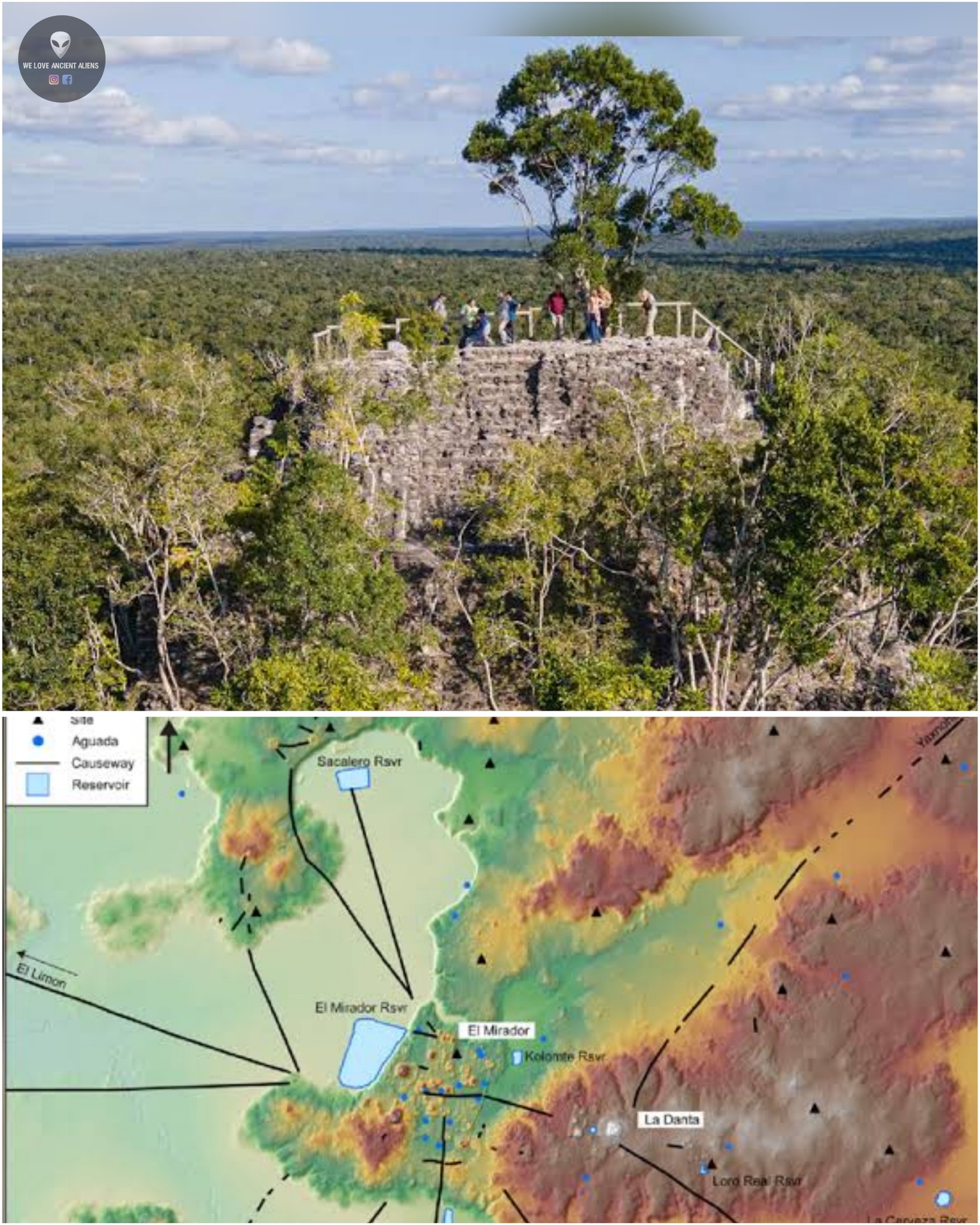
The Maya Megalopolis: A Jungle Empire More Vast Than We Dreamed
The Maya civilization has always been a source of fascination, but for over a century, the dominant theory was that they lived in sparsely populated city-states, with vast empty jungle between them. A noble class of priests and kings, ruling over a scattered peasantry, sustaining themselves with simple slash-and-burn farming. In one of the most stunning archaeological discoveries of the 21st century, LiDAR obliterated that idea completely.
In 2018, a consortium of scientists announced the results of a massive LiDAR survey over 2,100 square kilometers of the Maya Biosphere Reserve in northern Guatemala. They found over 60,000 previously unknown structures. This wasn’t a collection of isolated ceremonial centers. It was a continuous, densely packed urban network of homes, elevated causeways, complex irrigation canals, and defensive walls. They found farms built on raised platforms, maize fields terraced into swamps, and fortresses guarding the approaches. The population estimates shot through the roof. Where scholars once guessed a few million Maya lived across the lowlands, the new data suggests figures of 10 to 15 million. This was a hidden empire of staggering complexity, a true “tropical megalopolis” that had engineered its entire environment for intensive agriculture on an industrial scale.
“The LiDAR images make it clear that this entire region was a settlement system whose scale and population density had been grossly underestimated,” stated Thomas Garrison, an archaeologist on the project. This discovery fundamentally changes how we understand the Maya “collapse.” The massive landscape modification they undertook—razing forests, paving over soil—likely left them deeply vulnerable to climate change. When a prolonged drought hit, the over-engineered, over-populated system couldn’t cope. The hidden empire wasn’t just found; its tragic flaw was revealed, giving us a sobering mirror to our own modern world.
Similarly, the same technology is peeling back the Amazon. In the Bolivian Llanos de Mojos, LiDAR has revealed the ghostly outlines of the Casarabe culture, a society that built monumental mounds, conical pyramids, and intricate networks of causeways and canals from 500 to 1400 AD. These are the real-life counterparts to the legendary El Dorado, a lost civilization that flourished in an area we once called a “counterfeit paradise,” too harsh for complex society. Modern archaeology proved us gloriously wrong.

Invisible in Plain Sight: The Lost Kingdoms of the Old World
The hunt for hidden empires isn’t just a jungle affair. Sometimes, the most astonishing discoveries are hidden where you’d least expect them—right under our feet, in the heart of the so-called “Old World.”
Consider the Indus Valley Civilization, a Bronze Age powerhouse that, at its peak around 2500 BCE, rivalled Egypt and Mesopotamia combined. It sprawled over nearly a million square kilometers of modern-day Pakistan and India, with meticulously planned cities like Mohenjo-daro and Harappa boasting advanced plumbing, standardized bricks, and a yet-to-be-deciphered script. While its major cities were never truly “lost,” recent archaeological work is uncovering a vast, hidden rural hinterland, showing just how deeply this civilization transformed its landscape. A 2021 study using remote sensing and old-fashioned surveys identified hundreds of previously unknown sites, many now buried under meters of silt from the Indus River, revealing a population density that forces a complete rethink of the empire’s scale and its eventual decline. The Indus script remains a haunting message from a hidden empire, waiting for a modern-day Rosetta Stone.
Then there’s Göbekli Tepe in Turkey, a site so weird it practically rewrote the dawn of civilization. When German archaeologist Klaus Schmidt began excavating in the 1990s, he didn’t find a settlement. He found monumental T-shaped limestone pillars, carved with intricate animals and arranged in circles, dating back an astounding 11,000 to 12,000 years. This was a time before pottery, before the wheel, before agriculture was fully established—yet hunter-gatherers were building the world’s first known stone temple. For decades, the story of civilization was a straight line: farming led to settlements, which led to cities and then monumental architecture. Göbekli Tepe suggests the opposite: the impulse to gather for ritual and build sacred spaces may have driven the invention of agriculture. This hidden empire of the mind, a civilization of the spirit, was literally buried on purpose—the entire complex was deliberately backfilled and abandoned around 8000 BCE, sealing its secrets for ten millennia. Ground-penetrating radar has since shown that the mound we see is just the tip of the iceberg; dozens of similar enclosures lie untouched below the surface, a vast, still-hidden temple complex that stretches across the horizon.
And the sand doesn’t just hide things; it preserves them perfectly. In the remote deserts of Egypt, not far from the Valley of the Kings, divers exploring a sandstone cave in the 2000s made a miraculous find: an intact underground catacomb holding millions of dog mummies. This wasn’t a tomb for kings, but a huge, organized industry dedicated to the cult of the jackal-headed god Anubis. The site, known as the Dog Catacombs of Saqqara, speaks to a vast religious-economic empire that operated almost entirely out of sight, a commercial network of animal breeders, priests, and pilgrims that wasn’t recorded in any of the grand hieroglyphic texts. It’s a reminder that for every monumental pyramid, there are ten hidden empires of daily life, faith, and commerce waiting to be discovered.
Cities of Sand and Sea: How Climate Change Unveils Lost Stories
Climate change, a major threat to our world today, is ironically helping unveil some of the greatest lost civilizations. Melting glaciers in Norway’s Jotunheimen mountains are revealing a perfectly preserved “highway” of Viking-era artifacts – woolen tunics, leather shoes, snowshoes for horses, and wooden skis – items that would have rotted away millennia ago in a warmer climate. This isn’t a settlement, but a ghostly transport network, a hidden empire of trade and travel frozen in time. Similar melting ice patches in the Rockies and the Alps are giving up their own treasures, from ancient hunting tools to a 5,000-year-old body of “Ötzi” the Iceman’s equally trapped contemporaries.
At the other extreme, a severe drought in Iraq in 2022 brought an entire Bronze Age city to the surface in the reservoir of the Mosul Dam. The 3,400-year-old city, potentially the ancient Zakhiku from the Mittani Empire, had been submerged since the 1980s. As the waters receded, German and Kurdish archaeologists raced against the clock to excavate the sprawling urban complex, complete with a palace, massive fortification walls, and a warehouse filled with cuneiform tablets. They mapped the site, preserved what they could, and then watched as the waters rose to hide it again. This fleeting glimpse at a Mittani city, an empire that once rivaled the Babylonians and Egyptians, is a stark testament to how many hidden empires are just one extreme weather event away from being uncovered—and permanently lost if we’re not quick enough.
Even the sea is yielding its ghosts. Advances in underwater archaeology, including autonomous submersibles and 3D sonar mapping, are bringing the sunken pillars of ancient cities to light. Off the coast of Alexandria, divers have mapped the remains of the royal quarters, temples, and statues that slid into the Mediterranean more than a thousand years ago. Farther west, in the “African Atlantis,” the submerged Roman city of Neapolis in Tunisia was completely forgotten until researchers in 2017 found its vast garum (fish sauce) factories and streets stretching across 20 hectares of seabed. These were not just coastal villages; they were critical economic engines of a globalized Roman world, a commercial empire hidden under the waves.
Why These Ghosts Matter: The Wisdom of Hidden Empires
At this point, you might be asking: why should we care about a network of jungle cities or a millenia-old temple buried on purpose? The answer is simple: these lost civilizations hold the world’s largest database of solved problems and cautionary tales. The Maya hyper-urbanist superpower may have collapsed partly from self-inflicted environmental damage. The hidden empire of Greenland’s Vikings, once thought to have starved in a mini-ice age, turns out in the archaeological record to have stubbornly clung to a failing European pastoral lifestyle while ignoring the Inuit’s supremely adapted sealing and kayaking technology right next door. It’s a story of cultural rigidity in the face of climate change that feels unnervingly contemporary.
The Amazonian civilizations, found using LiDAR, challenge our very notion of what a “pristine” landscape is. They show us that huge human populations can live in a rainforest without turning it into a desert, using sophisticated agroforestry and soil engineering techniques. The hidden empire they created was one where the line between garden and forest didn’t exist. Their terra preta soils, man-made super-fertilizers full of charcoal and pottery shards, are still productive today and might hold secrets for modern sustainable agriculture. In the Sahara, radar imaging and paleoclimatic data show us a lost world of mega-lakes and rivers where pastoralists once built complex societies before a slowly shifting climate pushed them into the Nile Valley, creating the crucible of Egyptian civilization. These stories teach us that collapse isn’t a neat, single event; it’s a transformation. We don’t just find ruins; we find resilience and reinvention.
And there is a profound philosophical payoff. Finding a lost empire is a direct, humbling assault on the arrogance of the present. It tells us that the story of humanity is far richer, more diverse, and more surprising than our dusty textbooks ever admitted. These hidden empires are a reminder that we are not the only intelligent experiment in society-building ever to walk—or swim—across this planet.
The Hunt is Just Beginning
The great thing about the new age of modern archaeology is that we’re in a permanent state of discovery. There are vast areas still unscanned by LiDAR. Over a billion satellite images are waiting to be analyzed. The Amazon, the Congo Basin, the seafloors off the Indian coast—these are not empty spaces, but the next frontiers for uncovering ancient civilizations. Artificial intelligence is now being trained to spot subtle archaeological features in satellite data, automating a process that used to take years of squinting by human eyes. The next big headline about a hidden empire could be written by an algorithm, and the one after that could be sparked by a teenager exploring Google Earth from their bedroom.
Every time a drone flies over a remote Cambodian mountain and finds a lost Khmer city buried under the roots of strangler figs, or a scuba diver spots a perfectly cut stone block in the shallow waters off a Greek island, the map of human history gets a little more accurate. We are stitching together the greatest story ever told, a massive, global, multi-millennia epic in which we all have a part. The hidden empires are out there, not as gold-plated dreams of El Dorado, but as real stones, real bones, and real lessons, waiting for the right ray of light—laser, radar, or satellite—to bring them back into the world.
Frequently Asked Questions
What exactly is a “hidden empire”?
A hidden empire isn’t necessarily an empire in the political sense like Rome. It refers to any large, complex, and influential ancient society that was lost to history or underestimated until modern archaeological methods rediscovered its full scale and significance.
Is LiDAR the most important tool in modern archaeology?
It’s arguably the most transformative for landscape-scale discovery. However, it works best in combination with ground-truthing (actual excavation), GPR, and environmental DNA analysis. The magic happens when these technologies talk to each other.
What’s the most recent major discovery of a lost civilization?
Announcements happen regularly. A recent standout is the LiDAR-driven revelation of the vast Casarabe culture sites in the Bolivian Amazon, which were published in Nature in 2022, showing an entirely new type of low-density urbanism in the tropics.
How can I get involved in finding hidden empires?
You don’t need a PhD! Citizen science platforms like GlobalXplorer allow you to analyze satellite images for signs of ancient structures, and many archaeological projects are open to volunteers. Start by staying curious and following the latest archaeological discoveries online.
Are there any hidden empires still completely undiscovered?
Absolutely. Emerging theories suggest there could be massive, undiscovered settlements in areas like the Congo Basin, the shallow Sunda Shelf in Southeast Asia (which was dry land during the last Ice Age), and under the sands of the Rub’ al Khali desert. The next great discovery is waiting right under the surface.
Your Journey into the Past Starts Now
The story of our species isn’t confined to the well-thumbed pages of a textbook; it’s still being written—one laser scan, one dive, one excavation at a time. The hidden empires we’ve touched on here are just the beginning. Each one is a time capsule, a puzzle, and a reflection of our own possible futures. Now, it’s your turn to walk the causeways of a Maya megalopolis, peek into the temple circles of Göbekli Tepe, and dive down to a sunken Roman city.
Ready to travel through time and explore these secrets in vivid detail? Explore the secrets of hidden empires with our interactive timeline. From the dawn of monumental architecture to the submersion of ancient ports, our interactive map and timeline let you navigate the lost chapters of human history like never before. Unearth the stories no museum can hold. Start your expedition today.