
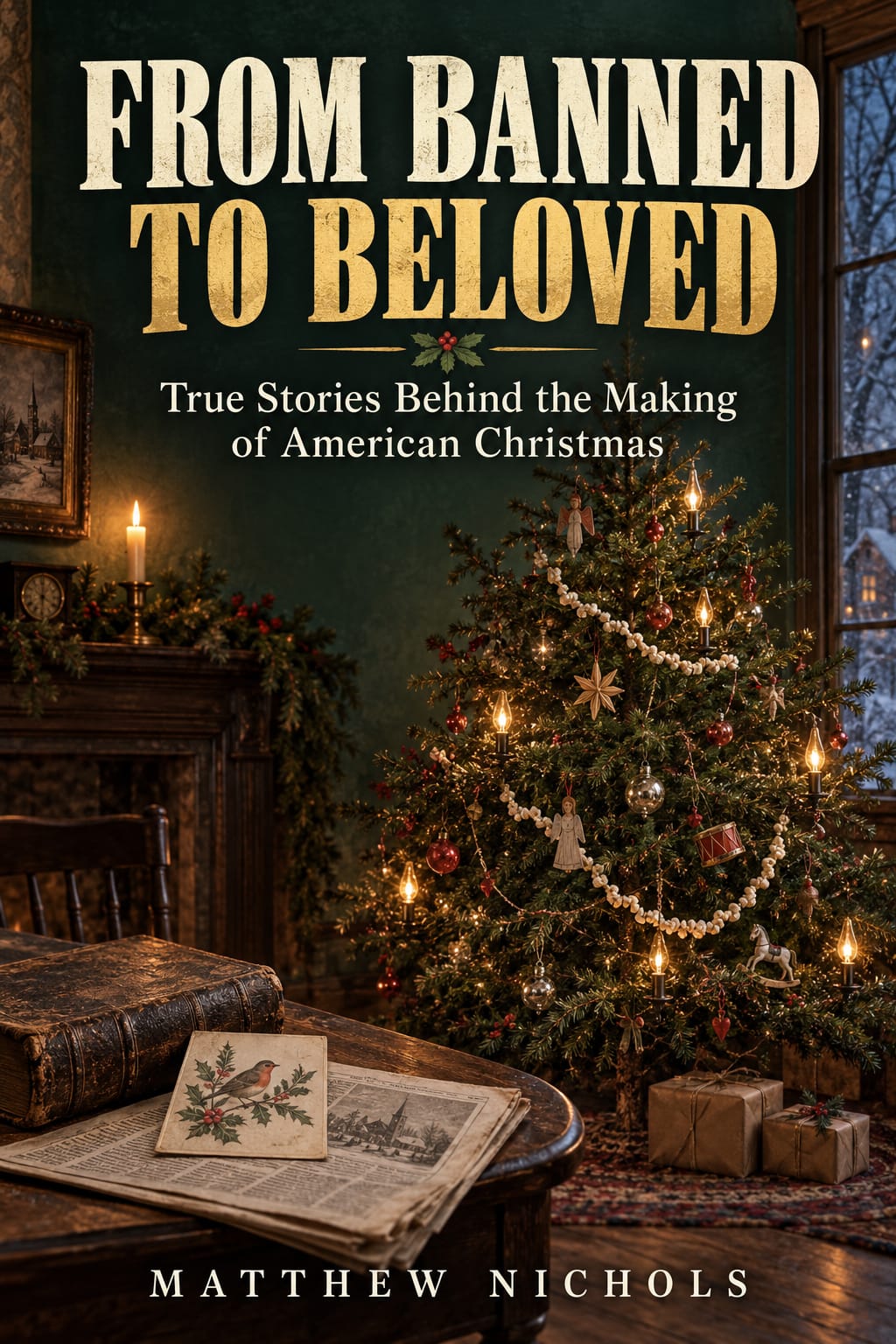
From Banned To Beloved
Christmas feels ancient. Familiar. Almost inevitable. But the American Christmas was not simply inherited. It was built.
Before the glowing trees, department-store windows, Christmas cards and red-suited Santa Claus, Americans fought over the holiday, prohibited it, reinvented it, commercialized it and eventually transformed it into one of the most powerful traditions in American life.
Get The Ebook Choose your preferred ebook retailer1621–1949
ADVERTISING / ARCHIVES
AMERICA REMEMBERS?
America Did Not Inherit Christmas. It Reinvented It.
In seventeenth-century New England, Christmas could be treated not as a sacred national tradition but as a religious and social problem. Puritan authorities distrusted customs they associated with disorder, excess and traditions unsupported by their reading of Scripture.
Yet the holiday did not disappear. Over the centuries that followed, Christmas changed with the country around it. Writers helped domesticate it. Illustrators gave it new imagery. Merchants discovered its commercial power. New technologies illuminated it. Advertising transformed characters into icons.
From Banned to Beloved follows those pieces through the surviving historical record, separating later tradition from documented history and asking a larger question: how does a culture build something that eventually feels as though it has always existed?
From Prohibition To Pop Culture
Plymouth
The conflict over how Christmas should — or should not — be observed appears in the earliest years of English settlement in New England.
Christmas Prohibited
Massachusetts Bay enacted a penalty against observing Christmas in ways authorities associated with the holiday.
Washington Irving
Literature began helping Americans imagine Christmas as a nostalgic, domestic and socially unifying celebration.
A Visit From St. Nicholas
A newspaper poem helped shape enduring American ideas about Santa Claus, reindeer and Christmas Eve.
The Christmas Tree
Popular imagery helped normalize the decorated Christmas tree within American domestic culture.
Thomas Nast
Civil War-era illustration became part of the long visual evolution of the American Santa Claus.
The Commercial Christmas
Department stores, greeting cards and mass consumer culture increasingly transformed Christmas into a commercial season.
Electric Christmas Lights
Edward H. Johnson displayed an electrically illuminated Christmas tree in New York during the early electrical age.
Santa And Advertising
Haddon Sundblom's Coca-Cola illustrations became one influential chapter in the already long evolution of Santa's American appearance.
Rudolph
A Montgomery Ward promotional project created a new Christmas character who would eventually escape his advertising origins and enter family tradition.
Ten True Stories Behind American Christmas
When Christmas Was Forbidden
Enter early New England, where Puritan theology collided with older Christmas customs and authorities attempted to suppress the celebration.
The Writers Who Reinvented Christmas
Follow the literary transformation that helped turn Christmas from a disorderly public festival into an increasingly nostalgic domestic holiday.
The Night Santa Took Shape
Investigate the famous 1823 poem and the role print culture played in establishing enduring elements of the American Santa Claus.
The Tree Comes To America
Trace how the Christmas tree moved from immigrant and European traditions into mainstream American homes.
Drawing Santa
Examine Thomas Nast's influential illustrations and the gradual visual construction of America's most recognizable Christmas figure.
Christmas Goes Shopping
Enter the department-store era, when window displays, gift buying and retail competition helped reshape the economics of the holiday.
Christmas In The Mail
Discover how mass-produced Christmas cards turned seasonal sentiment into a new American industry and social ritual.
The Electric Christmas
Follow Christmas into the electrical age as illuminated trees transformed both the spectacle and commercial possibilities of the season.
The Santa Advertising Did Not Invent
Separate the popular Coca-Cola myth from the longer history of Santa Claus while examining advertising's genuine influence on modern Christmas imagery.
The Reindeer In The Advertising Department
Follow Rudolph from a 1939 Montgomery Ward assignment through copyright, music and popular culture until a promotional character became a family tradition.
Christmas Has A History. It Also Has A Memory.
The Familiar Story
Christmas traditions are often remembered as ancient, continuous customs passed intact from one generation to another.
The Historical Record
Many familiar elements developed at different moments, influenced by religion, immigration, literature, technology, commerce, advertising and changing ideas about family life.
The Commercial Myth
Modern corporations are sometimes credited with inventing traditions that actually existed long before their advertising campaigns began.
The More Interesting Truth
Commerce did not invent Christmas — but businesses, publishers, illustrators and advertisers helped standardize and spread many of the images Americans now associate with it.
You Know The Tradition.
Now Discover How It Was Built.
Travel from Puritan New England to department-store windows, electric Christmas trees, advertising studios and the birth of Rudolph to uncover the strange, complicated and surprisingly modern history behind American Christmas.
Get From Banned To Beloved Available as an ebook through participating retailers