Ancient Mysteries and Lost Knowledge: 10 Enigmatic Riddles of the Past That Still Baffle Experts
Close your eyes and picture a library so vast that its burning lit the Mediterranean coast like a sunset. Imagine a bronze machine with gears delicate enough to predict eclipses, built more than 2,000 years before modern computers. What if the past is not a quiet museum of facts, but a locked door with keys scattered across deserts, oceans, and undeciphered scripts?
That is the magnetic heart of ancient mysteries. They whisper to us from half-erased texts, stones aligned with stars, and artifacts that should not exist—yet do. They remind us that history is not a closed case. It is an open investigation.
In this article, we will explore lost knowledge, enigmatic artifacts, and unsolved puzzles that continue to challenge historians, archaeologists, and armchair detectives. You will meet ancient machines, vanished libraries, cryptic symbols, and earth drawings so large they only make sense from the sky. And when you are done, you can put your own instincts to work. Delve into the enigmas of ancient civilizations with our interactive quiz at the end—if you think you are ready.

The Magnetic Pull of Ancient Mysteries
Why do we obsess over clues left by people who have been dust for millennia? Because unresolved questions make the past feel alive. A solved mystery becomes a fact. An unsolved mystery becomes a story we cannot stop telling.
Think about it. We have mapped the ocean floor and peered billions of light-years into space. Yet we still cannot read a 600-year-old book sitting in a Yale library. We can build artificial intelligence, but we cannot fully explain how workers without steel tools positioned stones weighing 25 tons with near-perfect astronomical alignment. That tension between human brilliance and human humility is exactly what makes ancient mysteries so addictive.
These mysteries also hint at a humbling possibility: maybe the ancients knew things we have forgotten. Maybe lost knowledge is not a fantasy of Atlantis-fever, but a real shadow in the archaeological record—a gap where something once glowed.
Enigmatic Artifacts That Rewrite History
Some objects refuse to fit into the timeline. They are the rogue evidence, the anomalies that force textbooks to add question marks. Here are three enigmatic artifacts that still raise more questions than answers.

The Antikythera Mechanism: A Computer Before Its Time
In 1901, sponge divers off the Greek island of Antikythera pulled a corroded lump of bronze from a shipwreck. At first, it looked like a rock. Later, X-rays revealed something astonishing: a complex arrangement of at least 30 interlocking gears. Scholars now call it the world’s first analog computer, built around 150–100 BCE.
The Antikythera Mechanism could track the movements of the sun and moon, predict eclipses, and even follow the irregular orbit of the moon. The precision of its gear teeth rivals clockwork not seen again until the 14th century. This device is a whispered secret from a lost era of mechanical genius.
Who built it? Archimedes has been suggested, but no one knows for certain. More importantly, why did this technology seemingly vanish for over a millennium? For more on the object itself, explore the Britannica’s overview of the Antikythera Mechanism. You may also enjoy our deep dive into Ancient Greek Technology.

The Voynich Manuscript: A Code No One Can Crack
Now imagine a book filled with curling script that matches no known language. Its pages show plants that do not exist, astrological charts, and nude figures bathing in green pools. Carbon dating places it in the early 15th century, but its meaning remains locked tight.
The Voynich Manuscript is perhaps the most famous unsolved puzzle in the history of cryptography. Named after Wilfrid Voynich, the book dealer who purchased it in 1912, the manuscript has defeated codebreakers from both World Wars, including teams that cracked much harder military ciphers. The script flows from left to right, with repeated word structures that suggest a real language—but one no one has ever identified.
Is it a hoax, an encoded herbal guide, or a message from another place entirely? We still do not know. The manuscript lives at the Beinecke Rare Book & Manuscript Library at Yale. You can view digitized pages via the Voynich Manuscript digital collection. If you love codes, our feature on The History of Cryptography offers a wider lens.
The Baghdad Battery: Electricity in Antiquity?
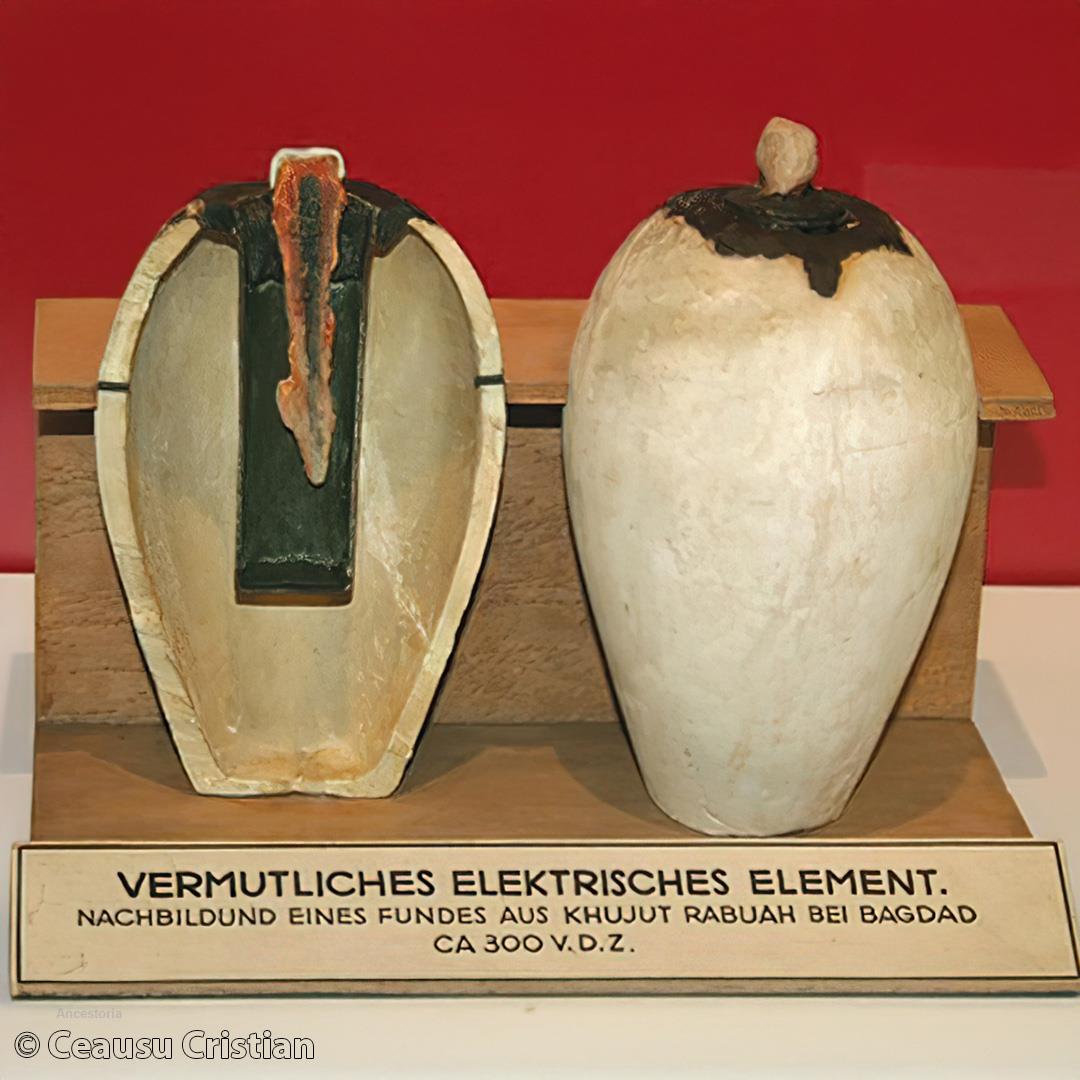
In 1938, archaeologists near Baghdad uncovered small terracotta jars, each containing a copper cylinder and an iron rod. They date to roughly 250 BCE–224 CE. The arrangement looks suspiciously like a simple galvanic cell: an acid such as wine or vinegar could have produced a small electric current.
But why? No one has found ancient lightbulbs or wiring. Some researchers suggest the jars were used for electroplating gold onto silver. Others remain skeptical, calling the “battery” a storage container for sacred scrolls. The debate is still live.
What makes the Baghdad Battery so tantalizing is its implication: if ancient people harnessed electricity, even weakly, then lost knowledge may include practical sciences we assume were modern inventions. It is a small object with a huge, crackling question mark.
| Artifact | Estimated Date | Why It Puzzles Us |
|---|---|---|
| Antikythera Mechanism | c. 150–100 BCE | Advanced gearwork far ahead of its time |
| Voynich Manuscript | c. 1404–1438 CE | Unreadable script and unknown plants |
| Baghdad Battery | c. 250 BCE–224 CE | Possible ancient electric cell without context |
Lost Knowledge: Vanished Libraries and Hidden Sciences
Artifacts are not the only place where lost knowledge hides. Sometimes the loss is a place—a building that held thousands of scrolls, a tradition of building that died with its masters. These gaps feel like missing chapters ripped from the book of humanity.
The Library of Alexandria: A Universe of Vanished Wisdom
No single flame erased the Library of Alexandria in one dramatic night, despite the stories. The great library likely declined over centuries through fire, funding cuts, and political neglect. But the result is the same: a staggering collection of ancient thought was lost.
What did it hold? We will never know the full catalog, but fragments mention works by Sophocles, Euclid, and hundreds of scientists and poets whose names now exist only as footnotes. The library may have contained maps of the known world, medical treatises, and astronomical tables. Its loss is a wound in collective memory.
Whenever I think of Alexandria, I wonder what ordinary knowledge vanished alongside the masterpieces—sailors’ logs, farmers’ almanacs, engineers’ notebooks. That is the quiet grief of lost knowledge: not only the stars, but the entire sky behind them. For more on vanished archives, see our timeline of Lost Libraries in History.
The Pyramids and Precision Engineering
The Great Pyramid of Giza was built around 2560 BCE, and yet its base is level to within a fraction of an inch. Its sides align with true north with an error of just 3/60th of a degree. The builders did this without compasses, cranes, or iron tools.
Modern engineers still debate how the massive limestone and granite blocks—some weighing up to 80 tons—were quarried, transported, and lifted into place. Ramp theories abound, but none fully satisfy the physical evidence. The pyramid’s construction is an unsolved puzzle that straddles engineering, astronomy, and sheer willpower.
Could the ancients have known a simple mechanical principle we have discarded? Or did they simply have unlimited labor and time? Either way, the Great Pyramid stands as a stone question mark against the horizon.
Ancient Astronomical Knowledge
Many ancient cultures tracked the stars with startling accuracy. The Maya predicted solar eclipses centuries in advance. Aboriginal Australians preserved oral traditions describing star changes that modern science only confirmed recently. And the builders of Stonehenge aligned their monument with the solstice sunrise, turning a ring of stones into a celestial calendar.
This raises a thrilling possibility: lost knowledge may not be about alien technology or mystical energy. It may simply be a different way of seeing the universe—patient, observational, and deeply connected to the natural world. We forgot some of it when we stopped looking up.
Unsolved Puzzles Carved into Earth and Stone
Some mysteries are not hidden in museums. They are sprawled across deserts, carved into rock, and etched into clay tablets. These unsolved puzzles are so large or so stubborn that they force us to rethink ancient capabilities.
The Nazca Lines: Messages for the Sky
On a dry plateau in southern Peru, ancient people removed reddish pebbles to reveal pale ground beneath. The result is a gallery of geoglyphs—hummingbirds, monkeys, spiders, spirals, and geometric lines—some stretching over 1,200 feet. Created between 500 BCE and 500 CE, the Nazca Lines are best seen from the air.
Why make art no one could fully see from the ground? Some researchers believe the lines were processional paths or ritual maps tied to water sources. Others, including early investigators, wondered if they were landing strips for ancient astronauts. The truth is likely more fascinating and more human: the Nazca people may have created the figures for the gods above, who alone could see the whole design.
UNESCO recognizes the lines as a World Heritage site, but their full meaning remains one of archaeology’s most haunting cultural riddles.
The Indus Valley Script: A Language Frozen in Time
The Indus Valley Civilization flourished in modern-day Pakistan and northwest India from about 2600 to 1900 BCE. It built cities with advanced drainage, standardized bricks, and weighing systems. And it left behind thousands of small seals covered in a script no one has ever read.
Unlike Egyptian hieroglyphs, which we cracked using the Rosetta Stone, the Indus script has no bilingual inscription to unlock it. Many of the known examples are short—five to ten symbols—making statistical analysis difficult. Some scholars argue the symbols are not writing at all, but a system of political or religious markers.
The Indus script is a locked diary from a civilization that may have held deep lost knowledge about urban planning, trade, and governance. Until we read it, those secrets remain sealed in stone.
Stonehenge’s Celestial Blueprint
Stonehenge rises from Salisbury Plain in England like a fossilized prayer. Built in phases between roughly 3000 and 2000 BCE, its massive sarsen stones were transported from miles away, possibly with rollers, sledges, and sheer human effort. But the deeper mystery is its design.
The monument aligns perfectly with the sunrise on the summer solstice and the sunset on the winter solstice. Some researchers believe it also tracked lunar cycles and marked ritual dates. The builders left no written records, so their exact intentions are unknowable.
What we do know is that Stonehenge was not an isolated oddity. It belonged to a wider sacred landscape of wooden circles, burial mounds, and processional routes. It is a reminder that the ancient world was more connected—and more cosmically aware—than we often assume.
Could These Mysteries Ever Be Solved?
Modern technology has already cracked open new possibilities. LiDAR scanning has revealed buried Maya cities beneath jungle canopies. Artificial intelligence has begun to search for patterns in the Voynich Manuscript’s script. DNA analysis is rewriting timelines of human migration. These tools give us hope that some ancient mysteries may yield answers in our lifetime.
But here is the strange truth: even if we solve one layer of a mystery, another layer usually appears. Decoding a few Indus symbols may only show that the script was used for trade receipts. That would be a breakthrough—but it would not tell us what the Indus people believed, feared, or dreamed. The greatest lost knowledge may not be technical. It may be emotional, spiritual, and cultural—the untranslatable inner life of past peoples.
There is also a quiet beauty in not knowing everything. If we solved every unsolved puzzle, history would lose its texture. The gaps are where imagination lives. They are invitations to wonder.
Frequently Asked Questions About Ancient Mysteries and Lost Knowledge
What is the most famous ancient mystery?
The Great Pyramid of Giza is arguably the most famous ancient mystery because its construction methods and precision still spark debate. The Voynich Manuscript and Stonehenge are also top contenders among ancient mysteries.
Why is the Voynich Manuscript considered lost knowledge?
The Voynich Manuscript is considered lost knowledge because it contains a complete writing system and botanical illustrations, but the language and purpose have been forgotten. It represents knowledge that existed but can no longer be accessed.
Could the Antikythera Mechanism be a hoax?
No. The Antikythera Mechanism is a verified ancient artifact, and multiple studies using X-ray and CT scanning have confirmed its complex gearwork. While its exact maker is unknown, its authenticity as a genuine enigmatic artifact is not in serious doubt.
Are the Nazca Lines visible only from the air?
Many of the Nazca Lines are best appreciated from the air, but some can be seen from nearby foothills or elevated platforms. The larger question is why the ancient Nazca people made geoglyphs that seem designed for a skyward viewer.
What lost knowledge still influences modern science?
Ancient astronomical observations, including eclipse records from Babylon and China, still help modern astronomers calibrate long-term cycles. Some ancient medical remedies, such as honey-based wound care, have also been validated by modern research.
How do archaeologists decode unsolved puzzles without written records?
Archaeologists combine material evidence, chemical analysis, spatial mapping, and cross-cultural comparison. They also use experimental archaeology—replicating ancient tools and techniques—to test possible explanations for unsolved puzzles.
Conclusion: The Enigma Endures
Ancient mysteries are not just questions about the past. They are questions about us—about our limits, our curiosity, and our hunger to understand where we came from. The Antikythera Mechanism suggests that brilliance can be forgotten. The Voynich Manuscript whispers that knowledge can be locked away by time. The Nazca Lines insist that meaning can be written on the earth in a language we are still learning to read.
We may never know whether the Library of Alexandria held the secret of eternal life or simply a very good recipe for lentil soup. But the searching matters. Each new dig, scan, and translation attempt is a light pressed into the dark.
So now the question turns to you. You have explored ancient mysteries, touched the edges of lost knowledge, and stared into the same riddles that have baffled generations. Do you have what it takes to think like an archaeologist, a codebreaker, or a cosmic detective? Delve into the enigmas of ancient civilizations with our interactive quiz and test your instincts against history’s most beguiling unknowns. The past is waiting. Are you?