
The Great Cataclysm: Unraveling the Late Bronze Age Collapse and the Enigma of the Sea Peoples
Around 1200 BCE, a catastrophic event plunged the Eastern Mediterranean and Near East into a dark age, bringing an abrupt end to a flourishing era of interconnected civilizations. This period, known as the Late Bronze Age Collapse, saw the sudden destruction of mighty empires, the abandonment of grand cities, and the disruption of vast trade networks. At the heart of this perplexing historical mystery lies the enigmatic group known as the “Sea Peoples,” whose marauding incursions are vividly documented in Egyptian records but whose origins and ultimate fate remain largely unknown. While archaeological evidence points to a complex interplay of factors, the specific role and identity of these maritime raiders continue to fuel intense debate among historians and archaeologists.
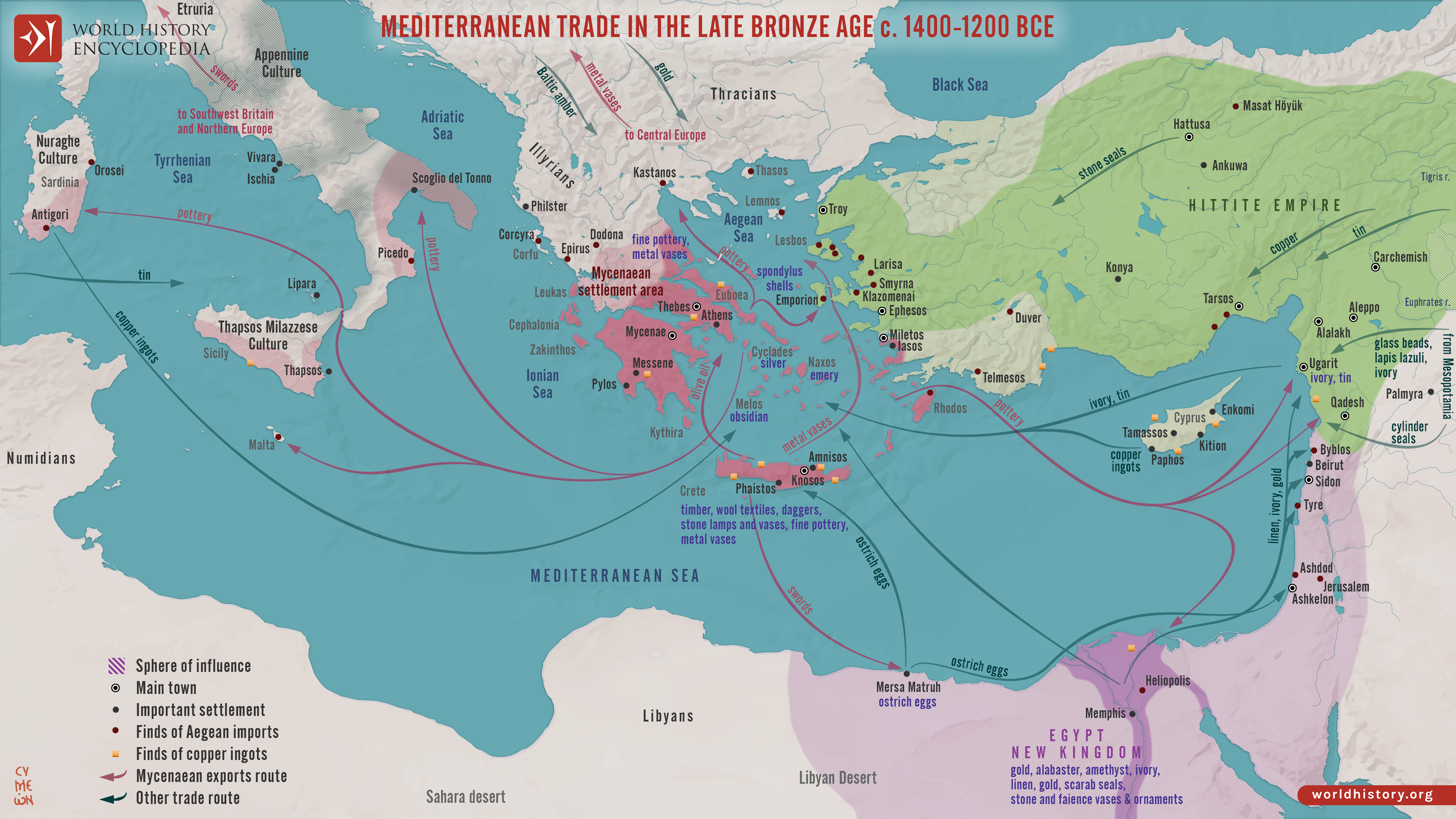
A World Undone: The Prosperous Late Bronze Age (c. 1600–1200 BCE)
To understand the magnitude of the collapse, one must first appreciate the sophisticated world that preceded it. The Late Bronze Age was a period of unprecedented internationalism and prosperity across the Eastern Mediterranean. Great powers like the Egyptian New Kingdom, the Hittite Empire in Anatolia, the Mycenaean civilization in Greece, and the Kassite kingdom of Babylonia maintained a delicate balance of power, engaging in diplomacy, trade, and occasional warfare. Smaller but significant kingdoms—such as the Hurrian state of Mitanni, the wealthy city-state of Ugarit on the Syrian coast, and Assyria—also played crucial roles in this intricate geopolitical tapestry.
This era was characterized by highly centralized palace economies that controlled vast resources, facilitated extensive trade in raw materials like copper and tin (essential for bronze production), and fostered a vibrant exchange of ideas and technologies. Diplomatic correspondence, such as the Amarna Letters, reveals a network of “Great Kings” addressing each other as “brothers,” exchanging gifts, and arranging dynastic marriages. Urban centers thrived, boasting monumental architecture, advanced craftsmanship, and complex administrative systems. For centuries, this system, though not without its conflicts, brought relative stability and immense wealth to the region.

The Sudden Silence: Evidence of Widespread Collapse (c. 1200–1150 BCE)
The transition from this golden age to a period of widespread destruction was remarkably swift and brutal. Within a span of approximately 50 to 70 years, major cities and administrative centers across the Aegean, Anatolia, the Levant, and Cyprus met violent ends. Archaeological excavations consistently reveal layers of destruction, often marked by evidence of widespread burning, unburied human remains, and the sudden cessation of ceramic production, writing, and international trade.
In Anatolia, the mighty Hittite capital of Hattusa was sacked and abandoned, its vast archives of cuneiform tablets left to crumble. The Hittite Empire, a dominant force for centuries, simply vanished from the historical record. In Mycenaean Greece, the grand palaces of Mycenae, Tiryns, Pylos, and Thebes were systematically destroyed and never rebuilt to their former glory, ushering in a “Dark Age” that lasted for centuries. On the Syrian coast, the prosperous international port city of Ugarit was razed, its final moments chillingly preserved in clay tablets detailing desperate pleas for aid against approaching enemies and references to ships being burned at sea. Emar, another significant Syrian center, also suffered a similar fate. Even distant Troy (Hisarlik VIIb) shows evidence of destruction around this time.
The archaeological record paints a consistent picture: not just isolated incidents, but a systemic collapse impacting an entire interconnected region. The sophisticated palace economies ceased to function, long-distance trade routes broke down, and literacy, once confined to scribal elites, largely disappeared from many areas. The cultural and technological regression was profound, leaving future generations to wonder about the forces that brought about such a cataclysm.
The Enigmatic Raiders: Who Were the Sea Peoples?
Among the various proposed causes for this widespread destruction, the “Sea Peoples” stand out due to their prominent mention in the few surviving contemporary accounts. These mysterious groups are primarily known through the monumental inscriptions of the Egyptian pharaohs, who recorded their desperate struggles against these invaders.

Egyptian Records: Our Primary Source
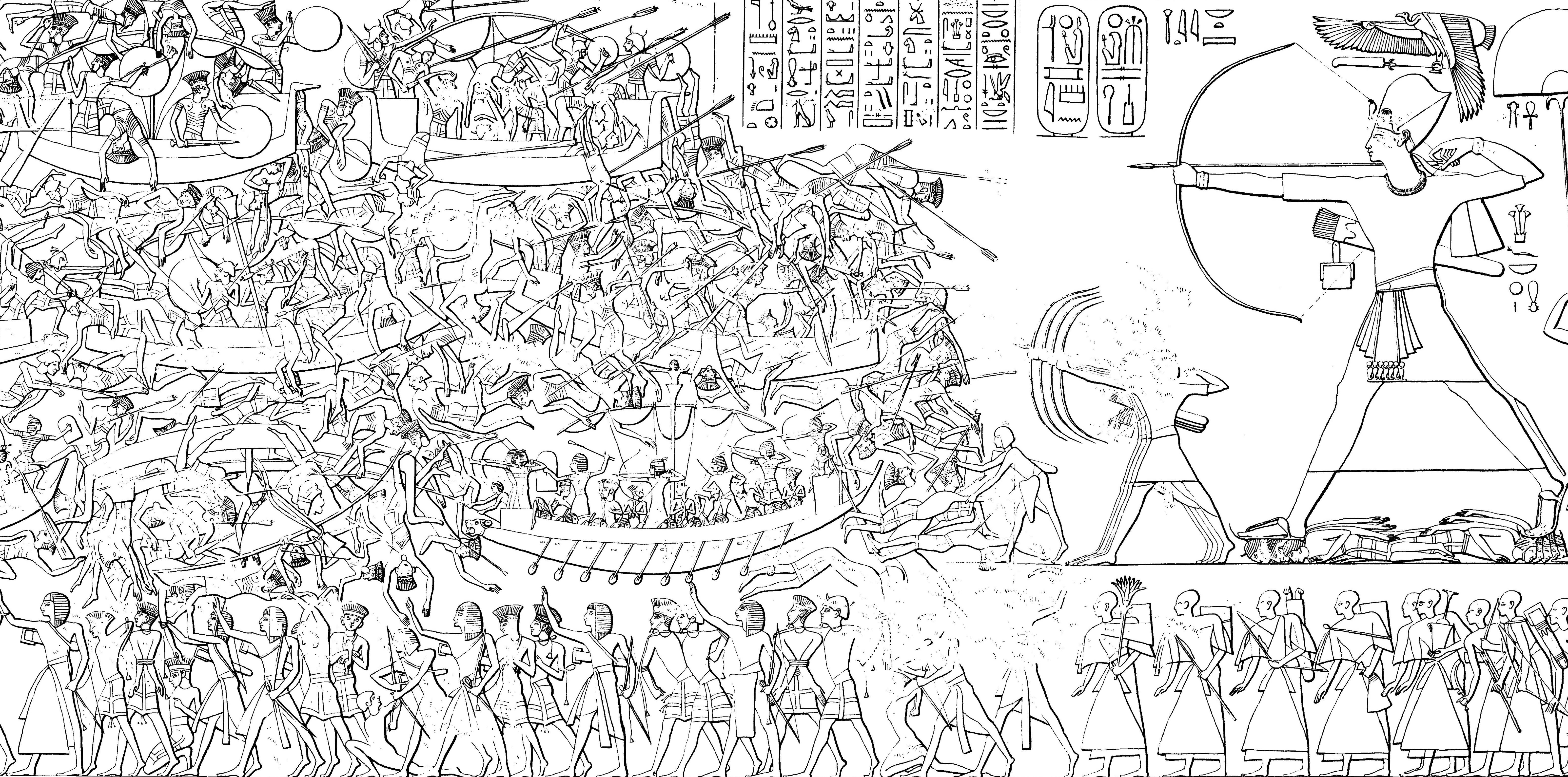
The most detailed accounts come from the mortuary temple of Ramesses III at Medinet Habu, dating to approximately 1175 BCE. Here, elaborate reliefs depict massive land and sea battles against a confederation of foreign invaders. Accompanying hieroglyphic inscriptions describe a wave of destruction that had already swept through the Near East before reaching Egypt’s borders:
“The foreign countries made a conspiracy in their islands. All at once the lands were removed and scattered in the fray. No land could stand before their arms, from Hatti, Kode, Carchemish, Arzawa, and Alashiya on, being cut off at one time. A camp was set up in Amurru. They desolated its people, and its land was like that which has never come into being. They were coming forward toward Egypt, while the flame was prepared before them. Their confederation was the Peleset, Tjeker, Shekelesh, Denyen, and Weshwesh, lands united. They laid their hands upon the land as far as the circuit of the earth, their hearts confident and trusting: ‘Our plans will succeed!'”
Ramesses III vividly describes defeating these invaders in both a land battle and a crucial naval engagement in the Nile Delta. He identifies several distinct groups within this confederation:
- Peleset: Widely believed to be the Philistines, who later settled in the southern Levant, giving their name to Palestine. Archaeological evidence from sites like Gath, Ashkelon, and Ekron supports this identification, showing a distinctive material culture that appears shortly after the collapse.
- Tjeker: Often associated with the Teucrians, possibly from the Troad region (around Troy), though this is speculative.
- Shekelesh: Their origin is debated, with some linking them to Sicily or other Mediterranean islands.
- Denyen: Sometimes identified with the Danaans (Greeks) or people from Adana in Anatolia, but this remains highly uncertain.
- Weshwesh: Another group whose origins are obscure.
- Sherden: Often linked to Sardinia due to the similarity in name, but concrete archaeological evidence for such a migration from the Aegean to Sardinia at this specific time is lacking. While Sardinian warriors are depicted in later Egyptian art, a direct link remains unproven.
- Denyen: Proposed connections to the Danaans (a Homeric name for Greeks) or the region of Adana in Cilicia are purely speculative, based on phonetic similarities rather than robust evidence.
- Tjeker: Similarly, connections to the Teucrians (associated with Troy) are educated guesses.
Other groups mentioned in earlier Egyptian texts, sometimes associated with the Sea Peoples, include the Sherden, who appear as mercenaries in Egyptian armies as early as the reign of Ramesses II, and the Lukka, often identified with people from Lycia in southwestern Anatolia. These earlier mentions suggest that some groups often categorized as “Sea Peoples” had interactions with Egypt long before the major collapse.
What the inscriptions tell us is that these were not just isolated pirate bands. They moved with their families in ox-carts, suggesting a significant migration or displacement. They were well-armed, possessing iron weapons in some cases (though bronze was still dominant), and fought with distinct round shields and feathered helmets, as depicted on the reliefs. Their motivations appear to have been conquest and settlement, driven by forces unknown to the Egyptians.

What the Inscriptions Tell Us (and Don’t Tell Us)
The Egyptian records are invaluable but also limited. They provide a snapshot from an Egyptian perspective, primarily detailing the invaders’ actions as they approached Egypt. They do not offer clear answers about the Sea Peoples’ ultimate origins, their internal organization, or the specific reasons for their mass movement. While Ramesses III claimed a decisive victory, the fact remains that Egypt itself was significantly weakened and never fully recovered its imperial reach in the Levant after this period. The inscription’s triumphal tone may also mask a more complex and costly defense.
Beyond the Raiders: Other Contributing Factors to the Collapse
While the Sea Peoples undoubtedly played a role, modern scholarship recognizes that the Late Bronze Age Collapse was not a monocausal event. Instead, it was likely the result of a complex interplay of environmental, economic, and socio-political factors, creating a “perfect storm” that overwhelmed the existing political order.
Climate Change and Drought
Growing archaeological and paleoclimate evidence strongly suggests that a period of prolonged and severe drought impacted the Eastern Mediterranean during the late 13th and early 12th centuries BCE. Studies of pollen cores from lakes, tree rings, and isotopic analysis of ancient remains point to significant aridification. Such environmental stress would have devastated agricultural yields, leading to widespread famine, population displacement, and increased competition for dwindling resources. The fragility of rain-fed agriculture in many areas would have made states particularly vulnerable to even minor climatic shifts.
Internal Revolts and Social Unrest
The highly centralized palace economies of the Late Bronze Age, while efficient in times of plenty, were also inherently fragile. They relied on a complex bureaucracy and the ability to extract surplus from a largely rural population. Periods of famine or economic hardship could easily trigger internal revolts by disgruntled peasants, slaves, or marginalized groups. Evidence of such unrest is difficult to pinpoint definitively in the archaeological record, but texts from Ugarit speak of social tensions and the king’s struggles to maintain order. The collapse of central authority might have been as much from within as from external pressure.
Systems Collapse and Interconnectedness
The very interconnectedness that defined the Late Bronze Age may have also been its undoing. Historians and archaeologists have proposed a “systems collapse” theory, suggesting that the intricate network of trade, diplomacy, and economic interdependence created a vulnerability. The disruption of one crucial element—say, the tin trade from Afghanistan or the copper trade from Cyprus—could have had a cascading effect, crippling the entire bronze-producing economy. If several core states weakened simultaneously due to drought or internal strife, the entire system could unravel, leading to a domino effect of economic disruption, political instability, and migration. This theory emphasizes that no single factor was sufficient; it was the synergistic combination that proved fatal.
Warfare and Technological Shifts
While the Late Bronze Age was generally prosperous, it was not peaceful. Empires like Egypt and the Hittites were frequently at war with each other or with smaller states. These prolonged conflicts could have drained resources, weakened central authorities, and made states less resilient to new threats. Additionally, the nascent technology of iron metallurgy was beginning to emerge. While bronze remained dominant for much of the period, the disruption of the tin and copper trade might have accelerated the transition to iron, which was more abundant and could be locally sourced. This shift could have conferred a military advantage on groups who mastered ironworking, potentially destabilizing the existing power structures.
Disputed Interpretations and Modern Speculation
The Sea Peoples and the Late Bronze Age Collapse remain fertile ground for academic debate and, inevitably, popular speculation. Distinguishing verified historical and archaeological findings from interpretations and outright myths is crucial.
The Identity of the Sea Peoples: From Philistines to Sardinians?
While the identification of the Peleset with the Philistines is widely accepted due to strong archaeological and textual correlations—such as the distinctive Philistine pottery and architecture that appears in the southern Levant shortly after the collapse—the origins of other Sea Peoples groups are far more contentious.
It’s important to emphasize that while some connections are plausible, many identifications of the Sea Peoples remain in the realm of hypothesis, lacking definitive proof. We must avoid the trap of assuming phonetic similarity equates to historical fact.
Catastrophe or Transformation?
Another key debate centers on the nature of the collapse itself. Was it a sudden, cataclysmic event, a true “Dark Age” that wiped the slate clean? Or was it a more gradual transformation, a period of decline and reorganization that, while disruptive, also laid the groundwork for new societies? While the archaeological record often shows abrupt destruction, the subsequent “Dark Age” was not uniform across all regions. Some areas, like parts of Assyria, experienced less severe disruption, while others, like Mycenaean Greece, endured centuries of regression.
The “systems collapse” theory tends to favor a more nuanced view, seeing the collapse as a complex process rather than a single, instantaneous event. It acknowledges that different regions experienced the crisis in different ways and at slightly different times, and that the seeds of the Iron Age were already being sown amidst the destruction of the Bronze Age.
It is also vital to separate these rigorous historical debates from unsupported claims and internet mythology. There is no archaeological or textual evidence to support theories involving alien intervention, the sinking of Atlantis, or other fantastical explanations for the Late Bronze Age Collapse. These narratives, while engaging, deviate significantly from the documented historical and archaeological record.
The Legacy of the Collapse: A New World Emerges
Despite the widespread destruction and the ensuing “Dark Age,” the Late Bronze Age Collapse was not an end but a dramatic transformation. It marked the definitive transition from the Bronze Age to the Iron Age in the Eastern Mediterranean. While large, centralized empires crumbled, new, more resilient political entities began to emerge from the ashes.
In the Levant, the Philistines (Peleset) established a powerful pentapolis, while the Israelite tribes consolidated their presence, eventually forming a kingdom. Phoenician city-states, known for their maritime prowess and alphabetic script, rose to prominence. In Anatolia, smaller, independent Neo-Hittite states preserved aspects of Hittite culture. Greece slowly re-emerged from its Dark Age with the development of the polis (city-state) and the eventual flowering of Archaic and Classical Greek civilization.
The collapse fundamentally altered the geopolitical landscape. The large, bureaucratic palace economies gave way to more decentralized, often smaller, city-state-based polities. The widespread use of iron, a more readily available metal, democratized tool and weapon production, reducing dependence on long-distance trade in copper and tin. This period of intense upheaval ultimately reshaped the ancient world, laying the foundations for the civilizations that would define the first millennium BCE.
Conclusion: Echoes of a Vanished Era
The Late Bronze Age Collapse and the enigma of the Sea Peoples remain one of the most compelling and complex archaeological mysteries of the ancient world. While the Egyptian inscriptions provide a crucial, albeit biased, glimpse into the chaos, the full story is far more intricate, involving environmental shifts, economic vulnerabilities, internal strife, and the disruptive force of mass migrations. Modern archaeology continues to unearth new evidence, refining our understanding and challenging older assumptions.
The documented mystery of how such a flourishing, interconnected world could unravel so completely serves as a powerful reminder of the fragility of even the most advanced civilizations. It is a testament to the ongoing work of historians and archaeologists who meticulously piece together fragments of the past, separating verified facts from the mists of speculation, to illuminate the forgotten stories that shaped our world.
Discover more documented mysteries and forgotten stories at TrueHistories.com.