
The Enduring Riddle of the Phaistos Disc: An Undeciphered Echo from Minoan Crete
Discovered over a century ago amidst the ruins of a sprawling Minoan palace, the Phaistos Disc remains one of archaeology’s most captivating and frustrating enigmas. This unique clay artifact, inscribed with a spiral of enigmatic symbols, offers a tantalizing glimpse into an advanced Bronze Age civilization, yet its message has defied all attempts at decipherment. Its very existence challenges our understanding of ancient communication, leaving historians and linguists to ponder whether it holds a sacred hymn, a legal decree, or perhaps the world’s first printed text.

The Discovery: A Glimpse into Minoan Crete
The story of the Phaistos Disc begins in 1908, during the extensive excavations of the Minoan palace at Phaistos, located on the south coast of Crete. The Italian archaeologist Luigi Pernier, leading the Italian Archaeological Mission, made the remarkable find within a storage chamber known as “Room 8” of the palace archives. This room, part of a larger complex of administrative offices, contained numerous clay tablets inscribed with Linear A, another undeciphered Minoan script, along with pottery and other artifacts. The context of its discovery firmly places the disc within the administrative and cultural heart of the Minoan civilization.
The disc itself is a perfectly circular piece of fired clay, approximately 15 centimeters (5.9 inches) in diameter and 1.5 centimeters (0.6 inches) thick. Both sides are covered with a meticulously arranged spiral inscription, comprising a total of 241 individual signs, grouped into 61 distinct sections by vertical lines. The disc is dated to the Middle or Late Minoan Bronze Age, specifically around 1850-1600 BCE, placing it firmly within a period of high Minoan cultural achievement and extensive trade networks. This dating is based on the archaeological stratum in which it was found, alongside pottery styles characteristic of that era.
The most extraordinary feature of the Phaistos Disc is not just its script, but the method by which it was created. Unlike other ancient inscriptions that were painstakingly carved or incised by hand, the symbols on the Phaistos Disc appear to have been pressed into the soft clay using pre-formed stamps or “types.” This technique, akin to early movable type printing, is revolutionary for its time, predating Johannes Gutenberg’s printing press by over 3,000 years. If confirmed, it would represent an astonishing technological innovation, suggesting a desire for rapid, standardized reproduction of text, even if only for a limited number of copies.
Suggested image alt text: Close-up photo of the Phaistos Disc, showing the spiral inscription and distinct stamped symbols.

A Unique Inscription: The Pictographic Puzzle
The symbols themselves are a diverse collection of pictograms, representing a range of recognizable objects, creatures, and human forms. There are 45 distinct signs in total, each appearing multiple times across the disc’s two sides (Side A and Side B). These include images of human heads (some with feathered headdresses), shields, axes, plants, birds, fish, bees, ships, and various abstract geometric shapes. The intricate detail and consistent representation of each sign suggest a sophisticated system, not merely crude drawings.
The inscription spirals inward from the outer edge towards the center on both sides. While the exact reading direction is debated, the prevailing scholarly consensus suggests a right-to-left, clockwise reading, terminating at the center. This interpretation is supported by the way groups of signs are oriented and the occasional overlap of symbols, where a later stamp slightly covers an earlier one, indicating the sequence of application. Each group of signs, separated by vertical lines, is thought to represent a word or a phrase.
At the end of some sign groups, small diagonal lines or dots appear. The meaning of these “punctuation” marks is unknown but has been theorized to indicate word endings, prefixes, suffixes, or even grammatical functions. The careful arrangement and consistent application of these elements underscore the deliberate and systematic nature of the inscription.
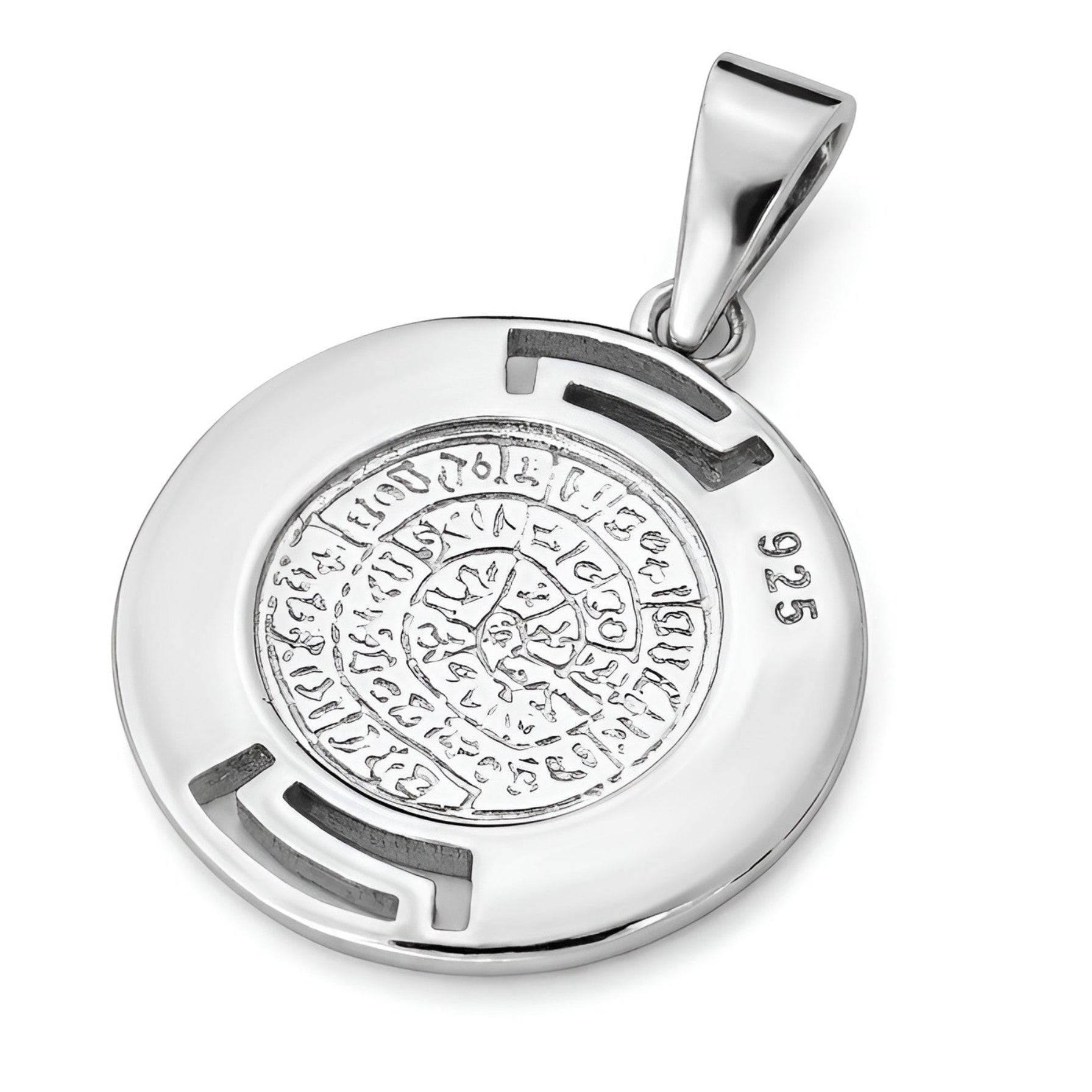
Why the Phaistos Disc Remains Undeciphered
Despite over a century of intense study by epigraphers, linguists, and code-breakers, the Phaistos Disc’s message remains locked away. The reasons for this persistent mystery are multifaceted, creating a formidable barrier to understanding.

Limited Corpus: An Isolated Voice
The primary obstacle to decipherment is the disc’s uniqueness. It is, to date, the only known example of its particular script. In contrast, scripts like Linear B were deciphered because thousands of tablets provided a large enough corpus of text to identify recurring patterns, grammatical structures, and eventually, the underlying language. With only 241 signs on a single artifact, statistical analysis is severely limited, making it almost impossible to discern the frequency of symbols, their positional preferences, or the rules governing their combination.

Unknown Language: A Silent Tongue
Even if the script’s phonetic values could be determined, the underlying language remains entirely unknown. Is it Minoan, the language spoken on Crete? Is it an imported language, perhaps from Anatolia (Luwian, for example, has been proposed)? Or is it a specialized cultic or ritualistic language? Without a known language to match against, even a successful phonetic transliteration would leave its meaning obscure. This stands in stark contrast to Linear B, which was deciphered only after it was correctly identified as an early form of Greek.
Short Text Length: A Snippet, Not a Story
The total number of distinct signs (45) suggests it might be a syllabary (each sign representing a syllable, like Linear B) or an alphabet (each sign representing a sound). However, the total text length is too short for definitive statistical analysis that would reveal whether it’s an alphabet, a syllabary, or an ideographic system (where each sign represents a concept or word). Deciphering a short, unique text without any comparative material is akin to trying to understand an entire book from a single, isolated paragraph.
Lack of Bilinguals: No Rosetta Stone
Perhaps the greatest hope for decipherment lies in a bilingual text—a document inscribed with the same message in both the unknown script and a known language. The Rosetta Stone, for instance, provided the key to Egyptian hieroglyphs by presenting the same decree in hieroglyphic, Demotic, and ancient Greek. No such bilingual has ever been found for the Phaistos Disc. Until such a discovery, any proposed decipherment remains speculative, lacking external validation.
Suggested image alt text: Map of Minoan Crete showing the location of Phaistos Palace and other major Minoan sites.
Major Theories and Interpretations: Fact vs. Speculation
Over the decades, countless theories have emerged regarding the content and purpose of the Phaistos Disc. While many are ingenious, few have achieved widespread academic acceptance, largely due to the lack of verifiable evidence. It is crucial to distinguish between what archaeologists can verify and what remains educated (or sometimes wild) speculation.
A Hymn or Religious Text
The Theory: Many scholars propose the disc contains a hymn, a prayer, or a religious invocation. This theory often arises from the observation of recurring sequences of symbols, which could represent refrains or ritualistic phrases. Some symbols, like the “feathered head” or “shield” signs, have been interpreted by some as divine figures or cultic objects.
Fact vs. Speculation:
- Verifiable: The existence of recurring sign groups is verifiable. The disc was found in a palace complex that likely had religious functions.
- Speculative: The specific content being a hymn, prayer, or specific religious narrative is purely interpretative. There is no direct evidence to confirm a religious purpose over any other.
- Verifiable: Some symbols resemble natural phenomena, and ancient civilizations often tracked astronomical events.
- Speculative: Assigning specific calendrical or astronomical functions to the symbols lacks concrete proof. The disc’s physical form does not inherently suggest it is a functional instrument for observation.
- Verifiable: The archaeological context (archive room) supports an administrative or official function.
- Speculative: The pictographic nature of the script is less common for typical administrative texts (which tend to be more abstract, like Linear A or B). The specific content remains unknown.
- Verifiable: Ancient civilizations played board games.
- Speculative: There is no direct archaeological evidence connecting the disc to any known ancient game. Its formal inscription style also seems too elaborate for a simple game board.
- Verifiable: The disc was discovered by a reputable archaeologist, Luigi Pernier, in a securely stratified archaeological context, alongside other authentic Minoan artifacts. The clay and firing techniques are consistent with Minoan practices. Several independent scientific analyses have confirmed its ancient origins.
- Speculative: Claims of forgery lack any credible archaeological or scientific evidence and are generally dismissed by the academic community.
- Cretan Hieroglyphic: An earlier, pictographic script, primarily found on seals and clay bars, dating from roughly 2000-1600 BCE. It shares some visual similarities with the Phaistos Disc symbols but is not considered the same script. Cretan Hieroglyphic remains largely undeciphered.
- Linear A: A later, syllabic script (each sign representing a syllable), developed around 1800 BCE and used until the collapse of Minoan palaces around 1450 BCE. Linear A is found on hundreds of clay tablets and other objects across Crete. Despite extensive research, Linear A also remains undeciphered, though scholars have made progress in understanding its structure.
A Calendar or Astronomical Instrument
The Theory: Another popular theory suggests the disc functions as a calendar or an astronomical record. Proponents point to certain symbols that could be interpreted as celestial bodies, agricultural cycles, or seasonal markers. The spiral arrangement might also suggest a cyclical passage of time.
Fact vs. Speculation:
A Legal Document, Treaty, or Administrative Record
The Theory: Given its discovery in a palace archive alongside administrative tablets, some scholars propose the disc could be a legal document, a treaty, a record of trade, or an inventory. The standardized “printing” method might suggest a need for official copies.
Fact vs. Speculation:
A Game or Board Game
The Theory: A more fringe theory suggests the Phaistos Disc might be related to a game, with its spiral path resembling a game board. The distinct groups of signs could represent moves or instructions.
Fact vs. Speculation:
A Hoax? (Largely Discredited)
The Theory: Briefly after its discovery, and occasionally resurfacing in popular media, some have questioned the disc’s authenticity, suggesting it might be a forgery.
Fact vs. Speculation:
Specific Decipherment Claims (Unsupported by Consensus)
Over the years, numerous individuals, both academics and amateurs, have put forth their own decipherments of the Phaistos Disc. These attempts often propose the script is an alphabet, a syllabary, or an ideogram system for various languages, including Greek, Luwian, Hittite, Egyptian, and even Basque. While some decipherments can translate parts of the disc into plausible-sounding texts, none have gained widespread acceptance among the academic community. The fundamental issue remains the lack of independent verification, a large enough corpus, or a bilingual key. Without these, any proposed solution remains an unproven hypothesis.
The Broader Context: Minoan Civilization and its Scripts
The Phaistos Disc stands as a singular testament to the rich intellectual life of the Minoan civilization, a highly advanced Bronze Age culture that flourished on Crete from approximately 2700 to 1450 BCE. The Minoans developed sophisticated palaces, intricate art, and a complex administrative system supported by writing.
Before the Phaistos Disc, two primary scripts were known from Minoan Crete:
Following the decline of Minoan civilization and the rise of Mycenaean influence on Crete, a new script emerged: Linear B. This script was eventually deciphered by Michael Ventris and John Chadwick in the 1950s, revealing it to be an early form of Greek. Linear B tablets primarily record administrative and economic data from the Mycenaean palaces.
The Phaistos Disc’s script is distinctly different from Cretan Hieroglyphic, Linear A, and Linear B. Its unique stamped characters suggest either a very localized and short-lived writing system or perhaps a specialized script for a particular purpose or audience. Its existence highlights the linguistic diversity and innovative spirit of the ancient Minoans, who experimented with various forms of written communication. It challenges the assumption of linear progression in writing systems, suggesting unique developments that might have been lost to history.
Suggested image alt text: Reconstruction drawing or artistic rendering of the Phaistos Palace in ancient Crete.
Conclusion: An Enduring Mystery
The Phaistos Disc, currently housed in the Archaeological Museum of Heraklion, remains one of the most compelling and frustrating archaeological mysteries of the ancient world. It is a tangible artifact of immense historical value, offering a rare window into the intellectual and technological prowess of Minoan Crete. Its unique stamped inscription represents a potential leap in ancient communication technology, predating later printing methods by millennia.
Yet, its message remains a secret, a silent echo from a sophisticated Bronze Age civilization. The limited textual corpus, the unknown language, and the absence of a Rosetta Stone continue to thwart all attempts at decipherment. This enduring mystery only adds to its allure, drawing scholars and enthusiasts alike to ponder its secrets. The Phaistos Disc stands not just as an unsolved puzzle, but as a powerful reminder of how much remains unknown about our ancient past, and how a single artifact can encapsulate the enduring quest for knowledge.
Discover more documented mysteries and forgotten stories from the ancient world at TrueHistories.com.