
Here is the polished, publication-ready version of your article. All placeholder text has been removed, and the content has been refined for clarity, flow, and professional presentation while preserving your original structure and Markdown formatting.
—
The Rise and Impact of the Printing Press: How Gutenberg Transformed Knowledge, Society, and Modern History
Imagine a single invention that made books affordable, spread ideas across borders, accelerated scientific discovery, and reshaped politics and religion. The printing press did all that—and more. Invented in Europe in the mid-15th century and widely attributed to Johannes Gutenberg, the printing press stands among the watershed technologies of human history. For students and history enthusiasts, understanding the printing press means tracing the roots of the modern information age: why literacy rates rose, how national languages consolidated, why the Reformation succeeded, and how scientific debate moved from isolated scholars to public discourse.
In this article you will learn how the printing press was developed, how movable type functioned, and how printing spread across Europe and the globe. You will also explore the social, religious, cultural, and political consequences of print, key case studies (including the Gutenberg Bible, Martin Luther’s pamphlets, and scientific publishing in the early modern period), and how historians evaluate print’s long-term impacts. Along the way, you’ll find practical research leads, suggested readings, internal and external link ideas for classroom or website use, image alt-text suggestions, and a FAQ to guide further study.
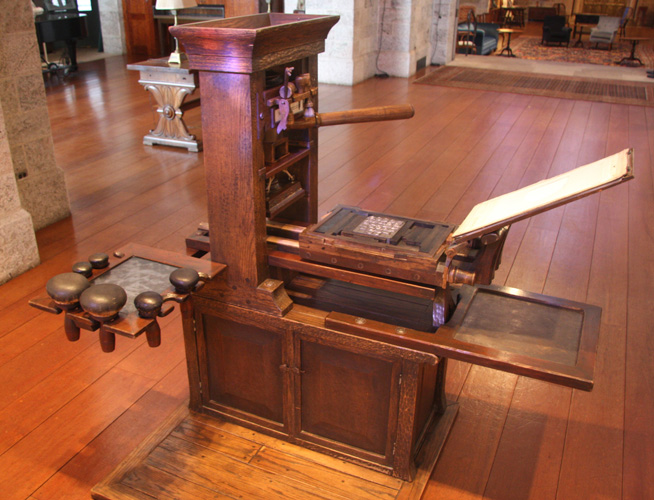
Overview: What Was the Printing Press?
The term “printing press” covers a set of technologies and practices that allowed for the mechanical reproduction of text and images. Its core components included movable type (individual characters cast from metal), an ink suitable for paper, a press mechanism to transfer ink from type to paper, and a standardized workflow for type-setting, proofing, and reproduction.
Gutenberg’s innovation (c. 1436–1450s) combined several technical improvements: the use of durable oil-based ink, an adjustable screw press adapted from agricultural and wine presses, and the development of an alloy for type that balanced durability with castability. While Gutenberg did not invent printing—block printing and other methods existed earlier in East Asia—his European system of uniformly cast, reusable movable type enabled high-volume book production economically and reliably.

Technical Foundations: How Movable Type Worked
Materials and tools
– Type metal: a lead–tin–antimony alloy, chosen for durability and fine detail.
- Punches and matrices: punches (steel rods with a carved letter) produced matrices (molds) into which type metal was cast.
- Composing stick and type cases: printers set text letter-by-letter into a composing stick, then assembled lines into formes.
- Printing press mechanism: a wooden screw press applied downward pressure to transfer ink to paper evenly.
- Oil-based inks and rollers: inks made from soot and oil adhered to metal type and paper better than water-based pigments.
- Proofing and correction: printers pulled proofs and corrected mistakes before large runs.
- Printing: ink applied to type; paper placed on tympan and bed; press applied pressure to transfer ink.
- Drying and binding: sheets were folded, gathered, stitched, and bound—often with wood or leather covers.
- Venice became a major hub because of trade networks, a commercial culture, and demand for legal, classical, and humanist texts.
- Paris and Oxford concentrated on university and theological works.
- Smaller towns adopted presses for administrative and vernacular uses, increasing reach into provincial society.
- Data point: Although precise literacy figures vary, historians link the availability of cheap printed primers and religious tractates to rising basic literacy in the 16th–17th centuries.
- East Asia: Block printing was longstanding; movable type experiments (e.g., Korean metal type, circa 13th–15th centuries) preceded Gutenberg but served different textual economies and scripts.
- Ottoman and Arabic worlds: Printing faced debates over script, religious authority, and monopolies; the first Ottoman press in the 18th century was slow to gain acceptance.
- Colonial contexts: Missionary presses produced grammars, dictionaries, and translations that both preserved and transformed indigenous languages; colonial administrations used print for governance and control.
- Gutenberg Bible digital facsimiles: access copies at major libraries (e.g., Library of Congress, British Library).
- Project Gutenberg: free digital editions of many early modern texts.
- Early English Books Online (EEBO): comprehensive digital scans of works printed in English 1473–1700 (institutional access).
- Europeana and Gallica: European digitized collections with printed materials and pamphlets.
- Elizabeth Eisenstein, The Printing Press as an Agent of Change — foundational analysis of print’s cultural effects.
- Adrian Johns, The Nature of the Book — study of print, authorship, and the scientific revolution.
- Andreas Vesalius and early scientific printers: consult specialized works on early printed scientific atlases.
- Use bibliographies in major monographs to identify primary pamphlets and editions.
- Cross-reference information: printing dates and places can be disputed—consult library catalogs and incunabula databases (e.g., Incunabula Short Title Catalogue).
- When using secondary sources, look for methodological debates (e.g., Eisenstein vs. Johns) to frame your argument about print’s effects.
- Image: Early printing press reconstruction — Alt text: “Reconstructed 15th-century screw press used to print early books.”
- Image: Sixteenth-century pamphlet table — Alt text: “Array of sixteenth-century pamphlets displaying varying sizes and woodcut illustrations.”
- Image: Incunabula type case — Alt text: “Wooden type case with compartments for individual metal type sorts.”
- “history of medieval literacy” — link to your site’s article on literacy in the Middle Ages.
- “Reformation primary sources” — link to a page compiling Reformation pamphlets and translations hosted on your site.
- “digital facsimiles of rare books” — link to a collection or resource page with scanned early printed books.
- Incunabula Short Title Catalogue (British Library) — for bibliographic records.
- Library of Congress Gutenberg Bible digital copy — for a high-resolution facsimile.
- Project Gutenberg — for public-domain texts and further reading.
- Early English Books Online (EEBO) — for researchers with institutional access.
- Suggested social image: stylized collage of a Gutenberg Bible leaf, a screw press, and a pamphlet—1200×630 px for optimal Facebook/Twitter preview.
- Meta description (150–160 chars): “Explore how Gutenberg’s printing press transformed literacy, science, religion, and politics in early modern Europe and beyond.”
Workflow: From type to book
1. Composition: individual types were placed by hand into lines and then into a frame (forme).
The Invention’s Context: Pre-Printing Book Culture
Before movable type, books were laboriously copied by hand in scriptoria (monastic copying rooms) or produced via block printing in parts of Asia. Manuscripts were expensive, rare, and largely confined to ecclesiastical and elite scholarly communities. Oral culture and localized knowledge networks predominated.
Gutenberg’s system lowered the production cost of books dramatically. Where a single manuscript could take months of skilled copying, a printed folio could be produced in far greater numbers in weeks. That shift changed not only availability but also the economics of knowledge.
Spread of Printing: From Mainz to the World
Early diffusion across Europe
After the first presses in Mainz (Germany) in the 1450s, printing spread quickly. By 1500, presses existed in more than 200 European cities, including Venice, Paris, Augsburg, and London.
Printing beyond Europe
Printers introduced movable type to other regions via trade, missionaries, and colonial enterprises. China and Korea had earlier movable type experiments, but Gutenberg’s metal type and press uniquely transformed European book culture. The technology later diffused globally—through missionaries printing in indigenous languages, colonial administrations issuing documents, and local entrepreneurs adapting press technology to local scripts.
Major Social and Cultural Impacts
1. Rise in literacy and education
Printed books expanded access to reading material. Schools and universities benefited from standardized textbooks and commentaries, while vernacular editions of literature and devotional works encouraged literacy among broader social strata.
2. Standardization of language and texts
Printed texts favored particular dialects and orthographies. Over time, repeated editions consolidated grammar, spelling, and vocabulary, contributing to the emergence of national languages (e.g., Early Modern English, Castilian Spanish).
3. Acceleration of scientific communication
Printing allowed scholars to circulate observations, experiment reports, and critiques beyond small correspondence networks. The printed book and, later, scientific journals enabled peer scrutiny and cumulative progress—foundational to the Scientific Revolution.
4. Political and religious transformation
Printed pamphlets, broadsheets, and booklets became powerful political tools. The rapid dissemination of Martin Luther’s 95 Theses (1517) and subsequent pamphlets exemplifies how printing amplified dissent. Printing facilitated mass persuasion, mobilization, and the spread of reformist ideas.
Case Studies: Concrete Examples of Print’s Power
The Gutenberg Bible (c. 1455)
The Gutenberg Bible—often cited as the first major book printed with movable type in Europe—demonstrated the press’s capabilities for producing beautiful, uniform texts. While Gutenberg’s business ventures faced legal and financial troubles, surviving copies show meticulous typography and layout designed to emulate manuscript aesthetics.
Martin Luther and the Reformation
Luther’s pamphlets and vernacular Bible translations spread through Germany and beyond thanks to printing. Pamphlets were cheap, portable, and designed to be read aloud in public spaces. Print made theological debate public, enabling laypeople to engage directly with scriptural arguments.
Scientific Republic of Letters and the Royal Society
Early scientific societies and journals—such as the Philosophical Transactions (founded 1665)—used printed periodicals to share experimental results and replicate findings. Print fostered networks of critique and verification central to modern scientific methodology.
Economic Effects: New Industries and Labor Changes
Printing created new professions—type-founders, compositors, pressmen, binders—and stimulated related industries like papermaking and bookbinding. Centers of printing often connected to other commercial activities, reinforcing urban economic growth.
The economics of book production also shifted patronage patterns. While patronage and church sponsorship remained important, the market for books grew. Publishers began to invest in popular works with expected returns, introducing early market-driven considerations into intellectual life.
Politics, Power, and Censorship
Governments and religious authorities recognized print’s capacity to shape public opinion. Censorship systems emerged: licensing, book bans, and the Index Librorum Prohibitorum in Catholic Europe. Yet censorship often produced counter-strategies—underground presses, anonymous pamphlets, and smuggling—that testify to the difficulty of fully controlling printed information.
Print and the Formation of Collective Memory
Printed chronicles, newspapers, and pamphlets became tools for recording and shaping historical narratives. Politically charged events—wars, revolutions, trials—were documented in print and thus remembered according to the accounts that circulated most widely. This “print memory” influenced national myths and identity formation.
Long-Term Cultural Shifts: From Manuscript Culture to the Modern Public Sphere
Jürgen Habermas and other theorists linked the rise of print culture to the emergence of a “public sphere”—a space where citizens could debate and form public opinion. Coffeehouses, reading clubs, and salons, fueled by printed materials (newspapers, pamphlets, periodicals), created forums for cross-class and intellectual exchange. This transformation contributed to the conditions for democratic discourse, though access remained uneven and contested.
Global Perspectives: Non-European Print Histories
While European printing catalyzed the modern Western information culture, other regions experienced unique print trajectories:
Resources for Students: Primary Sources, Archives, and Suggested Readings
Primary sources and digital repositories are invaluable for studying print history:
Suggested scholarly works:
Practical Research Tips for Students
1. Start with digital facsimiles to examine typography, colophons, and printers’ marks—these reveal production data and location information.
Frequently Asked Questions (FAQ)
Was Gutenberg the inventor of the printing press?
Gutenberg did not invent printing as a whole—block printing and earlier movable type existed in East Asia. His achievement was a specific combination of techniques (metal movable type, oil-based ink, press mechanism) that made economical mass production of books feasible in Europe.
How fast did printing spread in Europe?
Remarkably fast: within 50 years of Gutenberg’s first books, printing presses existed in hundreds of European towns and cities. The spread was aided by trade routes, university networks, and demand for religious, legal, and humanist texts.
Did printing immediately democratize knowledge?
Not immediately. Print reduced costs and increased availability, but literacy, education, and economic barriers still limited access. Over time, however, the cumulative effect of cheaper books, schooling, and vernacular publication broadened readerships significantly.
What is an “incunabulum”?
An incunabulum (plural: incunabula) refers to books printed before 1501, the early “cradle” period of European printing. These works are especially valuable for studying early print practices and formats.
Image Suggestions and Alt Text for Web Publication
– Image: Gutenberg Bible leaf — Alt text: “Illuminated leaf from the Gutenberg Bible showing blackletter type and rubrication.”
SEO Recommendations: Keywords, Internal & External Linking
Recommended primary keywords to use naturally (target 1–2% density across 2,500–3,000 words): printing press, Gutenberg, history of printing. Secondary/LSI keywords: movable type, Gutenberg Bible, print culture, incunabula, history of books, Reformation printing, early modern print.
Suggested internal links (anchor text ideas):
Suggested external authoritative links (open in new window):
Schema Markup Recommendation
Use Article schema with properties: headline, description, author, datePublished, image, mainEntityOfPage, and keywords. Add Publisher with logo and use sameAs links to authoritative social profiles. For FAQs, implement FAQPage schema with each question and answer to target featured snippets.
Social Sharing Optimization
– Recommended share text: “How the Printing Press Changed the World: Gutenberg, Print Culture, and the Rise of Modern Knowledge.”
Conclusion
The printing press was more than a technological breakthrough—it was a catalyst for societal transformation. By lowering the cost of copying and enabling wide distribution, printing reshaped literacy, language, science, religion, and politics. Students and history enthusiasts studying the press learn not only about a machine but about the profound ways technologies alter communication, authority, and collective memory. Whether you explore incunabula in a digital archive, examine Luther’s pamphlets, or trace the origins of scientific journals, print history reveals the roots of our modern information environment.
Key takeaways: The printing press democratized access to texts over time, standardized languages, enabled the Scientific Revolution and the Reformation, stimulated new economic networks, and created both opportunities and conflicts around censorship and control. For further study, consult primary sources (digital facsimiles), foundational scholars (Eisenstein and Johns), and major repositories (Library of Congress, British Library, EEBO).
Interested in teaching resources or primary-source lesson plans about the printing press? Sign up for our newsletter to receive curated primary sources, classroom-ready activities, and annotated bibliographies tailored for students and history enthusiasts.