
Unveiling Hidden Empires: Modern Archaeology’s Discoveries of Ancient Civilizations
For centuries, our understanding of ancient civilizations was largely confined to what was visible on the surface or recorded in surviving texts. But today, a revolution is underway. Modern archaeology, powered by cutting-edge technology and innovative methodologies, is literally peering through jungles, beneath deserts, and into the earth itself to uncover long-lost cities, vast networks, and entire cultures previously unknown or vastly underestimated. These “hidden empires” are not just tales of forgotten kings; they are windows into the incredible complexity, ingenuity, and diverse paths taken by human societies across millennia, forcing us to continually rewrite the story of our shared past.

What Makes an Empire “Hidden”?
When we talk about “hidden empires” in archaeology, we’re not always referring to civilizations deliberately concealed or magically vanished. Often, these are societies that were simply lost to the relentless march of time, swallowed by dense vegetation, buried under layers of sediment, or erased from collective memory. For decades, archaeologists relied on traditional methods: surveying visible ruins, interpreting historical documents, and painstakingly excavating by hand. While invaluable, these approaches had significant limitations. Vast areas remained unexplored, dense forests obscured monumental structures, and the sheer scale of ancient urbanism was often underestimated.
A hidden empire might be one whose existence was barely hinted at in myths or obscure texts, like the legendary city of El Dorado, now being re-evaluated in light of Amazonian discoveries. Or it could be a civilization whose true scale and sophistication were completely unknown until advanced technology provided an “aerial view,” revealing sprawling cities where only small village sites were once suspected. These discoveries challenge our preconceived notions of where and when complex societies emerged, demonstrating that human innovation was far more widespread and diverse than previously imagined.

The Technological Revolution in Archaeology: Eyes That See Beyond
The dramatic shift in our ability to find and understand these lost worlds is largely thanks to a suite of revolutionary technologies. Archaeology, once a field of trowels and brushes, has transformed into a high-tech science, integrating remote sensing, data analytics, and environmental studies.

Eyes in the Sky: Satellite Imagery and Lidar
Perhaps the most transformative tool in modern archaeology is Lidar (Light Detection and Ranging). Mounted on aircraft or drones, Lidar systems emit millions of laser pulses toward the ground. These pulses penetrate dense forest canopies, reflecting off the actual ground surface and any structures present. By filtering out the vegetation, archaeologists can create incredibly detailed 3D maps of the terrain, revealing hidden roads, buildings, agricultural terraces, and defensive fortifications that have been obscured for centuries.
Satellite imagery, too, plays a crucial role. High-resolution photos from space can pinpoint subtle changes in vegetation or soil color that indicate buried structures. Thermal imaging can detect ancient walls or roads that retain heat differently than their surroundings. These “eyes in the sky” allow researchers to survey vast, inaccessible areas rapidly and non-invasively, identifying potential sites for further investigation and providing a macro-level understanding of ancient landscapes before ever setting foot on the ground.
Beneath the Surface: Ground-Penetrating Radar (GPR) and Magnetometry
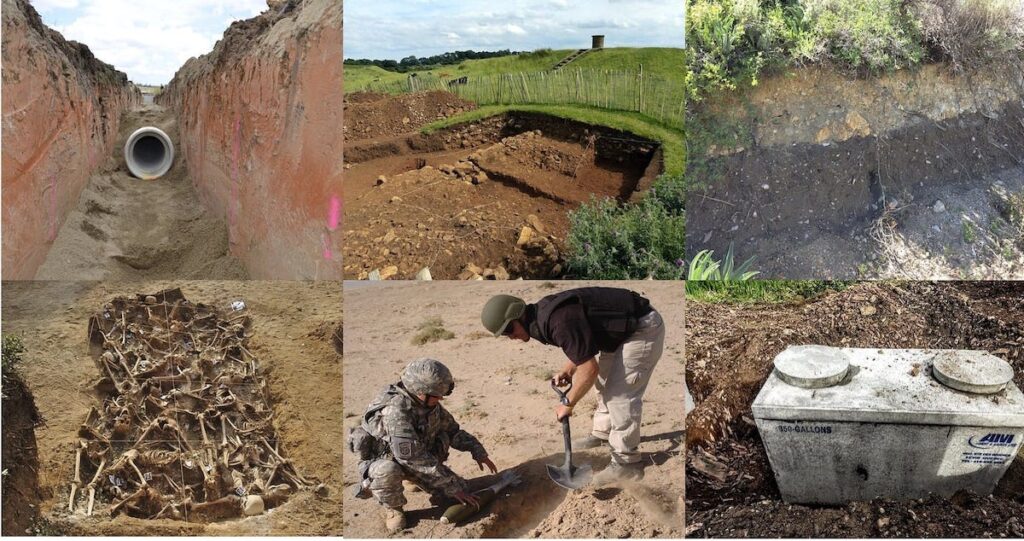
Once a promising area is identified, archaeologists can deploy Ground-Penetrating Radar (GPR). This technology sends electromagnetic pulses into the ground and measures the reflections. Different materials — soil, rock, ancient walls, buried artifacts — reflect these pulses differently, allowing researchers to create a subsurface “map” without digging. GPR can reveal the layout of buried buildings, roads, and even graves, guiding targeted excavations and preserving the integrity of the site.
Magnetometry works on a similar principle, detecting subtle variations in the Earth’s magnetic field caused by buried features. Features like kilns, hearths, or even ancient ditches filled with different soil types can leave a magnetic signature. Both GPR and magnetometry are invaluable for understanding the internal organization of a site, helping to plan excavations and interpret the function of different areas.

Data & AI: Computational Archaeology
The sheer volume of data generated by Lidar, satellite imagery, and geophysical surveys would be overwhelming without advanced computational tools. Artificial intelligence (AI) and machine learning algorithms are now being employed to process these massive datasets, identify subtle patterns, and even predict the location of new sites based on known environmental and cultural factors. AI can analyze historical maps, ancient texts, and environmental data to create predictive models, guiding archaeologists to areas with high potential for discovery. This integration of big data and AI is accelerating the pace of discovery and allowing for a more holistic understanding of ancient human-environment interactions.
Environmental Archaeology: Unlocking Climate Clues
Beyond finding physical structures, modern archaeology deeply integrates environmental science. Paleobotany (the study of ancient plants), zooarchaeology (the study of ancient animal remains), and sediment analysis provide crucial insights into ancient diets, agricultural practices, climate patterns, and how ancient societies adapted to or impacted their environments. Analyzing pollen, seeds, bones, and soil layers can reveal shifts in climate, deforestation, irrigation systems, and even the causes of a civilization’s collapse. This interdisciplinary approach paints a much richer picture of life in ancient times, connecting human history with ecological history.
Remarkable Discoveries: Unearthing Lost Worlds
With these new tools, archaeologists are uncovering breathtaking evidence of complex societies across the globe, forcing us to redraw maps and timelines of human civilization.
The Maya Lowlands: A Megalopolis Revealed
For decades, scholars believed that the ancient Maya civilization in Mesoamerica consisted primarily of scattered city-states within a largely pristine jungle. However, recent Lidar surveys have utterly transformed this understanding. In Guatemala, researchers using Lidar penetrated the dense canopy of the Mirador Basin and other regions, revealing an astonishing network of interconnected cities, towns, and villages. What was once thought to be a collection of independent centers is now understood as a vast, interconnected megalopolis, home to millions of people.
These surveys have unveiled elaborate road systems, massive agricultural terraces, complex irrigation canals, and extensive defensive structures, all hidden beneath centuries of jungle growth. Sites like El Mirador, once known for its colossal pyramids, are now revealed as part of an urban sprawl far larger and more sophisticated than previously imagined, with sophisticated engineering designed to support an enormous population. This discovery not only expands the known scale of Maya civilization but also highlights their incredible mastery of landscape management and urban planning.
Greater Angkor: A Sprawling Hydraulic City
Similarly, the iconic temples of Angkor Wat in Cambodia, a UNESCO World Heritage site, were long admired as isolated architectural marvels. Yet, Lidar scans of the surrounding landscape, particularly by the Greater Angkor Project, have uncovered the true extent of this ancient Khmer empire’s urban footprint. What was revealed was not just a collection of temples, but a sprawling, low-density megacity that stretched for over 1,000 square kilometers, supporting an estimated population of up to a million people.
The Lidar data exposed an intricate, city-wide hydraulic system — a vast network of canals, reservoirs, and embankments — designed to manage monsoon floods and provide water for agriculture and consumption throughout the year. This sophisticated water management infrastructure allowed Angkor to sustain its enormous population and agricultural output, demonstrating an unparalleled level of engineering and societal organization for its time. The discovery radically changed our perception of Angkor, from a religious center to a truly integrated urban and agricultural landscape.
Caral-Supe: South America’s Earliest City
In the arid Supe Valley of Peru, the ancient city of Caral stands as a testament to early urbanism in the Americas, pushing back the timeline for complex societies in the region by over a millennium. Discovered in the early 20th century but only extensively excavated and recognized for its significance in the late 20th and early 21st centuries, Caral-Supe is now considered the oldest known city in the Americas, predating the Olmecs of Mesoamerica.
Dating back to approximately 2600 BCE, Caral features monumental stone and earthen pyramids, ceremonial plazas, and residential complexes. What makes Caral particularly intriguing is its pre-ceramic nature – its inhabitants built monumental architecture and developed a complex society without the aid of pottery or extensive warfare, focusing instead on trade (especially for marine resources) and possibly religious authority. Its discovery challenged the prevailing view that complex societies in the Andes developed later and were primarily influenced by later coastal cultures, establishing Caral as a foundational center of Andean civilization.
Göbekli Tepe: Redrawing the Dawn of Civilization
Perhaps no single site has shaken our understanding of human history quite like Göbekli Tepe in southeastern Turkey. Discovered in 1994 and extensively excavated since, this site consists of massive, intricately carved stone pillars arranged in circular enclosures, dating back to around 9600 BCE – more than 6,000 years before Stonehenge and long before the advent of agriculture.
Göbekli Tepe was built by hunter-gatherers, a fact that upends the long-held belief that monumental architecture and complex social organization only emerged after the development of settled agricultural societies. It suggests that the desire for communal ritual and possibly religious belief might have been a driving force for early human cooperation and settlement, rather than a consequence of it. The sheer scale and sophistication of its construction, requiring significant labor and coordination from pre-agricultural communities, forces us to rethink the very origins of civilization, religion, and the human capacity for collective endeavor.
The Indus Valley Civilization: Reconsidering Harappan Urbanism
The Indus Valley Civilization, also known as the Harappan Civilization, flourished in what is now Pakistan and northwest India from around 2500 to 1900 BCE. While its major cities like Mohenjo-Daro and Harappa have been known for decades, modern archaeological methods are continually refining our understanding of its vast extent, sophisticated urban planning, and eventual decline. New excavations at sites like Rakhigarhi, one of the largest Harappan sites, are revealing more about their advanced drainage systems, grid-planned cities, and extensive trade networks that stretched to Mesopotamia.
Crucially, environmental archaeology is shedding new light on the civilization’s collapse. Climate studies indicate a prolonged drought around 4,200 years ago likely played a significant role, disrupting their agricultural base and leading to a gradual decline and migration. This research offers vital lessons about climate change and societal resilience, showing how even highly advanced civilizations are vulnerable to environmental shifts.
Lost Cities of the Amazon: The Casarabe Culture
For centuries, the Amazon rainforest was largely considered a pristine wilderness, home only to small, nomadic tribes. This perception is rapidly changing thanks to Lidar technology. Recent discoveries in the Llanos de Mojos region of Bolivia have revealed the remnants of a sophisticated urban society, the Casarabe culture, which flourished between 500 and 1400 CE.
Lidar scans have uncovered extensive networks of settlement mounds, monumental earthworks, interconnected reservoirs, and causeways stretching for kilometers. These structures suggest a highly organized society capable of large-scale landscape engineering to manage water resources and facilitate transportation across the seasonally flooded plains. The Casarabe culture built impressive ceremonial centers with pyramid-like structures and defensive palisades, demonstrating a level of complexity and population density in the Amazon far beyond what was previously imagined. These findings are dismantling the myth of the “unspoiled” Amazon and revealing a long history of human intervention and sophisticated environmental adaptation in the basin.
Why Do These Discoveries Matter?
These revelations are more than just fascinating historical footnotes; they profoundly impact our understanding of humanity’s journey.
Rewriting History Books
Every new hidden empire uncovered forces us to revise our historical narratives. They challenge Eurocentric biases, demonstrating that complex societies emerged independently and in diverse forms across the globe, not just in a few “cradles of civilization.” These discoveries extend the timeline of human innovation, showing that monumental architecture, urban planning, and sophisticated social structures existed far earlier and in unexpected places.
Understanding Human Resilience and Adaptation
Studying how ancient civilizations managed resources, adapted to climate change, and organized their societies offers invaluable lessons for our present and future. From the Maya’s sustainable agriculture to Angkor’s hydraulic engineering, these past societies grappled with challenges eerily similar to our own. Their successes and failures provide case studies in human resilience, adaptation, and the delicate balance between human activity and the environment.
Preserving Our Shared Heritage
The identification of these hidden sites underscores the urgent need for preservation. Many of these ancient landscapes are threatened by modern development, logging, agriculture, and climate change. By accurately mapping and understanding their extent, archaeologists can advocate for their protection, ensuring that these invaluable chapters of human history are not lost forever. Protecting these sites means preserving the tangible evidence of our shared past and the diverse legacies of human ingenuity.
The Future of Archaeological Exploration
The era of hidden empires is far from over. With less than 10% of the Earth’s land surface archaeologically surveyed, the potential for new discoveries remains immense. The future of archaeology will likely see even greater integration of AI, machine learning, and advanced remote sensing, allowing us to process data faster and more accurately. Citizen science, engaging local communities and enthusiasts, will also play an increasingly important role in identifying and protecting sites.
The ongoing quest to uncover these lost worlds is a testament to human curiosity and our innate desire to understand where we come from. Each new discovery is a puzzle piece added to the grand mosaic of human history, revealing the incredible diversity and complexity of our ancestors.
The Enduring Quest
From the depths of the Amazon to the jungles of Southeast Asia, modern archaeology is constantly expanding our understanding of ancient civilizations. These hidden empires, once merely whispers in the wind or invisible beneath the earth, are now being brought into sharp focus, revealing a past far richer, more complex, and more interconnected than we ever imagined. They remind us that history is not a static record but a living, evolving narrative, continuously reshaped by our relentless pursuit of knowledge. The story of humanity is still being written, and with every new technological advance, another lost chapter is revealed.
Explore hidden empires with our interactive timeline and journey through the incredible discoveries that are redefining our understanding of ancient civilizations.