
Forbidden Archaeology Discoveries: Shocking Finds That Defy Historical Narratives
What if everything you’ve been told about human history is only half the story? Imagine uncovering a perfectly machined metal gear from a 2,000-year-old shipwreck, or a hammer encased in rock that’s supposedly 400 million years old. These aren’t the makings of a fantasy novel — they’re real artifacts that sit in museums and private collections, quietly challenging the bedrock of mainstream archaeology. Welcome to the captivating, often infuriating world of forbidden archaeology, where controversial discoveries are brushed aside as anomalies, and those who dare to question the timeline are met with academic stonewalling.
If you’re a history buff who loves peering behind the curtain, or a conspiracy enthusiast who suspects that the truth is being deliberately obscured, you’re in for a treat. We’re going to dig into some of the most mind-bending finds that just don’t fit the official narrative. These aren’t fringe rumors — they are physical specimens, maps, and texts that suggest advanced civilizations may have walked the earth long before we ever imagined. But be warned: once you start down this rabbit hole, you might never look at a history textbook the same way again.
So grab your mental shovel, because we’re excavating the suppressed history that could rewrite everything we know about humanity’s past — and we’ll even look at the debunked theories explanations skeptics cling to. The question is, are you ready to question the official story?

What Is Forbidden Archaeology and Why Does It Matter?
Let’s start by clearing the ground. The term “forbidden archaeology” was popularized by researchers Michael Cremo and Richard Thompson in their doorstop of a book, Forbidden Archeology: The Hidden History of the Human Race. Their central premise is simple: the scientific establishment systematically ignores or suppresses evidence that contradicts the dominant evolutionary paradigm. If a discovery hints at anatomically modern humans walking with dinosaurs, or metal tools in rock layers millions of years old, it’s almost guaranteed to be mocked, dismissed, or literally buried in the back rooms of institutions.
Why does this matter to you? Because the history we learn in schools shapes our entire understanding of human capability. If our ancestors possessed technologies we can’t fully explain, or if we’re far older than we’ve been led to believe, then the story of civilization — from the Stone Age to spaceflight — starts to look more like a cycle of rise and fall, not a straight line of progress. Forbidden archaeology forces us to ask: What else haven’t they told us?

The Top 7 Forbidden Archaeology Discoveries That Will Blow Your Mind
Beneath the well-swept floors of accepted history, these controversial discoveries cry out for explanation. Read on, but keep an open mind — the truth may be stranger than fiction.

1. The Antikythera Mechanism — An Ancient Computer?
In 1901, sponge divers off the Greek island of Antikythera hauled up a corroded lump of bronze from a 2,000-year-old Roman-era shipwreck. When scientists finally peered inside decades later using X-ray tomography, they couldn’t believe their eyes: a complex clockwork device with over 30 interlocking gears, differential gears, and an intricate system of pointers and inscriptions. It’s now understood to be an analog computer that calculated astronomical positions, eclipses, and even the four-year cycle of the Olympic Games. Mainstream archaeology maintains the technology for such precision didn’t re-emerge until 14th-century Europe. So, was this a one-off genius invention, or a remnant of a lost mechanical tradition? The Antikythera Mechanism sits comfortably in the Athens National Archaeological Museum, while the question of who truly built it remains deeply unsettling.
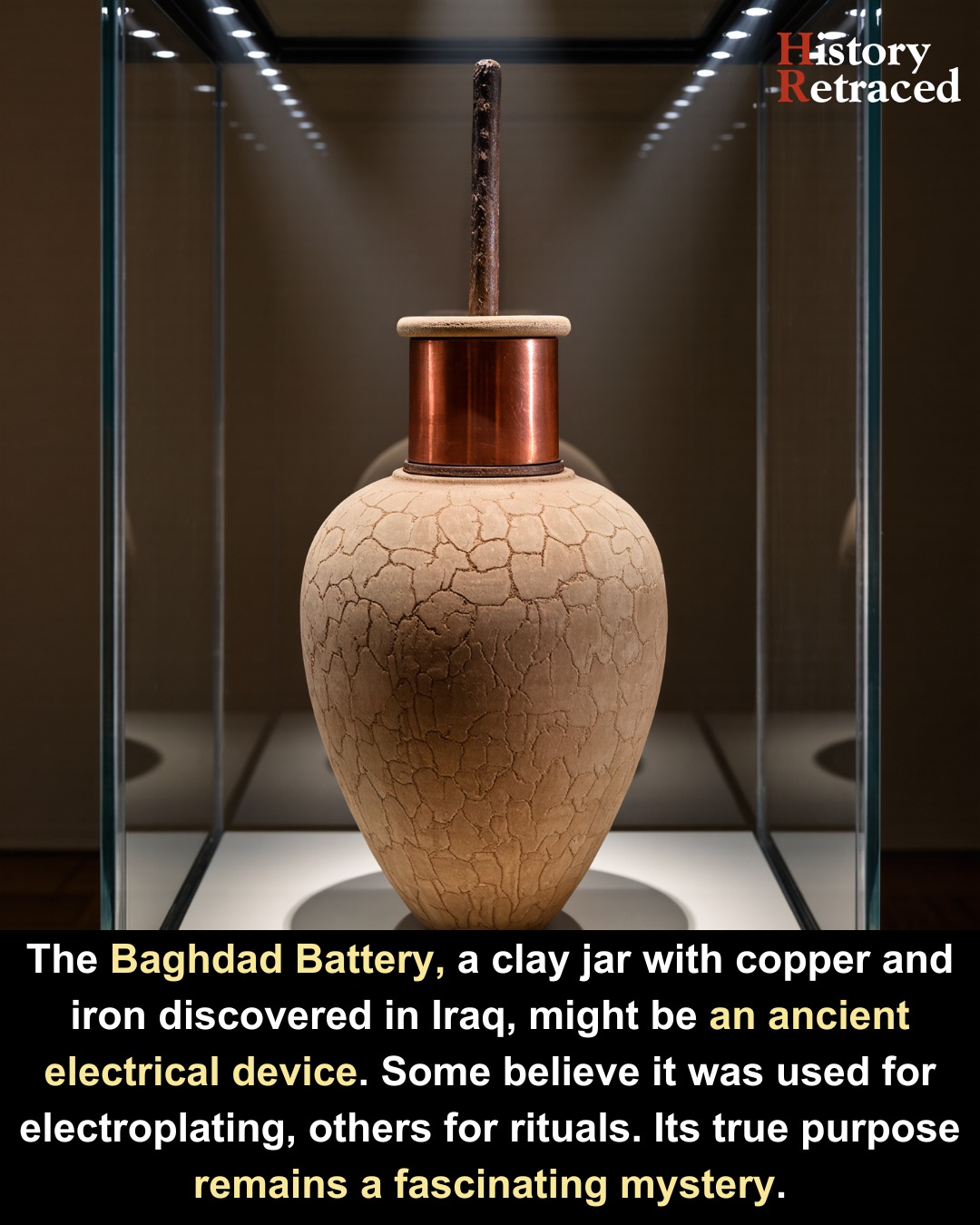
2. The Baghdad Battery — Electricity 2,000 Years Ago?
In the 1930s, a peculiar small clay jar was found near Baghdad, containing a copper cylinder and an iron rod suspended inside, sealed with asphalt. When filled with an acidic liquid like vinegar or grape juice, it can produce a small electrical charge — yes, a 2,000-year-old battery. While some experts insist it was merely a scroll container or a mystical amulet, replicas have generated up to 2 volts. If ancient Mesopotamians harnessed electricity, what did they use it for? Electroplating jewelry? Religious experiences where a god’s statue “shocked” worshippers? The mainstream dismisses the battery as a gimmick, but the artifact is real, and it works. You can find a replica at the Baghdad Museum (whenever it reopens) and plenty of YouTube channels recreating the effect.
3. The Piri Reis Map — Antarctica Without Ice?
In 1929, a 16th-century Ottoman admiral’s map was discovered in Istanbul. Compiled by Piri Reis, it shows the west coast of Africa, the east coast of South America, and — astonishingly — the northern coastline of Antarctica. But here’s the catch: Antarctica wasn’t officially discovered until 1820, and its coast under the ice wasn’t mapped until the 20th century using ground-penetrating radar. Piri Reis himself wrote that he used source maps from ancient mariners, possibly from the Library of Alexandria. Does this mean a pre-ice-age civilization charted the continent? Skeptics argue the “Antarctica” part is just a fanciful depiction of South America’s tip, but the geographical accuracy remains uncanny. This map is kept at the Topkapı Palace in Istanbul, waiting for an explanation that doesn’t involve rewriting polar history.
4. The Giant of Castelnau — Real-Life Giants?
During the 1890s, anthropologist Georges Vacher de Lapouge unearthed three fragments of a human femur and a humerus at a Bronze Age cemetery in Castelnau-le-Lez, France. The bones were so enormous that they suggested an individual between 11 and 12 feet tall. These aren’t tall tales from a tabloid — Lapouge’s findings were published in the respected journal La Nature in 1890, and the bones were studied by other scientists before vanishing from public view. If giants walked among us, why are they erased from human history? The mainstream attributes the bones to a very rare case of gigantism, but multiple independent reports of giant skeletons in other parts of the world hint at something more systematic. Today, the remnants are lost, leaving only a few photos and sketches to fuel the debate.
5. The Ica Stones — Dinosaurs and Humans Together?
Dr. Javier Cabrera Darquea amassed over 15,000 engraved andesite stones from the Ocucaje desert in Peru, depicting scenes that directly challenge the geologic timeline. Many show humans interacting with dinosaurs — some riding them, others fighting them, and a few performing medical procedures on them. Other engravings illustrate advanced telescopes, open-heart surgery, and star maps. The standard dismissal is that local farmers carved them to sell to gullible tourists, but Cabrera argued that the sheer volume and detailed anatomical knowledge point to a genuine ancient record. If just a handful of these stones are authentic, it would mean humans and non-avian dinosaurs coexisted. That’s the kind of idea that gets you labeled a crackpot, but the stones exist, and they’re still being studied today at the private Ica Stones Museum in Peru.
6. The Dropa Discs — Alien Encounter in Ancient China?
In 1938, Chinese archaeologist Chi Pu Tei allegedly discovered a series of stone discs inside a cave system in the Bayan Har Mountains near Tibet. The discs, up to 12 inches in diameter with a central hole, were covered in tiny, spiral grooves of microscopic hieroglyphics. When decoded (so the story goes), they told the tale of a spacecraft that crashed in the region 12,000 years ago, piloted by beings called the Dropa. The local population, unfamiliar with these visitors, hunted them down, though a few reportedly survived. Mainstream archaeologists dismiss the Dropa discs as a complete hoax — the discs themselves have never been produced for public examination. Yet the story persists because of the tantalizing what-if: if pre-modern people witnessed extraterrestrial visitors, wouldn’t the evidence be hidden away to preserve order?
7. The London Hammer — An Out-of-Place Artifact in Cretaceous Rock
In 1936, Max and Emma Hahn discovered a wooden-handled hammer protruding from a chunk of rock near London, Texas. The rock was dated to the Cretaceous period, roughly 100 million years old, yet the hammer head itself is composed of 96% iron, a purity typical of modern smelting. The wooden handle has partially turned to coal, indicating great age. The artifact is owned by the Carl Baugh Creation Evidence Museum, which uses it to argue for a young Earth. A mainstream analysis suggests the hammer is a 19th-century miner’s tool that got concreted in very old rock due to natural chemical processes — a case of rapid geological formation rather than extreme antiquity. Still, the London Hammer remains one of the most famous out-of-place artifacts (OOPArts) that continues to stir heated debate.
The Academic Wall: Why Are These Finds Suppressed?
So why don’t your favorite history podcasts and museum exhibits feature such remarkable objects? The uncomfortable truth is that academia operates on a paradigm — a set of rules and assumptions that very few are willing to break. Thomas Kuhn, a philosopher of science, described how “normal science” resists novelties that undermine the existing framework. A tenured professor who stakes her career on the Out-of-Africa migration model, for instance, isn’t eager to entertain giant skeletons that suggest an entirely different branch of hominids. Research funding, publication, and reputation all depend on reinforcing the consensus.
Moreover, when an artifact can’t be explained by the known timeline, it’s often branded a “ritual object” (the classic dustbin category) or dismissed as a hoax without rigorous re-examination. Andrew Collins, a popular alternative historian, argues that a culture of ridicule prevents junior researchers from touching these subjects. To question the official story is to commit professional suicide. And so the artifacts gather dust, their true potential hidden.
The Skeptic’s Counterpoint: Debunked Theories or Convenient Explanations?
Now, let’s pull back the lens and engage the skeptics — because healthy debate makes the truth sharper. For each of our seven wonders, there is a well-worn debunking:
- Antikythera Mechanism: It’s simply a brilliant outlier; ancient Greeks were known for mechanical genius (Archimedes), and no other similar devices exist because they were rare and valuable, later melted down for metal.
- Baghdad Battery: It probably wasn’t used as a battery; the iron rod and copper cylinder arrangement could be an accident, and no conductive wiring was found.
- Piri Reis Map: The “Antarctica” coastline is likely a distorted, but understandable, representation of South America’s southern cone — map-making errors squished it to the south.
- Giant of Castelnau: Gigantism as a medical condition can produce extraordinary bone lengths; the individual was just an unusually tall person, not a member of a giant race.
- Ica Stones: They are modern forgeries. Farmers in the region have confessed to carving and aging the stones to sell to Cabrera. The patina is superficial.
- Dropa Discs: There is no verifiable evidence the discs ever existed. Chi Pu Tei is a shadowy figure, and the “translation” comes from a questionable source.
- London Hammer: Concretion can happen rapidly around a 19th-century tool; the Cretaceous dating applies to the rock, not the hammer embedded in it.
These rebuttals are tidy, aren’t they? Yet they often ignore nagging details: the Baghdad jar duplicates produce electricity and were found in contexts seemingly unrelated to storage. The Piri Reis map correctly shows the Andes, which weren’t well-mapped in 1513. The London Hammer’s wood handle defies simple modern origin because of the coal-like carbonization. A skeptic’s dismissal can be just as dogmatic as a believer’s acceptance, and that’s why forbidden archaeology remains a battlefield, not a settled case.
How to Dig Deeper (No Shovel Required)
If your curiosity is now fully ablaze, you’re ready to become an explorer of suppressed history. Start by visiting the museums that dare to display these anomalies (yes, many are privately owned). Seek out first-hand sources: the Antikythera Mechanism can be eyeballed at the National Archaeological Museum in Athens, and replicas of the Baghdad Battery are viewable at the Pergamon Museum in Berlin (when on display). Books like Cremo’s Forbidden Archeology or Graham Hancock’s Fingerprints of the Gods provide tons of case studies that will keep your bedside lamp burning late into the night.
But the most rewarding path is to join a community of inquisitive minds. Sitting alone with a controversial book can feel like shouting into the void — connect with others who question the narrative. Together, you can sift claims, share obscure museum finds, and maybe even uncover the next big forbidden discovery.
Frequently Asked Questions About Forbidden Archaeology
Q: Is “forbidden archaeology” a real academic discipline?
A: No, it’s a term used largely outside mainstream academia to describe artifacts and theories that are ignored or rejected by conventional archaeology and anthropology. You won’t find it listed in university course catalogs — at least, not yet.
Q: Are all forbidden archaeology discoveries