
Forbidden Archaeology: 7 Mind-Bending Discoveries That Rewrite History (Or Do They?)
Picture this: a dusty ancient workshop, and lying beneath centuries of dirt is a complex bronze mechanism with delicate gears and dials. It looks like the inner workings of a modern clock. The catch? It was built around 100 BC, over a thousand years before such mechanical wizardry was supposed to exist. This isn’t a scene from a sci-fi novel—it’s just one chapter in the shadowy world of forbidden archaeology.
You’ve probably felt it too: that nagging suspicion that the history books aren’t telling the whole story. Maybe your high school teacher glossed over a weird artifact, or you stumbled on a late-night documentary that claimed “they” don’t want you to see the truth. Welcome to the crossroads of controversial discoveries and suppressed history, where solid science collides head-on with mystery, skepticism, and the tantalizing possibility that human civilization is far older—and stranger—than we’ve been led to believe.
In this romp through the vaults of the unexplained, we’ll examine seven artifacts that have been labeled hoaxes, ignored by mainstream archaeology, or branded as debunked theories. Are they windows into a forgotten past, or just clever fakes? Grab a metaphorical shovel, and let’s dig into the secrets that dare to challenge our entire historical narrative.
—

1. The Antikythera Mechanism: An Ancient Computer That Shouldn’t Exist
When sponge divers off the Greek island of Antikythera pulled up a corroded lump of bronze in 1901, nobody paid much attention—until the lump cracked open, revealing intricate gearwheels. After decades of study, X-ray tomography finally revealed the truth: this was a sophisticated analog computer used to predict astronomical positions and eclipses with stunning accuracy. Mainstream archaeology eventually accepted it, but imagine the initial shock: here was a machine that rewrote the timeline of technological development overnight.
The controversy wasn’t just about its complexity. The real forbidden archaeology kicker? Nothing like it was supposed to appear for another 1,400 years. The mechanism pushed back the birth of geared technology so far that many experts initially dismissed it as a misidentified medieval artifact. Even today, the sheer precision of its manufacturing—down to a differential gear—hints at a knowledge base that some say must have been inherited from an even older, lost civilization. Coincidence? Or a whisper from a forgotten past that academia was slow to hear?
—

2. The Baghdad Battery: Did the Ancients Harness Electricity?
In 1938, German archaeologist Wilhelm König found a peculiar set of objects in the National Museum of Iraq: a terracotta pot, a copper cylinder, and an iron rod. When assembled and filled with an acidic liquid like vinegar or grape juice, it created a small electric current—around 0.5 to 1 volt. If that doesn’t scream “ancient power source,” what does?
The mainstream view calls the Baghdad Battery a simple storage jar for sacred scrolls, the copper and iron used purely for ritual. But proponents of suppressed history see a galvanic cell that Sumerians or Parthians might have used for electroplating gold onto silver. Imagine whispering vaults where priests gilded objects via a secret electrical art, a thousand years before Alessandro Volta. Yet, no wires or electroplated artifacts have been found in the region. Still, the devices work as batteries. The question remains: was this a fluke of preservation, or evidence of an ancient electrical age we’ve been taught to ignore?
—

3. The London Hammer: A Modern Tool Encased in Ancient Stone
Take a deep breath, because this one cranks the forbidden archaeology dial to eleven. In 1936, Max Hahn and his wife discovered a wooden-handled iron hammer protruding from a chunk of Ordovician or Cretaceous rock near London, Texas. The rock was dated to roughly 100 million years old—long before dinosaurs went extinct, let alone tool-wielding humans.
Creationists and alternative historians grabbed the hammer as proof that humans and dinosaurs coexisted, or that geological dating is fatally flawed. But debunkers have a simpler (and frankly, less exciting) explanation: the hammer is a 19th-century miner’s tool that fell into a crack, and a natural limestone concretion quickly encased it through rapid chemical precipitation. The wood is partially coalified, the iron rusted—but neither process demands millions of years. The mystery isn’t that a hammer got stuck in rock; it’s why the artifact still refuses to be quietly filed away as a simple concretion. When you look at the photos, the rock does seem to have formed around the hammer, not cracked open and filled later. The London Hammer remains a thorn in the side of strict uniformitarian history, however much it’s been dismissed as a creationist stunt.
—

4. The Ica Stones: Dinosaurs and Humans Living Together?
Dr. Javier Cabrera, a Peruvian physician, accumulated over 11,000 engraved stones from the Ica region in the 1960s. Many depict humans hunting or even riding dinosaurs like triceratops and stegosaurus. Since dinosaurs supposedly died out 65 million years before modern humans, these stones are either the most dramatic evidence of a hidden timeline—or a massive hoax. Cabrera believed them to be a library of a lost civilization that coexisted with dinosaurs and possessed advanced knowledge of surgery and astronomy.
The barnacles of debunking cling tight: a local farmer named Basilio Uschuya admitted to carving the stones himself using a dentist’s drill and then artificially aging them. Yet, Cabrera and others argue that tens of thousands of stones would require an impossible amount of labor and that some show genuine ancient patina. Even if 99% are fake, could a handful be authentic? Mainstream science says no, but the Ica stones are a cornerstone of controversial discoveries, feeding the belief that academics reflexively label inconvenient artifacts “hoaxes” rather than re-examining their assumptions.
—
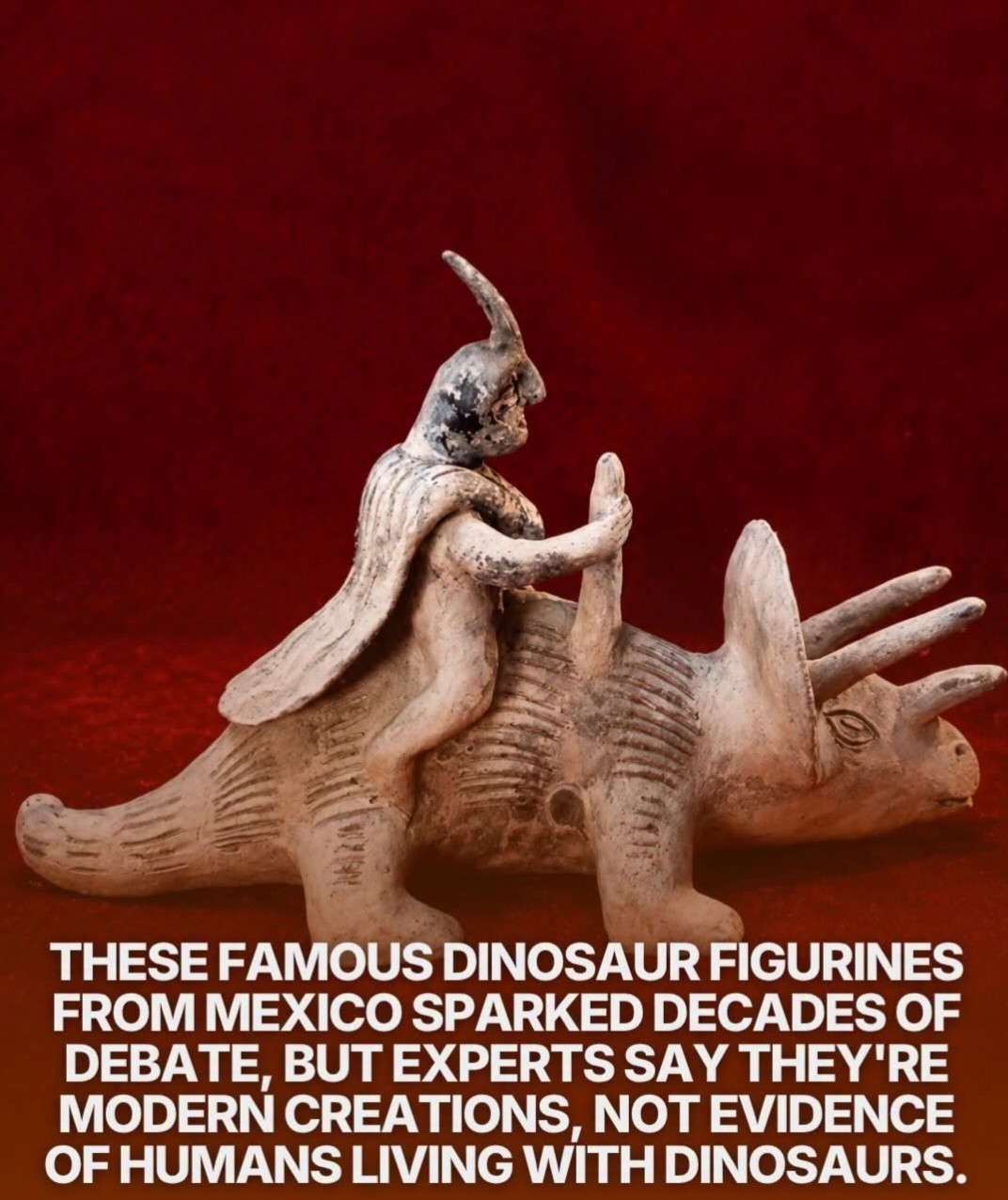
5. The Acámbaro Figures: Ceramic Dinosaurs from Pre-Columbian Mexico
In 1944, German immigrant Waldemar Julsrud discovered odd clay figurines near Acámbaro, Mexico. Over time, he amassed over 32,000 pieces—small statues of humans, animals, and most shockingly, what appear to be dinosaurs. Thermoluminescence dating by an archaeologist in the 1970s suggested they were fired between 4,500 and 6,500 years ago, long after dinosaurs, but still far too early for accurate paleontological reconstruction.
What’s the verdict? Later tests indicated that the figurines were made in the late 1930s and 1940s, using modern clay, and that Julsrud likely bought them from local craftsmen who realized they’d struck a profitable vein. The figures became a classic debunked theory, yet many cling to the belief that creatures like the Brachiosaurus couldn’t be imagined by primitive farmers unless they’d seen the real thing. Could oral traditions of extinct megafauna have survived for millennia? Or was this just another example of wishful thinking getting ahead of the evidence? Either way, it’s a juicy tale of suppressed history that refuses to die.
—
6. The Dropa Stones: Alien Discs in a Chinese Cave
In 1938, an expedition led by Chinese archaeologist Chi Pu Tei allegedly discovered a series of graves in the Baian-Kara-Ula mountains. Inside were skeletal remains with abnormally large heads, and nearby lay 716 stone discs with a hole in the center and a fine spiral groove of tiny characters. Decoding supposedly revealed the story of a spaceship that crash-landed 12,000 years ago, leaving the stranded Dropa aliens to live among the local Han until they died out.
Is any of this real? No one has ever produced a single authenticated Dropa stone. The entire story traces back to an obscure Russian publication and a 1967 book by Tsum Um Nui, a writer whose name suspiciously resembles a Chinese version of “made up.” Despite being one of the flimsiest controversial discoveries on this list, the Dropa Stones have become an internet legend, a staple of ancient astronaut lore, and a testament to how badly we want our history to be wilder than it is. The stones themselves are usually explained as bi-discs used in Bronze Age burials—but where’s the fun in that?
—
7. Göbekli Tepe: The Site That Broke History (And Proved the Point)
Göbekli Tepe is the outlier that changed everything. Discovered in southeastern Turkey in the 1990s, this massive complex of carved stone pillars and circular enclosures predates Stonehenge by 6,000 years and was built before the invention of pottery, writing, or the wheel. For decades, the archaeological establishment held that hunter-gatherers couldn’t have organized large-scale construction—it required stratified societies and agriculture first. Göbekli Tepe turned that dogma on its head, and it is now hailed as a triumph of mainstream archaeology.
But why was Göbekli Tepe accepted while the Ica Stones gather dust? Because its excavation was meticulous, its dating irrefutable, and its discovery rapidly published in peer-reviewed journals. For forbidden archaeology enthusiasts, Göbekli Tepe is proof that the established timeline can shift overnight when the evidence is overwhelming—and therefore, the gatekeepers might be prematurely burying other anomalous finds. The site whispers a tantalizing idea: how many more world-changing monuments lie hidden, waiting for their moment to topple our tidy narratives?
—
Why Are These Discoveries “Forbidden”? The Psychology of Suppression
We’ve danced around a core question: is there a cabal of archaeologists actively hiding the truth, or is the “forbidden” label more of a sensational myth? The reality is more nuanced, and way more interesting. Academic archaeology operates under a strict scientific paradigm. Extraordinary claims require extraordinary evidence, and most of the artifacts we’ve discussed suffer from compromised provenance, unverifiable contexts, or direct evidence of fabrication.
But here’s the controversial kicker: the peer-review system can also act as a gatekeeper that penalizes dissent. Careers have been sidelined because a researcher dared to suggest a pre-Clovis human presence in the Americas (now accepted) or a Neanderthal ability to create art (now accepted). So when a strange hammer or stone appears, the knee-jerk response is often dismissal rather than investigation. That habit, multiplied over decades, has created a subculture of forbidden archaeology—where every debunked artifact becomes a martyr for a larger truth.
History enthusiasts and conspiracy theorists alike find common ground in the thrill of “what if?” There’s a deep romance in imagining that our ancestors left us clues we’re too proud to read. And honestly, aren’t we all a little fascinated by the possibility that the experts might be wrong?
—
Frequently Asked Questions About Forbidden Archaeology
What exactly is forbidden archaeology?
It’s a term popularized by author Michael Cremo to describe artifacts and sites that challenge the established timeline of human civilization—and that are allegedly suppressed, ignored, or discredited by mainstream science. The field blends genuine archaeological puzzles with speculative theories about lost civilizations, ancient aliens, and hyperdiffusion.
Are any of these controversial discoveries actually proven?
The Antikythera Mechanism is universally accepted as genuine and remarkable. Göbekli Tepe revolutionized our understanding of the Neolithic. Most others—like the Ica Stones and the Acámbaro figurines—have been thoroughly debunked as hoaxes or misinterpretations. A few, like the Baghdad Battery, remain in a gray zone of plausible but unproven functionality.
Why would scientists hide the truth?
Conspiracy theories aside, scientists generally don’t “hide” the truth; they follow evidence and consensus. However, paradigm shifts are notoriously slow, and researchers sometimes resist data that would upend their life’s work. The idea of active suppression is largely a narrative born from those frustrations, but it makes for a compelling story.
Can I visit any of these artifacts myself?
Absolutely! The Antikythera Mechanism is in the National Archaeological Museum in Athens. You can visit Göbekli Tepe in Turkey. The London Hammer is in a creationist museum in Texas. The Ica Stones are in a small museum in Ica, Peru. Seeing them with your own eyes might not solve the mysteries, but it’ll certainly fire your imagination.
—
What Do You Think? The Floor Is Yours
Forbidden archaeology lives in the tension between wonder and skepticism. On one hand, rigorous science protects us from falling for every farmer with a hammer and a story. On the other, those same filters can blind us to uncomfortable truths. The Antikythera Mechanism gathered dust for decades because nobody believed it was possible. What else lies in a museum basement, wrongly cataloged, waiting for a fresh set of eyes?
This journey through controversial discoveries and suppressed history isn’t about swapping one dogma for another. It’s about keeping the door open to genuine curiosity—and, yes, a healthy dash of cynicism toward any authority that claims to have all the answers. Whether you’re a hardcore skeptic or you secretly want the Dropa Stones to be real, your voice matters in this ongoing excavation of the human story.
Ready to dive deeper? Join the debate on forbidden archaeology in our community forum. Share your own favorite anomalous artifacts, dissect the evidence, and connect with fellow history buffs and truth-seekers who refuse to let the past stay silent. Click here to join the conversation—because history, after all, is never truly settled.