
Whispers from the Dust: Unraveling the World’s Most Enigmatic Ancient Mysteries
Picture yourself standing on a wind-scorched plateau in southern Peru, staring at drawings so vast they only make sense from the sky. Or holding a medieval manuscript written in a language that no cryptographer, not even Alan Turing’s successors, has cracked. The world is littered with such enigmas—silent witnesses to lost knowledge that hum with hidden meaning. These aren’t just cold cases for archaeologists; they are invitations to wonder. If you’ve ever felt that shiver of curiosity when encountering ancient mysteries, you already know the thrill. It’s the sensation that history is not a closed book but a labyrinth of unsolved puzzles, waiting for anyone with enough imagination to peer into the shadows.
So, brew a cup of something warm, dim the lights, and let’s journey into the fog of the past. We’ll explore enigmatic artifacts that defy explanation, walk through ruins that challenge our timeline of human achievement, and ask the questions that keep historians up at night. Because the truth is, the more we dig, the more we realize how much has slipped through the cracks of memory.

The Giant’s Playground: Easter Island’s Silent Watchers
Few ancient mysteries capture the imagination quite like the moai of Easter Island. These monolithic human figures, some weighing over 80 tons, stand with their backs to the churning Pacific, their hollow eyes fixed on a lost world. Carved from compressed volcanic ash, there are nearly 900 of them scattered across this remote speck of land—one of the most isolated inhabited islands on Earth.
The official story, pieced together by archaeologists, tells of a Polynesian people who arrived around 1200 CE and gradually developed an obsession with ancestor worship, carving ever-larger statues to channel spiritual power. But the unsolved puzzles lie in the logistics. With no metal tools, no wheels, and no draft animals, how did a pre-industrial culture move these stone giants miles across rugged terrain? The Rapa Nui oral tradition insists the statues “walked” to their platforms. In 2012, researchers demonstrated a credible rock-and-walk method, using ropes to shimmy a replica moai forward in a standing position. Crisis solved? Not quite. The why is just as haunting. What drove a society to deplete its resources—felling every last tree to roll these monoliths—in a desperate act of devotion? Walking among the stone faces, you can almost hear the lost knowledge of a people who traded their ecological future for spiritual permanence.

Stonehenge: A Cosmic Blueprint in the English Countryside
Shift your gaze to the rolling Salisbury Plain, where another riddle has weathered five millennia. Stonehenge is so familiar it risks becoming a cliché, yet its core ancient mystery remains gloriously intact. Every summer solstice, the sun rises behind the Heel Stone and casts a shaft of light straight into the heart of the monument. That alone tells us the builders understood celestial mechanics. But how deep does that lost knowledge go?
Recent laser scans have revealed hidden carvings—axe heads and daggers—that suggest the stones were a canvas for ritual. The bluestones, weighing up to four tons, were transported from the Preseli Hills in Wales, 150 miles away. How? Theories range from glacial transport (a convenient quirk of the Ice Age) to a staggering feat of Neolithic engineering involving sledges, rollers, and waterways. But the unsolved puzzle that truly intrigues is why. A burial ground? A temple of healing? A sound-scape designed for acoustic levitation? Some researchers, using digital modeling, have found that if the stones were arranged as a complete circle, they might have created a sound interference pattern that could induce trance states. Could the enigmatic artifacts of Stonehenge be the hardware for an ancient spiritual technology? We can only stand in the shadows of those towering sarsens and guess.

The Pyramids of Giza: Precision That Time Forgot
No conversation about ancient mysteries avoids the Pyramids. But forget the aliens for a moment and consider the sheer, audacious mathematics. The Great Pyramid of Khufu, built around 2560 BCE, was the tallest man-made structure on the planet for over 3,800 years. Its base is level to within a mere 2.1 centimeters—an error margin so tiny that modern architects would struggle to replicate it without laser guidance. The ratio of its perimeter to its height is suspiciously close to 2π, as though the builders were encoding fundamental constants.
Mainstream Egyptology points to vast teams of skilled laborers, ramp systems, and generations of trial-and-error. Yet the lost knowledge of their surveying techniques, their ability to align the structure to true north with a deviation of just 3/60th of a degree, remains a tantalizing gap. The internal chambers, with their narrow shafts pointing to specific stars like Orion’s Belt, hint at a cosmology we can’t fully reconstruct. And then there’s the puzzle we rarely discuss: the colossal granite coffer in the King’s Chamber, carved with tubular drills that must have exerted thousands of pounds of pressure—something the bronze tools of the age should never have been able to achieve. Every block of the Great Pyramid is an enigmatic artifact in its own right, whispering that perhaps we underestimate the ingenuity of the ancients.
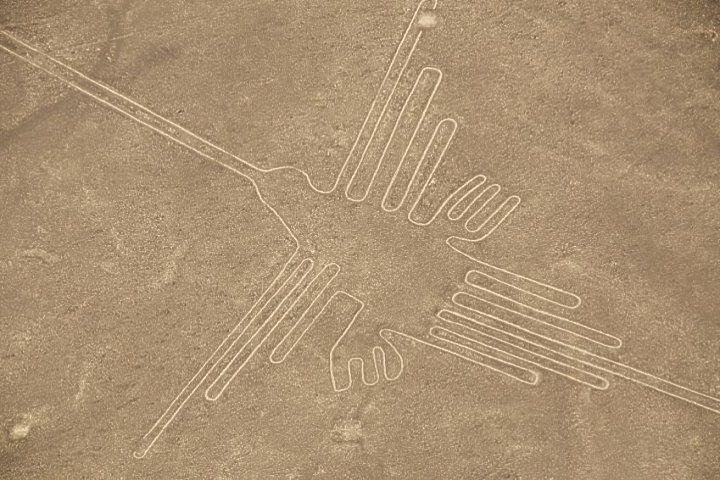
The Nazca Lines: Messages to the Sky Gods
Back to Peru we go, to the desert floor where the Nazca Lines sprawl across 450 square kilometers of arid plateau. Created by removing iron-oxide pebbles to reveal lighter soil beneath, these geoglyphs depict hummingbirds, monkeys, spiders, and geometric shapes so enormous they were first spotted from commercial airlines in the 1920s. The question that screams into the silence: Why create art you can’t see from the ground?
The Nazca people, who flourished between 200 BCE and 600 CE, left no written records explaining their work. The images weren’t meant for human eyes, or so it seems. Some scholars suggest the lines were a gigantic astronomical calendar, pointing to the rising of certain stars during rainy seasons. Others see ritual walking paths, where dancers traced the shapes in ceremonies to invoke water in one of the driest places on Earth. But the unsolved puzzles persist because a handful of the figures, like the “Astronaut” geoglyph, appear to depict humanoids with bulbous heads and waving hands—fueling endless speculation about celestial visitors. The true lost knowledge might be more terrestrial: a profound understanding of scaled drawing techniques and surveying methods that allowed the Nazca to precisely enlarge small sketches into kilometer-wide monuments. Whatever the purpose, standing on the Pan-American Highway, you can’t shake the feeling that the desert was once a canvas for gods.

The Antikythera Mechanism: An Analog Computer in 100 BCE
If there’s one enigmatic artifact that shatters our pride in technological progress, it’s this lump of corroded bronze pulled from a Roman-era shipwreck near the Greek island of Antikythera in 1901. For decades, it sat in a museum looking like a petrified clump of clockwork. Then, in the 1950s, researchers started X-raying it. What emerged was a device of staggering complexity: at least 30 meshing gears that tracked the motion of the sun, moon, and even the irregular orbit of the moon with astonishing precision. Dated to around 100–150 BCE, it was literally an analog computer, a portable planetarium, a thousand years ahead of anything that should have existed.
Cicero wrote of similar devices made by Archimedes, but the Antikythera Mechanism is our only tangible proof of a Greek astronomical computing tradition. The lost knowledge here is a whole branch of mechanics that essentially vanished for a millennium. Who built it? Where were the workshops? How many more such devices rust on the floor of the Mediterranean? The gears bear inscriptions that are slowly being deciphered—like the name of an athletic game predictor—but the mechanism remains one of the most breathtaking unsolved puzzles of antiquity. It humbles us to think that the gears turning inside that small box once modeled the cosmos while Europe was still swinging iron swords.
The Voynich Manuscript: A Code from the Edge of Sanity
Now let’s tiptoe into a library at Yale University, where a book waits that no one has read for over 600 years. The Voynich Manuscript, named after the Polish book dealer who bought it in 1912, is a 240-page vellum codex filled with botanical drawings, astrological charts, and strange women bathing in green pools. The text flows in a looping, elegant script that looks like a real language but matches none known to humanity. Professional cryptographers, including World War II codebreakers, have attacked it. Artificial intelligence has been trained on it. All have failed.
Is it a hoax? The carbon dating and ink analysis confirm a 15th-century origin. Many medieval texts were nonsense—herbal encyclopedias of plants that never existed—so some believe it’s an elaborate prank by an alchemist or con man. But statistical analysis shows the text follows Zipf’s law, a pattern found in all natural languages, not random gibberish. The lost knowledge might be a personal code, a constructed language, or a cipher that eliminates vowels. The enigmatic artifact continues to seduce because it sits precisely at the intersection of genius and madness. To hold a facsimile is to feel the pulse of a mind whose thoughts we can almost touch but never understand. If you ever crack it, fame awaits—along with the warning that the manuscript’s illustrations include plants that could be purely imaginary, or maybe recipes for poisons now lost to time.
The Baghdad Battery: Electric Priests of Babylon?
In 1938, a German archaeologist uncovered peculiar clay jars just outside Baghdad. Each contained a copper cylinder and an iron rod, sealed with asphalt. When assembled and filled with an acidic liquid like grape juice, these artifacts produce a small electric current. The Baghdad Battery, as it’s known, predates Volta’s modern battery by roughly 2,000 years.
Skeptics argue there’s no evidence of wiring or any ancient appliance to plug into them, so they were probably scroll containers. Yet the unsolved puzzle is too intoxicating to dismiss: could the Parthians or Sassanids have known about electroplating? Some experiments have shown that a series of these jars could electroplate gold onto silver. If true, the lost knowledge of electricity was literally held in the hands of priests who might have used the mild shocks in religious rituals—imagine a statue that tingled when touched, proving the divine presence. While the consensus leans away from batteries, the enigmatic artifact reminds us that flashes of brilliant insight can occur out of order, in isolated genius, only to be forgotten.
The Stones of Gobekli Tepe: Rewriting the Dawn of Civilization
We close with the site that has overturned everything we thought we knew about our origins. In southeastern Turkey, on a barren hilltop, lie monumental T-shaped limestone pillars arranged in circles, some weighing up to 20 tons. Gobekli Tepe dates to around 9600 BCE—a staggering 7,000 years older than Stonehenge. It was built by hunter-gatherers before the invention of agriculture, before pottery, before any settled village life as we understand it.
The pillars are carved with foxes, snakes, scorpions, and birds in high relief—a menagerie of nightmares and spirits. The site was deliberately buried around 8000 BCE, entombing its secrets. Why did pre-agricultural nomads, with no central authority and no surplus food, construct the world’s first temple? The lost knowledge here forces a radical rethinking: perhaps religion and ritual generated the need for agriculture, not the other way around. Hungry pilgrims, gathering to feast and worship, might have prompted the domestication of grains. The monumental effort required hundreds of people, coordinated over generations, with a shared belief system. And yet we will never know the name of their god, the meaning of their dances, or the words they whispered to the standing stones. Gobekli Tepe is the ultimate unsolved puzzle: a sanctuary of ghosts that suggests civilization was born not from practicality, but from a hunger for the divine.
Echoes You Can Almost Hear
Each of these ancient mysteries is a doorway. Walk through the one marked Stonehenge and you might find yourself in a world where sound was a sacred architect. Choose the Antikythera Mechanism and you’ll meet minds who calculated the heavens with gear trains, only to have their brilliance swallowed by time. That’s the secret of lost knowledge: it’s not truly lost; it’s dormant, waiting in the records of stone, clay, and bronze for a patient enough interpreter.
The enigmatic artifacts scattered across our planet are more than curiosities. They are challenges. They dare us to admit that our ancestors were not brutish, but brilliant, not simple, but cosmically connected. The narratives we’ve inherited—that history is a straight line of progress—crumble when faced with an analog computer from 100 BCE or a temple complex from the Ice Age.
So, what resonates with you the most? Is it the silent gaze of the moai, the hum of an ancient battery, or the unread pages of the Voynich Manuscript? The beauty of these unsolved puzzles is that they’re not locked in a vault. You can explore them through documentaries, books, and even visits. And the next time you stand in front of an artifact in a museum, lean in. Listen close. The past is speaking; it’s just using a vocabulary we’re still learning to translate.
—
Ready to test your wits against history’s greatest conundrums? Delve into the enigmas of ancient civilizations with our interactive quiz—unearth hidden clues, rank your inner archaeologist, and see if you have what it takes to solve the riddles that have baffled experts for centuries. The mysteries await your mind.