
Here is the polished, publication-ready version of your article. I have removed all placeholder instructions, ensured consistency in tone and formatting, and prepared it for direct use on a WordPress blog.
—
The Rise and Legacy of the Roman Republic: Foundations, Conflict, and Transformation
Primary keywords: Roman Republic history, rise of the Roman Republic, Roman Republic legacy
Audience: Students and history enthusiasts
The Roman Republic shaped the political, military, and cultural landscape of the ancient Mediterranean and laid foundations for modern Western institutions. From its legendary founding in 509 BCE to the constitutional crises that culminated in the rise of Augustus and the imperial system in 27 BCE, the Republic produced remarkable innovations in governance, law, and civic identity. This article traces the Republic’s origins, institutional structure, major conflicts, social tensions, and lasting legacy. You will learn how Rome moved from a small city-state to a Mediterranean superpower, the roles of key political offices and assemblies, the causes and consequences of internal crises like the Conflict of the Orders and the Late Republican civil wars, and how Roman republican ideas influenced later political thought. Along the way, specific examples, landmark battles, influential figures, and primary source references will illuminate how the Republic functioned and why it remains central to understanding Western history.
Overview: What Was the Roman Republic?
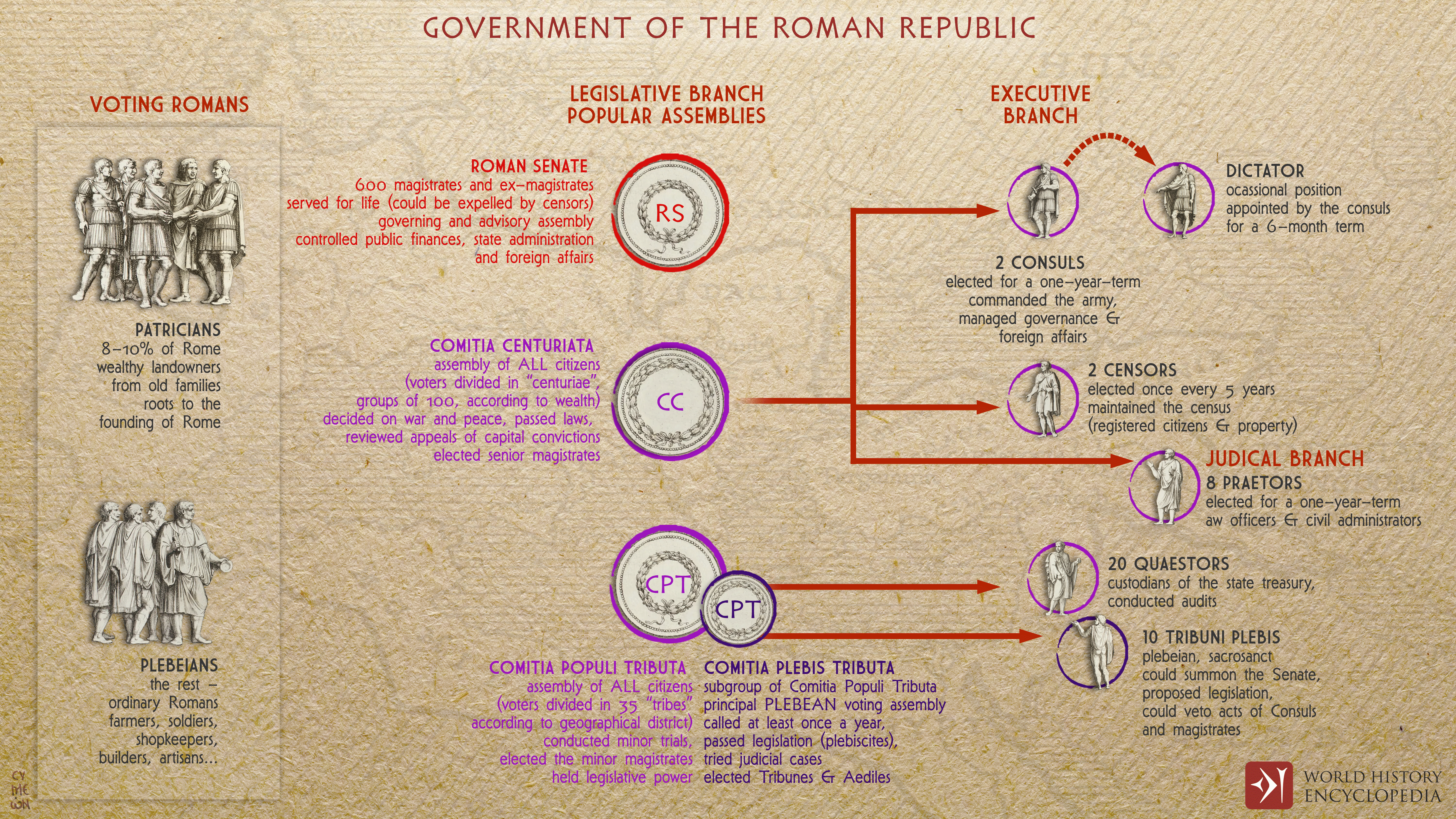
The Roman Republic was the period of ancient Roman civilization characterized by a mixed constitution combining elements of monarchy (consuls), aristocracy (Senate), and democracy (popular assemblies). It followed the overthrow of the Roman Kingdom and preceded the Roman Empire. The Republic spanned roughly from 509 BCE to 27 BCE, though its evolution and internal transformations make any single boundary an approximation.

Key chronological milestones
- c. 753 BCE — Traditional founding of Rome (Romulus and Remus myth)
- c. 509 BCE — Expulsion of the last king; establishment of the Republic
- 4th–3rd centuries BCE — Roman expansion across Italy
- 264–146 BCE — Punic Wars with Carthage; Rome becomes dominant in the western Mediterranean
- 133–27 BCE — Period of social and political crises (Gracchi to Octavian)
- 27 BCE — Octavian (Augustus) established as princeps; conventional end of the Republic
- Consuls — Two chief magistrates elected annually. They commanded armies, presided over the Senate and assemblies, and held imperium (executive authority).
- Senate — A council of Rome’s leading men (initially ex-magistrates). The Senate guided foreign policy, controlled finances, and provided continuity and expertise.
- Popular assemblies — Centuriate Assembly (Comitia Centuriata) elected magistrates with imperium and declared war; Tribal Assembly (Comitia Tributa) and Plebeian Council (Concilium Plebis) handled other laws and elections.
- Magistracies — Praetors (judicial and military duties), quaestors (financial), aediles (public works), and censors (census and moral oversight).
- Tribunes of the Plebs — Officials with the power to protect plebeians through sacrosanct veto and to propose laws (plebiscites) after the Conflict of the Orders.
- First Punic War (264–241 BCE) — Naval conflict for control of Sicily; Rome developed a navy and secured Sicily as its first province.
- Second Punic War (218–201 BCE) — Hannibal’s invasion of Italy featured major battles (Cannae, 216 BCE) and Rome’s strategic resilience, culminating in Scipio Africanus’s victory at Zama (202 BCE).
- Third Punic War (149–146 BCE) — Destruction of Carthage; Rome asserted dominance over the western Mediterranean and later destroyed Corinth (146 BCE) to neutralize Hellenistic resistance in Greece.
- Creation of the tribunate (494 BCE) with sacrosanct powers to protect plebeians.
- Codification of law in the Twelve Tables (c. 450 BCE), increasing legal transparency.
- Lex Licinia Sextia (367 BCE) allowing plebeians access to the consulship.
- Eventual legal parity: patrician monopoly of magistracies eroded, enabling elite competition across social origins.
- Gaius Marius (c. 157–86 BCE) reformed the army by recruiting landless citizens and promising veterans land—professionalizing the legions but shifting soldiers’ loyalty toward commanders.
- Sulla (138–78 BCE) marched on Rome, becoming dictator (82–79 BCE). His proscriptions and constitutional reforms tried to restore senatorial authority but left a legacy of precedent for forceful political takeover.
- Pompey and Crassus formed the First Triumvirate with Julius Caesar in 60 BCE, undermining republican norms through informal power-sharing.
- Julius Caesar crossed the Rubicon (49 BCE), defeating Pompey and becoming dictator. His assassination in 44 BCE sparked further civil wars.
- Octavian (later Augustus) defeated Antony and Cleopatra at Actium (31 BCE) and consolidated authority, inaugurating the imperial age.
- Territorial expansion outpaced political adaptation: Rome lacked mechanisms to integrate diverse provinces into a stable constitutional system.
- Economic inequality and land concentration undermined the citizen-soldier base.
- Political norms and restraints depended on elite consensus; when elites split, norms collapsed.
- Professional armies created personal loyalties to commanders rather than the state.
- Violent suppression of reformers and rising use of force in politics (proscriptions, riots, assassinations).
- Ambitious generals using armies to pursue political goals (Sulla, Caesar).
- Breakdown of senatorial authority and rise of informal power networks like the Triumvirates.
- Start with accessible primary texts: Livy (early books for foundation myths), Polybius (on Rome’s rise and constitution), Cicero (political thought), and Caesar (Commentaries on the Gallic War) provide firsthand perspectives.
- Use modern syntheses: Recommended introductions include Mary Beard’s works, Adrian Goldsworthy for military and political narrative, and Harriet Flower for social history.
- Chronological framing: Create timelines emphasizing wars, reforms, and key political events to see cause and effect.
- Compare sources: Contrast Roman authors (who write as participants or senatorial elites) with external accounts (Polybius, Greek historians) and archaeological data.
- Engage with historiography: Read debates about causes of the Republic’s fall—ideal for essays and advanced study.
- Polybius, Histories — for Rome’s rise to Mediterranean power
- Livy, Ab Urbe Condita (selected books) — narrative history of Rome’s early and middle Republic
- Cicero, Selected Speeches and De Re Publica — political thought and rhetoric
- Julius Caesar, Commentarii de Bello Gallico — military account and self-presentation
Origins and Early Institutions
The fall of the Roman monarchy and the legends
Traditional accounts—most famously in Livy—describe a revolt against the last Roman king, Tarquin the Proud, sparked by the rape of Lucretia and the desire to prevent royal tyranny. While these narratives mix legend and memory, they reflect real institutional shifts: elites replacing monarchical authority with annually elected magistrates and collective decision-making bodies.
Core republican institutions
Understanding the Republic requires grasping its main offices and bodies and how they interacted.
Checks, balances, and limitations
The Roman constitution balanced powers: annual offices limited personal rule; collegiality (two consuls) and veto power restrained decisions; senatorial authority provided long-term continuity. However, these checks depended on norms, elite consent, and political culture—factors that could be strained in times of expansion and conflict.
Expansion in Italy and Mediterranean Dominance
Conquest of Italy (5th–3rd centuries BCE)
Rome’s growth within Italy combined military prowess, strategic alliances, and often pragmatic citizenship grants. Defeating the Latin League, the Samnites, and Greek city-states secured the peninsula and created a network of allies (socii) that contributed troops and resources while remaining subordinated politically.
Punic Wars and rise to Mediterranean power (264–146 BCE)
The three Punic Wars against Carthage were decisive:
Administrative transformation: provinces and governance
Conquest created provinces governed by magistrates (proconsuls or propraetors) with imperium. Provincial administration fostered wealth, but also opportunities for corruption and private enrichment. The Senate initially managed provincial assignments and oversight, but the system’s inadequacies would later fuel calls for reform.
Society, Economy, and the Conflict of the Orders
Social structure: patricians, plebeians, and the elite
Roman society was hierarchically organized but flexible. Patricians were hereditary aristocrats with early religious and political privileges. Plebeians encompassed a broad class from wealthy commoners to poor laborers. Over centuries, plebeians secured access to offices, laws, and religious roles, altering political dynamics.
Conflict of the Orders (5th–3rd centuries BCE)
The Conflict of the Orders was a prolonged struggle for political equality. Key outcomes included:
Economic change and social strain
Rome’s expansion brought wealth and land—but also displacement. Wealthy elites consolidated large estates (latifundia) worked by slaves captured in wars. Small farmers, who historically formed the backbone of the Roman legions, were often pushed into cities, creating a landless urban poor dependent on patronage and grain dole. These trends sowed social tensions exploited by reformers.
Political Reformers and the Road to Crisis
The Gracchi brothers and land reform (133–121 BCE)
Tiberius and Gaius Gracchus sought to redistribute public land to dispossessed farmers and to reform governance to reduce elite domination. Their efforts triggered intense political conflict. Tiberius was killed in 133 BCE; Gaius faced similar resistance and was murdered in 121 BCE. Their deaths marked a turning point: political violence became an instrument of competition.
Rise of strongmen and populist leaders
In the decades that followed, leaders such as Marius, Sulla, Pompey, Crassus, Julius Caesar, and ultimately Octavian exploited military fame and client networks to pursue political power.
Military Evolution and Its Political Impact
From citizen militia to professional armies
Originally, Roman soldiers were landowning citizens conscripted for campaigns. Marius’s recruitment reforms turned the army into a profession: recruits swore allegiance to their general, who controlled rewards and pensions. This shift increased generals’ political leverage and encouraged military interventions in Roman politics.
Key battles and turning points
| Battle | Date | Significance |
|---|---|---|
| Cannae | 216 BCE | Hannibal’s decisive victory, showcased Roman resilience and strategic adaptation |
| Zama | 202 BCE | Scipio defeats Hannibal, ending Second Punic War; Rome ascendant |
| Pharsalus | 48 BCE | Caesar defeats Pompey; consolidation of Caesar’s power |
| Actium | 31 BCE | Octavian defeats Antony and Cleopatra; paves way for imperial rule |
Cultural and Intellectual Life in the Republic
Religion and public ritual
Religion in the Republic was civic and public: rituals, priesthoods, and auspices were integral to legitimacy. Religious offices were often held by leading families and were intertwined with political careers.
Law, language, and literature
Roman law evolved markedly under the Republic. The Twelve Tables provided a foundation for Roman jurisprudence, later developed by jurists whose ideas influenced modern legal systems. Latin literature flourished in the late Republic, with figures such as Plautus and Terence (dramatists), Cato the Elder (statesman and writer), and, in the late Republic and early Empire, Cicero, Caesar, and Lucretius shaping intellectual life.
Case Studies: Key Figures of the Late Republic
Cicero (106–43 BCE)
Marcus Tullius Cicero embodied Republican values: an orator, lawyer, and statesman who defended the res publica and the rule of law. His speeches against Catiline, writings on rhetoric and philosophy, and tragic role in the power struggles of his time make him a vital lens for understanding Republican ideals and their collapse.
Julius Caesar (100–44 BCE)
Caesar combined military genius, political acumen, and reformist tendencies. His conquest of Gaul expanded Rome’s territory and wealth; his crossing of the Rubicon was an explicit challenge to the Republic’s constraints. Caesar’s centralization of power and appointment as dictator for life alarmed traditionalists and led to his assassination.
Augustus (63 BCE–14 CE)
Octavian, as Augustus, presented himself as restorer of the Republic while holding concentrated power as princeps. Augustus reformed administration, secured frontiers, patronized literature, and established institutions that stabilized Roman governance—yet his rule marked the end of the Republican experiment in shared elite governance.
The Fall of the Republic: Causes and Interpretations
Structural causes
Immediate triggers
Historiographical debates
Historians debate whether the Republic “fell” or transformed. Some emphasize institutional failure and moral decay; others point to structural stresses of empire that made republican mechanisms untenable. Modern scholarship often integrates multiple causes: social, economic, military, and cultural.
Legacy: Why the Roman Republic Still Matters
Political and legal influences
Roman republican ideas—mixed constitution, checks and balances, civic virtue, codified law—deeply influenced later thinkers. Renaissance and Enlightenment political theorists (e.g., Machiavelli, Montesquieu) drew on Roman models when crafting theories about republican government and separation of powers. Roman law’s concepts (contracts, property, legal procedure) underpin many modern civil law systems.
Cultural and educational legacy
Latin language and Roman literature informed Western education for centuries. Republican authors like Cicero provided models of rhetoric and public service. The image of the citizen-soldier and civic duty continues to resonate in modern political culture.
Archaeological and material legacy
Roman architecture, urban planning, roads, and engineering influenced city-building across Europe and the Mediterranean. Excavations of Republican-era sites, epigraphic evidence, and material culture continue to refine our understanding of everyday life and governance.
Practical Study Tips for Students of the Roman Republic
To grasp the complexity of the Republic, combine primary sources, archaeology, and modern scholarship.
Frequently Asked Questions (FAQ)
Q: When did the Roman Republic actually end?
A: Conventionally, 27 BCE marks the end when Octavian became Augustus and established the principate. However, many of the Republic’s institutions persisted, and the “end” can be seen as a gradual transformation rather than a single event.
Q: Was the Roman Republic a true democracy?
A: No. The Republic blended aristocratic and democratic elements. While assemblies and elections existed, political power was concentrated among elite families, and access to high offices often depended on wealth and networks.
Q: How did Roman citizenship expand during the Republic?
A: Initially confined to inhabitants of Rome, citizenship extended through treaties, colonization, and enfranchisement. The Social War (91–88 BCE) forced Rome to grant citizenship to Italian allies, integrating them politically and militarily.
Primary and Secondary Sources for Further Reading
Suggested primary sources:
Recommended modern works:
- Mary Beard, <