
Challenging History: Unearthing Provocative and Controversial Archaeological Finds
Imagine a world where everything you thought you knew about human history was suddenly turned on its head. Where ancient civilizations possessed technologies we’re only just rediscovering, or where our ancestors walked the Earth far earlier and achieved feats far greater than mainstream textbooks suggest. This isn’t just the stuff of science fiction; it’s the tantalizing promise of “forbidden archaeology,” a realm where provocative finds challenge established narratives and spark fiery debates between conventional scholars and those who believe a deeper, more complex past awaits discovery.
This article delves into some of the most captivating and controversial archaeological discoveries ever made. We’ll explore artifacts and sites that seem to defy explanation, examine the theories—both mainstream and alternative—that attempt to make sense of them, and ponder why these mysteries hold such an enduring grip on our collective imagination. Prepare to question, to wonder, and perhaps, to see history in a whole new light.

What is “Forbidden Archaeology” and Why Does it Spark Debate?
The term “forbidden archaeology” often refers to archaeological finds that appear to contradict established historical timelines or scientific paradigms. These aren’t just minor puzzles; they are discoveries that, if proven true in their most radical interpretations, would force a complete rewriting of our understanding of human origins, technological development, and the very nature of ancient civilizations.
Such finds become controversial because they often lack clear context, display features far ahead of their supposed time, or suggest human capabilities that don’t fit the accepted evolutionary or cultural progression. For mainstream archaeologists, these anomalies are typically explained through misinterpretation, natural geological processes, or even outright hoaxes. However, for enthusiasts of alternative history and conspiracy theories, these objects represent “suppressed history”—evidence that the academic establishment is either unwilling or unable to accept, perhaps even actively concealing. The tension between these perspectives is where the real intrigue lies.

The Out-of-Place Artifacts (OOPArt) Phenomenon
One of the most thrilling categories of controversial finds are “Out-of-Place Artifacts,” or OOPArts. These are objects discovered in contexts that challenge conventional historical chronology, suggesting advanced knowledge or technology existed in periods where it shouldn’t have. They ignite our curiosity, making us wonder if ancient humans were far more sophisticated than we give them credit for.

The Antikythera Mechanism: A Glimpse of Ancient Genius?
Not all OOPArts remain “out of place.” The Antikythera Mechanism, recovered from a Roman-era shipwreck off the coast of Greece in 1901, is a prime example of an ancient artifact that initially baffled researchers. This complex device, dating to around 150-100 BCE, features an intricate system of meshing bronze gears and dials. For decades, its purpose was a mystery, as nothing remotely similar had been found from that period.
Initial interpretations suggested it was a navigational tool or an astronomical calculator. Modern research, employing advanced imaging techniques, has revealed it to be an incredibly sophisticated analog computer, capable of predicting astronomical positions and eclipses decades in advance, tracking the cycles of the Olympic Games, and even modeling the irregular orbit of the Moon. Its complexity was unprecedented for its time, demonstrating a level of mechanical engineering thought to have emerged over a millennium later. While no longer “forbidden,” its discovery forced historians to dramatically revise their understanding of ancient Greek technological prowess, proving that sometimes, the past truly can surprise us with its sophistication.
The Klerksdorp Spheres: Natural Formations or Ancient Tools?
Diving into more contentious territory, the Klerksdorp Spheres are small, metallic objects, often with parallel grooves around their equators, found in pyrophyllite deposits near Klerksdorp, South Africa. These deposits are estimated to be around 2.8 billion years old. To some, these perfectly formed, grooved spheres are undeniable evidence of intelligent design from an impossibly ancient civilization, challenging the timeline of human existence and technological capability.
However, mainstream geologists largely dismiss this interpretation. They identify the Klerksdorp Spheres as concretions, natural geological formations created by the gradual accretion of minerals around a central nucleus. The grooves, they argue, are a result of natural layering within the concretion or a byproduct of the surrounding rock’s metamorphic processes. While undeniably intriguing in their symmetry, the scientific consensus points to natural, rather than artificial, origins, making them a classic case study in how natural phenomena can be interpreted through a “forbidden archaeology” lens.
The Baghdad Battery: Electroplating or Ritual Object?
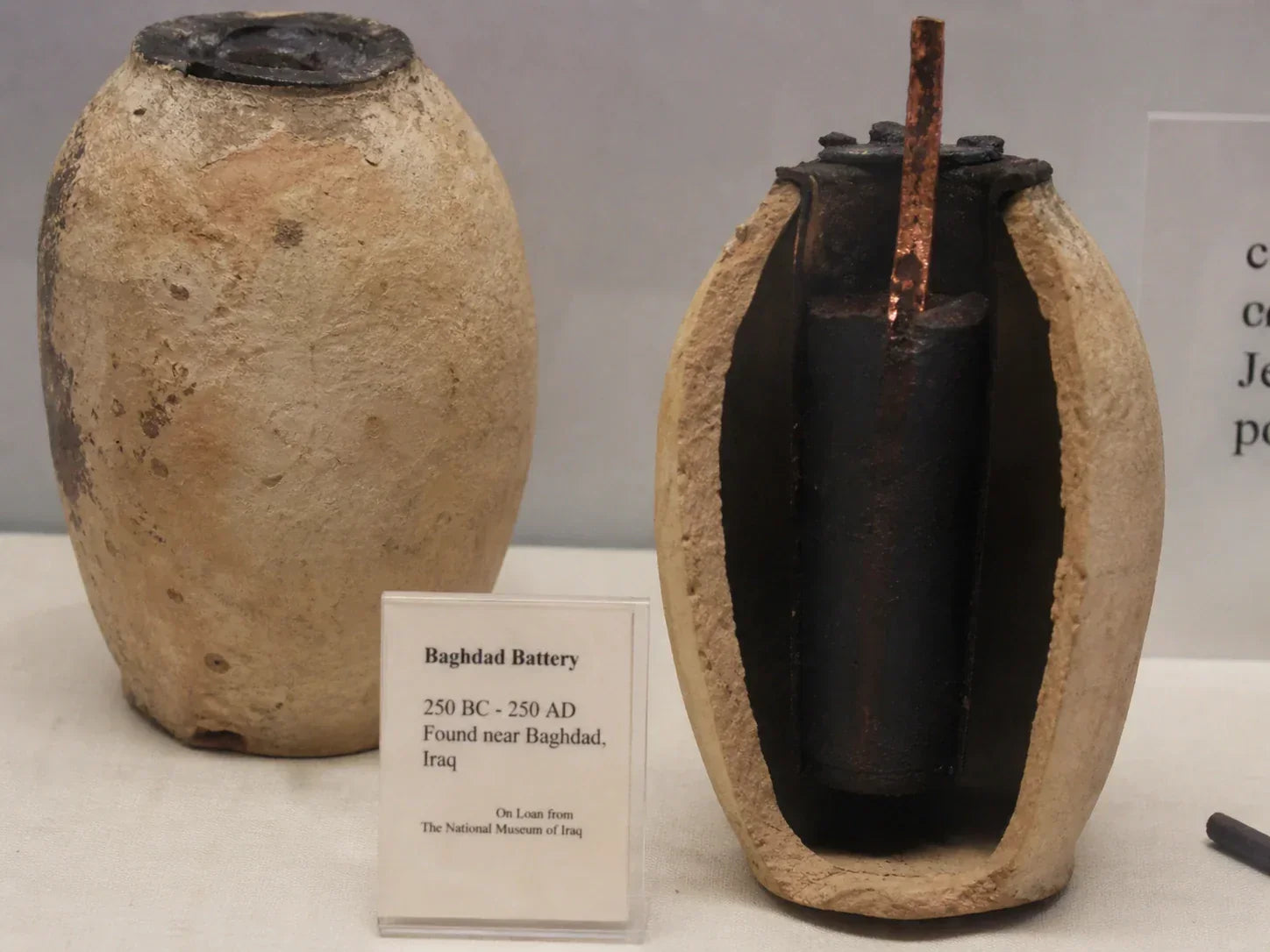
Another widely debated OOPArt is the “Baghdad Battery,” discovered in 1938 in Khujut Rabu, Iraq, and dated to the Parthian era (around 250 BCE to 224 CE). It consists of a clay jar containing a copper cylinder, which encloses an iron rod. When filled with an acidic electrolyte like grape juice or vinegar, this assembly could, in theory, generate a small electrical current.
Proponents of the “ancient battery” theory suggest the device was used for electroplating objects with precious metals, for medical purposes like pain relief through electrostimulation, or even for ritualistic shock therapy. They point to ancient artifacts with thin gold coatings that might have been applied using such a method. Skeptics, however, argue that there’s no definitive evidence of wires or electrical usage in the archaeological record of the time. They propose the jars were more likely used for storing sacred scrolls, pigments, or spices, with the metal components serving a structural or symbolic purpose rather than a functional electrical one. The debate continues, highlighting the challenge of interpreting ancient technology without explicit instructions.
Giants, Lost Civilizations, and Suppressed Knowledge
Beyond individual artifacts, some archaeological claims point to entirely different histories—tales of giant humanoids, forgotten super-civilizations, or knowledge deliberately hidden from the public. These narratives often tap into a deep-seated human desire for a grander, more mysterious past.
The Giant Skeletons of Lovelock Cave: Fact or Folklore?
Stories of ancient giants exist in cultures worldwide, and North America is no exception. Legends of a race of red-haired giants, the Si-Te-Cah, who inhabited Lovelock Cave in Nevada, have long fascinated alternative history enthusiasts. These legends gained traction in the early 20th century when miners excavated the cave for guano, reportedly finding exceptionally large human skeletons, some over eight feet tall.
Mainstream archaeology, however, offers a different interpretation. While the cave did yield significant archaeological finds, including numerous artifacts and remains of the Paiute people, there is no verified scientific evidence of giant human skeletons. The “giants” are generally attributed to misinterpretations of normal-sized human remains, perhaps unusually tall individuals, or even simple exaggeration and folklore. The “red hair” is often explained by the natural degradation and staining of hair over centuries in the cave environment. Despite the scientific debunking, the allure of ancient giants persists, fueled by local legends and the romantic notion of a forgotten race.
Gobekli Tepe: Rewriting the Dawn of Civilization?
Sometimes, a genuine archaeological discovery is so profound that it forces a paradigm shift, proving that “forbidden archaeology” isn’t always about hoaxes, but about truly revolutionary finds. Gobekli Tepe in southeastern Turkey is one such site. Dated to roughly 9600–8200 BCE, it predates Stonehenge by about 6,000 years and the invention of pottery, metallurgy, and even agriculture.
This massive complex of megalithic structures, featuring intricately carved T-shaped pillars arranged in circles, was built by hunter-gatherer societies. Its existence challenges the long-held belief that complex social structures, monumental architecture, and organized religion only emerged after the development of settled agriculture. Gobekli Tepe suggests that the desire for spiritual gathering and monumental building might have preceded and even driven the shift to agriculture, rather than being a consequence of it. This site is a powerful example of how real archaeological discoveries can profoundly rewrite our understanding of human development, proving that history is far more dynamic and surprising than we often assume.
The Bosnian Pyramids: A Geological Anomaly or Ancient Wonder?
Few modern “controversial discoveries” have ignited as much passion and scientific condemnation as the so-called “Bosnian Pyramids.” In 2005, Dr. Semir Osmanagić, an amateur archaeologist, claimed that several hills near Visoko, Bosnia and Herzegovina, were actually ancient, man-made pyramids, far older and larger than the Egyptian pyramids. He posited that they were built by an advanced civilization over 12,000 years ago.
Osmanagić’s claims gained significant public attention and local support, leading to extensive excavations. He points to geometric shapes, alleged concrete blocks, and underground tunnels as evidence. However, the vast majority of professional geologists and archaeologists have vehemently rejected these claims. They assert that the “pyramids” are natural geological formations (flat-topped hills or “flatirons”), that the “concrete” is natural conglomerate rock, and that the “tunnels” are ancient mining shafts. Scientific organizations, including the European Association of Archaeologists, have issued strong statements condemning the project as a pseudoscientific hoax that damages legitimate archaeological sites in the region. This case is a stark reminder of the often-heated conflict between popular enthusiasm for alternative history and rigorous scientific methodology.
Challenging the Human Timeline: Evidence of Earlier Civilizations?
Some of the most provocative finds are those that suggest human activity or even advanced culture existed far earlier than our current understanding allows. These discoveries, if verified, would not just tweak our timelines but shatter them entirely.
The Ica Stones: Dinosaurs and Ancient Peruvians?
The Ica Stones, a collection of thousands of engraved andesite stones found in the Ica region of Peru, became a sensation in the 1960s and 70s. Many of these stones depict scenes of incredible detail, including humans interacting with dinosaurs, advanced medical procedures (like brain surgery and organ transplants), and even astronomical maps. If authentic, they would prove that humans coexisted with dinosaurs and possessed advanced knowledge tens of millions of years ago, completely overturning established paleontology and anthropology.
The primary proponent, Dr. Javier Cabrera Darquea, claimed to have amassed over 11,000 such stones. However, the scientific community widely regards the Ica Stones as modern hoaxes. Several individuals involved in their creation confessed to carving them, often using simple tools and inspired by comic books and movies. The depictions are anatomically inconsistent with known dinosaurs, and the sheer number and consistency of the “impossible” imagery strain credulity. While still popular in certain circles as evidence of “suppressed history,” the Ica Stones are a classic example of a “debunked theory,” highlighting the importance of verifiable evidence.
The Laetoli Footprints: Our Earliest Walkers?
While many claims of early human activity are contentious, some legitimate discoveries genuinely push back our understanding of human origins. The Laetoli footprints, discovered in Tanzania by Mary Leakey’s team in 1978, are one such groundbreaking find. These fossilized footprints, preserved in volcanic ash, were made by three hominins walking upright approximately 3.6 million years ago.
The remarkable detail of the footprints, showing clear arches and big toes aligned with the foot, provides undeniable evidence of habitual bipedalism at a much earlier stage than previously accepted. This discovery was a profound challenge to the prevailing theories of human evolution at the time, particularly the idea that large brains evolved before bipedalism. The Laetoli footprints demonstrated that our ancestors were walking upright long before their brains significantly increased in size, forcing a re-evaluation of the sequence of evolutionary developments. This is a powerful testament to how genuine archaeological breakthroughs can indeed redefine our understanding of the human timeline, albeit through rigorous scientific methods rather than speculative claims.
The Psychology of Controversy: Why Do These Finds Fascinate Us?
Why do these controversial finds and “forbidden archaeology” narratives captivate us so deeply? Part of the allure lies in the human desire for mystery and the thrill of imagining a past far grander or stranger than we currently know. The idea of “suppressed history” resonates with those who are naturally skeptical of authority or believe in hidden truths. It offers a sense of empowerment, suggesting that ordinary people can uncover secrets the establishment ignores.
Furthermore, these stories often tap into profound questions about our origins, purpose, and potential. If ancient civilizations were more advanced, what does that say about our own trajectory? If giants once roamed the Earth, what other wonders might be lost to time? While the scientific method demands verifiable evidence and rigorous peer review, the human imagination thrives on possibility and the unknown. This creates a fertile ground for theories that challenge the status quo, even when scientific consensus points in another direction.
Debunked Theories and the Scientific Method
It’s crucial to understand how archaeology and the broader scientific community approach these challenging finds. The scientific method is a process of observation, hypothesis formation, experimentation, and rigorous testing. For a theory to gain acceptance, it must be supported by verifiable, repeatable evidence, withstand peer review, and offer a more robust explanation than existing models.
When a “controversial discovery” is presented, archaeologists and geologists don’t immediately dismiss it. Instead, they apply scientific scrutiny:
- Dating methods: Is the dating reliable and consistent with multiple techniques?
- Material analysis: Is the material consistent with the alleged age and origin?
- Expert consensus: Do specialists in relevant fields (e.g., geology, paleontology, anthropology) concur with the interpretation?
- Anchor Text: Understanding Archaeological Dating Methods
- Suggested URL:
/articles/understanding-archaeological-dating-methods(Hypothetical article on how carbon dating, stratigraphy, etc., work) - Anchor Text: The Science of Human Evolution
- Suggested URL:
/articles/the-science-of-human-evolution(Hypothetical article covering hominin development and key discoveries) - Anchor Text: Antikythera Mechanism
- Suggested URL:
https://www.antikythera-mechanism.gr/(Official Antikythera Mechanism Research Project website) - Anchor Text: Gobekli Tepe
- Suggested URL:
https://www.smithsonianmag.com/history/gobekli-tepe-the-worlds-first-temple-83613665/(Smithsonian Magazine article on Gobekli Tepe, a reputable general science publication) - Image 1 (Antikythera Mechanism): Close-up of the complex bronze gears and dials of the Antikythera Mechanism, an ancient Greek astronomical calculator.
- Image 2 (Klerksdorp Spheres): Several small, reddish-brown Klerksdorp Spheres, some with distinct grooves, resting on a rocky surface.
- Image 3 (Baghdad Battery): A reconstructed Baghdad Battery showing a clay jar, copper cylinder, and iron rod, with an explanation of its supposed function.
- Image 4 (Gobekli Tepe): Massive T-shaped megalithic pillars with intricate animal carvings standing in circular arrangements at the ancient site of Gobekli Tepe.
- Image 5 (Laetoli Footprints): Fossilized hominin footprints clearly preserved in volcanic ash, showing an ancient bipedal gait.
- Article Schema: This entire article is suitable for
Articleschema. - FAQPage Schema: An FAQ section could be added at the end to address common questions like “What is an OOPArt?” or “Are the Bosnian Pyramids real?” to leverage
FAQPageschema.# Challenging History: Unearthing Provocative and Controversial Archaeological Finds - Dating methods: Is the dating reliable and consistent with multiple techniques?
- Material analysis: Is the material consistent with the alleged age and origin?
- Expert consensus: Do specialists in relevant fields (e.g., geology, paleontology, anthropology) concur with the interpretation?
Context: Was the artifact found in situ* (in its original place) with undisturbed layers, or was it a surface find or from a disturbed context?
Many “forbidden” finds eventually become “debunked theories” because they fail one or more of these tests. This isn’t about suppressing truth; it’s about maintaining the integrity of historical and scientific knowledge. True breakthroughs, like Gobekli Tepe or the Antikythera Mechanism, are eventually integrated into our understanding because they survive this rigorous process, forcing us to expand our knowledge rather than abandon our methods.
The Enduring Allure of the Unknown
The world of archaeology is far from static. It’s a dynamic field where new discoveries constantly reshape our understanding of the past. While many “forbidden” finds ultimately fall short of scientific scrutiny, they serve an important purpose: they fuel our curiosity, push the boundaries of conventional thought, and remind us that history is an ongoing excavation, not a closed book.
The tension between established history and provocative claims will likely always exist. It’s in this space of questioning, debating, and critically examining evidence that both legitimate breakthroughs and fascinating, if unproven, theories emerge. Whether you lean towards the rigorous evidence of mainstream archaeology or find yourself drawn to the tantalizing possibilities of suppressed history, one thing is certain: the human past is full of wonders, both known and yet to be fully understood.
Join the debate in our community forum and share your thoughts on these controversial discoveries. What do you believe about these ancient mysteries?
—
Internal Link Suggestions:
External Link Suggestions:
Image Alt Text Suggestions:
Structured Data Suggestions:
Imagine a world where everything you thought you knew about human history was suddenly turned on its head. Where ancient civilizations possessed technologies we’re only just rediscovering, or where our ancestors walked the Earth far earlier and achieved feats far greater than mainstream textbooks suggest. This isn’t just the stuff of science fiction; it’s the tantalizing promise of “forbidden archaeology,” a realm where provocative finds challenge established narratives and spark fiery debates between conventional scholars and those who believe a deeper, more complex past awaits discovery.
This article delves into some of the most captivating and controversial archaeological discoveries ever made. We’ll explore artifacts and sites that seem to defy explanation, examine the theories—both mainstream and alternative—that attempt to make sense of them, and ponder why these mysteries hold such an enduring grip on our collective imagination. Prepare to question, to wonder, and perhaps, to see history in a whole new light.
What is “Forbidden Archaeology” and Why Does it Spark Debate?
The term “forbidden archaeology” often refers to archaeological finds that appear to contradict established historical timelines or scientific paradigms. These aren’t just minor puzzles; they are discoveries that, if proven true in their most radical interpretations, would force a complete rewriting of our understanding of human origins, technological development, and the very nature of ancient civilizations.
Such finds become controversial because they often lack clear context, display features far ahead of their supposed time, or suggest human capabilities that don’t fit the accepted evolutionary or cultural progression. For mainstream archaeologists, these anomalies are typically explained through misinterpretation, natural geological processes, or even outright hoaxes. However, for enthusiasts of alternative history and conspiracy theories, these objects represent “suppressed history”—evidence that the academic establishment is either unwilling or unable to accept, perhaps even actively concealing. The tension between these perspectives is where the real intrigue lies.
The Out-of-Place Artifacts (OOPArt) Phenomenon
One of the most thrilling categories of controversial finds are “Out-of-Place Artifacts,” or OOPArts. These are objects discovered in contexts that challenge conventional historical chronology, suggesting advanced knowledge or technology existed in periods where it shouldn’t have. They ignite our curiosity, making us wonder if ancient humans were far more sophisticated than we give them credit for.
The Antikythera Mechanism: A Glimpse of Ancient Genius?
Not all OOPArts remain “out of place.” The Antikythera Mechanism, recovered from a Roman-era shipwreck off the coast of Greece in 1901, is a prime example of an ancient artifact that initially baffled researchers. This complex device, dating to around 150-100 BCE, features an intricate system of meshing bronze gears and dials. For decades, its purpose was a mystery, as nothing remotely similar had been found from that period.
Initial interpretations suggested it was a navigational tool or an astronomical calculator. Modern research, employing advanced imaging techniques, has revealed it to be an incredibly sophisticated analog computer, capable of predicting astronomical positions and eclipses decades in advance, tracking the cycles of the Olympic Games, and even modeling the irregular orbit of the Moon. Its complexity was unprecedented for its time, demonstrating a level of mechanical engineering thought to have emerged over a millennium later. While no longer “forbidden,” its discovery forced historians to dramatically revise their understanding of ancient Greek technological prowess, proving that sometimes, the past truly can surprise us with its sophistication.
The Klerksdorp Spheres: Natural Formations or Ancient Tools?
Diving into more contentious territory, the Klerksdorp Spheres are small, metallic objects, often with parallel grooves around their equators, found in pyrophyllite deposits near Klerksdorp, South Africa. These deposits are estimated to be around 2.8 billion years old. To some, these perfectly formed, grooved spheres are undeniable evidence of intelligent design from an impossibly ancient civilization, challenging the timeline of human existence and technological capability.
However, mainstream geologists largely dismiss this interpretation. They identify the Klerksdorp Spheres as concretions, natural geological formations created by the gradual accretion of minerals around a central nucleus. The grooves, they argue, are a result of natural layering within the concretion or a byproduct of the surrounding rock’s metamorphic processes. While undeniably intriguing in their symmetry, the scientific consensus points to natural, rather than artificial, origins, making them a classic case study in how natural phenomena can be interpreted through a “forbidden archaeology” lens.
The Baghdad Battery: Electroplating or Ritual Object?
Another widely debated OOPArt is the “Baghdad Battery,” discovered in 1938 in Khujut Rabu, Iraq, and dated to the Parthian era (around 250 BCE to 224 CE). It consists of a clay jar containing a copper cylinder, which encloses an iron rod. When filled with an acidic electrolyte like grape juice or vinegar, this assembly could, in theory, generate a small electrical current.
Proponents of the “ancient battery” theory suggest the device was used for electroplating objects with precious metals, for medical purposes like pain relief through electrostimulation, or even for ritualistic shock therapy. They point to ancient artifacts with thin gold coatings that might have been applied using such a method. Skeptics, however, argue that there’s no definitive evidence of wires or electrical usage in the archaeological record of the time. They propose the jars were more likely used for storing sacred scrolls, pigments, or spices, with the metal components serving a structural or symbolic purpose rather than a functional electrical one. The debate continues, highlighting the challenge of interpreting ancient technology without explicit instructions.
Giants, Lost Civilizations, and Suppressed Knowledge
Beyond individual artifacts, some archaeological claims point to entirely different histories—tales of giant humanoids, forgotten super-civilizations, or knowledge deliberately hidden from the public. These narratives often tap into a deep-seated human desire for a grander, more mysterious past.
The Giant Skeletons of Lovelock Cave: Fact or Folklore?
Stories of ancient giants exist in cultures worldwide, and North America is no exception. Legends of a race of red-haired giants, the Si-Te-Cah, who inhabited Lovelock Cave in Nevada, have long fascinated alternative history enthusiasts. These legends gained traction in the early 20th century when miners excavated the cave for guano, reportedly finding exceptionally large human skeletons, some over eight feet tall.
Mainstream archaeology, however, offers a different interpretation. While the cave did yield significant archaeological finds, including numerous artifacts and remains of the Paiute people, there is no verified scientific evidence of giant human skeletons. The “giants” are generally attributed to misinterpretations of normal-sized human remains, perhaps unusually tall individuals, or even simple exaggeration and folklore. The “red hair” is often explained by the natural degradation and staining of hair over centuries in the cave environment. Despite the scientific debunking, the allure of ancient giants persists, fueled by local legends and the romantic notion of a forgotten race.
Gobekli Tepe: Rewriting the Dawn of Civilization?
Sometimes, a genuine archaeological discovery is so profound that it forces a paradigm shift, proving that “forbidden archaeology” isn’t always about hoaxes, but about truly revolutionary finds. Gobekli Tepe in southeastern Turkey is one such site. Dated to roughly 9600–8200 BCE, it predates Stonehenge by about 6,000 years and the invention of pottery, metallurgy, and even agriculture.
This massive complex of megalithic structures, featuring intricately carved T-shaped pillars arranged in circles, was built by hunter-gatherer societies. Its existence challenges the long-held belief that complex social structures, monumental architecture, and organized religion only emerged after the development of settled agriculture. Gobekli Tepe suggests that the desire for spiritual gathering and monumental building might have preceded and even driven the shift to agriculture, rather than being a consequence of it. This site is a powerful example of how real archaeological discoveries can profoundly rewrite our understanding of human development, proving that history is far more dynamic and surprising than we often assume.
The Bosnian Pyramids: A Geological Anomaly or Ancient Wonder?
Few modern “controversial discoveries” have ignited as much passion and scientific condemnation as the so-called “Bosnian Pyramids.” In 2005, Dr. Semir Osmanagić, an amateur archaeologist, claimed that several hills near Visoko, Bosnia and Herzegovina, were actually ancient, man-made pyramids, far older and larger than the Egyptian pyramids. He posited that they were built by an advanced civilization over 12,000 years ago.
Osmanagić’s claims gained significant public attention and local support, leading to extensive excavations. He points to geometric shapes, alleged concrete blocks, and underground tunnels as evidence. However, the vast majority of professional geologists and archaeologists have vehemently rejected these claims. They assert that the “pyramids” are natural geological formations (flat-topped hills or “flatirons”), that the “concrete” is natural conglomerate rock, and that the “tunnels” are ancient mining shafts. Scientific organizations, including the European Association of Archaeologists, have issued strong statements condemning the project as a pseudoscientific hoax that damages legitimate archaeological sites in the region. This case is a stark reminder of the often-heated conflict between popular enthusiasm for alternative history and rigorous scientific methodology.
Challenging the Human Timeline: Evidence of Earlier Civilizations?
Some of the most provocative finds are those that suggest human activity or even advanced culture existed far earlier than our current understanding allows. These discoveries, if verified, would not just tweak our timelines but shatter them entirely.
The Ica Stones: Dinosaurs and Ancient Peruvians?
The Ica Stones, a collection of thousands of engraved andesite stones found in the Ica region of Peru, became a sensation in the 1960s and 70s. Many of these stones depict scenes of incredible detail, including humans interacting with dinosaurs, advanced medical procedures (like brain surgery and organ transplants), and even astronomical maps. If authentic, they would prove that humans coexisted with dinosaurs and possessed advanced knowledge tens of millions of years ago, completely overturning established paleontology and anthropology.
The primary proponent, Dr. Javier Cabrera Darquea, claimed to have amassed over 11,000 such stones. However, the scientific community widely regards the Ica Stones as modern hoaxes. Several individuals involved in their creation confessed to carving them, often using simple tools and inspired by comic books and movies. The depictions are anatomically inconsistent with known dinosaurs, and the sheer number and consistency of the “impossible” imagery strain credulity. While still popular in certain circles as evidence of “suppressed history,” the Ica Stones are a classic example of a “debunked theory,” highlighting the importance of verifiable evidence.
The Laetoli Footprints: Our Earliest Walkers?
While many claims of early human activity are contentious, some legitimate discoveries genuinely push back our understanding of human origins. The Laetoli footprints, discovered in Tanzania by Mary Leakey’s team in 1978, are one such groundbreaking find. These fossilized footprints, preserved in volcanic ash, were made by three hominins walking upright approximately 3.6 million years ago.
The remarkable detail of the footprints, showing clear arches and big toes aligned with the foot, provides undeniable evidence of habitual bipedalism at a much earlier stage than previously accepted. This discovery was a profound challenge to the prevailing theories of human evolution at the time, particularly the idea that large brains evolved before bipedalism. The Laetoli footprints demonstrated that our ancestors were walking upright long before their brains significantly increased in size, forcing a re-evaluation of the sequence of evolutionary developments. This is a powerful testament to how genuine archaeological breakthroughs can indeed redefine our understanding of the human timeline, albeit through rigorous scientific methods rather than speculative claims.
The Psychology of Controversy: Why Do These Finds Fascinate Us?
Why do these controversial finds and “forbidden archaeology” narratives captivate us so deeply? Part of the allure lies in the human desire for mystery and the thrill of imagining a past far grander or stranger than we currently know. The idea of “suppressed history” resonates with those who are naturally skeptical of authority or believe in hidden truths. It offers a sense of empowerment, suggesting that ordinary people can uncover secrets the establishment ignores.
Furthermore, these stories often tap into profound questions about our origins, purpose, and potential. If ancient civilizations were more advanced, what does that say about our own trajectory? If giants once roamed the Earth, what other wonders might be lost to time? While the scientific method demands verifiable evidence and rigorous peer review, the human imagination thrives on possibility and the unknown. This creates a fertile ground for theories that challenge the status quo, even when scientific consensus points in another direction.
Debunked Theories and the Scientific Method
It’s crucial to understand how archaeology and the broader scientific community approach these challenging finds. The scientific method is a process of observation, hypothesis formation, experimentation, and rigorous testing. For a theory to gain acceptance, it must be supported by verifiable, repeatable evidence, withstand peer review, and offer a more robust explanation than existing models.
When a “controversial discovery” is presented, archaeologists and geologists don’t immediately dismiss it. Instead, they apply scientific scrutiny:
Context: Was the artifact found in situ* (in its original place) with undisturbed layers, or was it a surface find or from a disturbed context?
Many “forbidden” finds eventually become “debunked theories” because they fail one or more of these tests. This isn’t about suppressing truth; it’s about maintaining the integrity of historical and scientific knowledge. True breakthroughs, like Gobekli Tepe or the Antikythera Mechanism, are eventually integrated into our understanding because they survive this rigorous process, forcing us to expand our knowledge rather than abandon our methods.
The Enduring Allure of the Unknown
The world of archaeology is far from static. It’s a dynamic field where new discoveries constantly reshape our understanding of the past. While many “forbidden” finds ultimately fall short of scientific scrutiny, they serve an important purpose: they fuel our curiosity, push the boundaries of conventional thought, and remind us that history is an ongoing excavation, not a closed book.
The tension between established history and provocative claims will likely always exist. It’s in this space of questioning, debating, and critically examining evidence that both legitimate breakthroughs and fascinating, if unproven, theories emerge. Whether you lean towards the rigorous evidence of mainstream archaeology or find yourself drawn to the tantalizing possibilities of suppressed history, one thing is certain: the human past is full of wonders, both known and yet to be fully understood.
Join the debate in our community forum and share your thoughts on these controversial discoveries. What do you believe about these ancient mysteries?