
Challenging History: Unearthing Provocative and Controversial Archaeological Finds
Have you ever looked at history and wondered if there’s more to the story than what the textbooks tell us? For centuries, archaeologists have meticulously pieced together the narrative of human civilization, but every now and then, a discovery emerges that doesn’t quite fit. These controversial discoveries often spark heated debates, leading some to question the very foundations of our understanding of the past. Are these anomalies simply misinterpretations, or do they represent glimpses into a suppressed history that challenges established paradigms?
Welcome to the thrilling, often frustrating, world of forbidden archaeology. This isn’t just about dusty relics; it’s about the clash between scientific dogma and tantalizing evidence that hints at advanced ancient civilizations, unknown human origins, or even pre-Columbian global contacts. For history buffs and those fascinated by debunked theories and alternative narratives, these finds are more than just curiosities – they’re keys to unlocking a deeper, perhaps more complex, truth about humanity’s journey. Prepare to delve into the shadows of history, where the line between fact and speculation blurs, and the past is anything but settled. Let’s explore some of the most provocative and fiercely debated archaeological finds that continue to baffle experts and ignite the imaginations of millions.

The Enigma of Out-of-Place Artifacts (Ooparts): Challenging Our Timeline
One of the most persistent threads in forbidden archaeology is the phenomenon of Out-of-Place Artifacts, or Ooparts. These are objects discovered in archaeological contexts that seem far too advanced, anachronistic, or geographically misplaced for the period and culture to which they are attributed. They challenge our conventional understanding of technological development and historical timelines, suggesting that ancient peoples might have possessed knowledge or capabilities we’ve long underestimated.
Consider the implications: if a complex mechanism or an intricate artwork predates the known development of such technology by thousands of years, what does that tell us about the intelligence and ingenuity of our ancestors? Or, perhaps more controversially, does it hint at external influences or a lost, advanced civilization? These are the questions that keep the debate alive and fuel the fascination with Ooparts.

The Antikythera Mechanism: A Glimpse into Ancient Sophistication
Discovered in a shipwreck off the coast of the Greek island of Antikythera in 1901, the Antikythera Mechanism is often hailed as the world’s first analog computer. Dating back to the 2nd century BCE, this complex device, composed of dozens of meshing bronze gears, was designed to predict astronomical positions and eclipses with astonishing accuracy.
It’s a marvel of ancient engineering that utterly defies its supposed era. Mainstream archaeology acknowledges its complexity but struggles to place it within a known lineage of Hellenistic technology. Where are its predecessors? Why does such advanced clockwork technology seem to vanish for over a thousand years after its creation? For proponents of controversial discoveries, the Antikythera Mechanism isn’t just an anomaly; it’s a stark reminder that our historical narrative might have significant gaps. It prompts us to ask: what else have we overlooked or lost?

The Baghdad Battery: Electric Thoughts from Antiquity?
Unearthed near Baghdad in 1936, the “Baghdad Battery” consists of a clay jar, a copper cylinder, and an iron rod. Dated to the Parthian era (around 250 BCE – 224 CE), some researchers propose it was an ancient electrical battery, potentially used for electroplating or even rudimentary medical treatments. Experiments have shown that a replica filled with an electrolyte like grape juice can indeed produce a small electrical current.
While many archaeologists remain skeptical, suggesting it might have been a storage vessel for scrolls or a ritual object, the resemblance to galvanic cells is uncanny. If this was indeed a battery, it would push back the invention of practical electricity by nearly two millennia, presenting a significant challenge to our understanding of ancient technology. Could ancient civilizations have harnessed electricity long before Faraday and Volta? The debate continues to spark curiosity and fuel speculation about suppressed history.
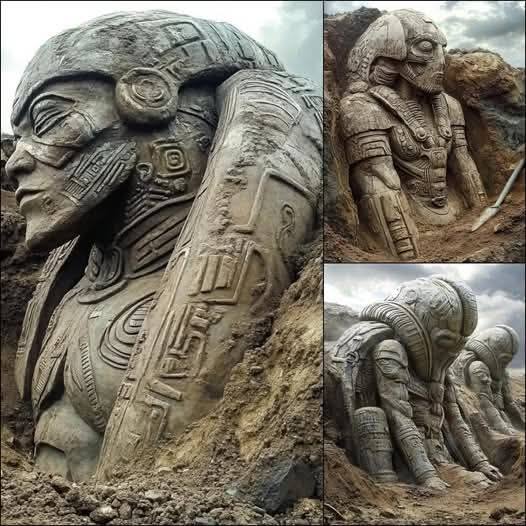
Echoes of Giants and Lost Civilizations: Re-evaluating Human History
Beyond anachronistic technology, some controversial discoveries touch upon the very origins and nature of humanity itself. Tales of giants, advanced pre-diluvian civilizations, and evidence of human presence far earlier than accepted timelines challenge the widely accepted models of human evolution and societal development. These are the narratives that truly resonate with those who believe in a suppressed history.

The Bosnian Pyramids: Natural Formations or Ancient Structures?
In 2005, Dr. Semir Osmanagić declared that several hills in Visoko, Bosnia, were not natural formations but rather ancient pyramids, possibly thousands of years older than the Egyptian pyramids. He points to precise orientations, geometric shapes, and alleged evidence of ancient concrete, claiming they represent the largest and oldest pyramid complex on Earth.
This claim has ignited a firestorm of controversy. Mainstream archaeologists overwhelmingly dismiss the theory, asserting that the formations are entirely natural geological structures. They cite a lack of conventional archaeological evidence, such as artifacts or clear construction techniques, to support the pyramid hypothesis. Yet, for many, the sheer scale and intriguing symmetry of these “hills” offer a compelling alternative narrative, pushing the boundaries of what we thought was possible in ancient Europe. The idea of such a monumental, unknown civilization in Europe is certainly provocative.
Gobekli Tepe: Rewriting the Dawn of Civilization
While not “forbidden” in the traditional sense, Gobekli Tepe in southeastern Turkey is a controversial discovery because it fundamentally reshapes our understanding of the origins of civilization. Dating back approximately 11,600 years – predating Stonehenge by 6,000 years and the invention of agriculture – this site features massive carved stone pillars, some weighing up to 20 tons, arranged in sophisticated circular enclosures.
Gobekli Tepe defies the long-held belief that complex, monumental architecture and organized religion only emerged after the development of settled agriculture. Instead, it suggests that hunter-gatherer societies were capable of immense feats of engineering and abstract thought, possibly driving the very need for agriculture to sustain large groups working on such projects. This discovery isn’t just challenging; it’s actively forcing archaeologists to debunk theories about the progression of human societal development and consider a much more complex, non-linear path to civilization.
Suppressed History and Unconventional Narratives: The Battle for the Past
The concept of suppressed history often arises when evidence, real or perceived, conflicts with established narratives, leading some to believe that certain discoveries are deliberately ignored or discredited by the academic establishment. This isn’t always about malice; sometimes it’s the natural friction between new, unconventional data and deeply entrenched scientific paradigms.
The Piri Reis Map: A Cartographic Conundrum
The Piri Reis Map, compiled in 1513 by the Ottoman admiral and cartographer Piri Reis, is a fascinating document. It depicts parts of the western coast of Africa, the eastern coast of South America, and, most controversially, a portion of Antarctica that appears to be ice-free. The map claims to be based on older source maps, some