
The Uncracked Code of the Phaistos Disc: An Ancient Minoan Enigma
The ancient world, a tapestry woven from the threads of forgotten empires and monumental achievements, continues to guard its secrets with captivating tenacity. From the sun-baked sands of Egypt to the sprawling ruins of Rome, archaeological mysteries abound, drawing us into a relentless quest for knowledge. Among these profound ancient discoveries, few artifacts present as tantalizing and enduring a puzzle as the Phaistos Disc. Unearthed from the heart of Minoan civilization on the island of Crete, this circular clay tablet, adorned with an enigmatic spiral of stamped symbols, stands as a singular testament to an advanced yet largely undeciphered writing system. It represents a profound challenge to ancient history scholars—a silent sentinel from a lost civilization whose message has remained locked for millennia.
Discovered over a century ago, the Phaistos Disc immediately captivated the imagination of archaeology enthusiasts and professional epigraphers alike. Unlike other ancient scripts that have yielded their secrets—such as Egyptian hieroglyphs or Linear B—the Disc’s unique nature, its method of creation, its isolated presence, and its seemingly singular set of symbols have defied all attempts at decipherment. This article explores the documented facts surrounding the Phaistos Disc, examining its fascinating discovery, its physical characteristics, the myriad attempts to unravel its meaning, and the crucial distinction between verifiable historical mysteries and the alluring, often unfounded, speculation that surrounds it. Join us as we journey into the heart of Minoan Crete to investigate one of the most compelling ancient artifacts and enduring forgotten-history puzzles of the ancient world.

The Discovery on Crete: Unearthing a Minoan Enigma
The story of the Phaistos Disc begins in the spring of 1908 amidst the sun-drenched ruins of the Minoan Palace of Phaistos on the island of Crete. This grand palace, a contemporary of the more famous Knossos, was a vital administrative and religious center for the powerful Minoan civilization. Italian archaeologist Luigi Pernier, leading an excavation for the Italian Archaeological Mission, made the remarkable find.
On July 3, 1908, Pernier’s team uncovered the disc in a basement storeroom beneath the north-east quarter of the palace. It lay within a small, rectangular deposit, approximately 60 cm below the floor level of a building that had been destroyed by fire. Crucially, the disc was found alongside a Linear A tablet, identified as PH 1, which provided immediate archaeological context and helped date the discovery. This stratigraphic evidence placed the disc within the Middle Minoan IIB period, roughly corresponding to 1850–1600 BCE, marking it as a truly ancient artifact. The storeroom itself contained a layer of fine black ash and pottery from the Late Minoan IB period, suggesting the disc was deposited before this later destruction.
The discovery site was part of the original palace complex, specifically in what Pernier termed “Room XLIV,” a secure context that immediately underscored the disc’s authenticity and Minoan origin. Its presence within a well-stratified archaeological layer, alongside other known Minoan artifacts, firmly rooted it in the ancient history of Crete. From the moment it was unearthed, the Phaistos Disc presented itself as an extraordinary object, unlike anything previously encountered in Minoan archaeology. It was clear that this was no ordinary piece of pottery but a carefully crafted item bearing a complex and deliberate message, destined to become one of the most profound archaeological mysteries of its time.
A Unique Artifact: Form, Symbols, and Production
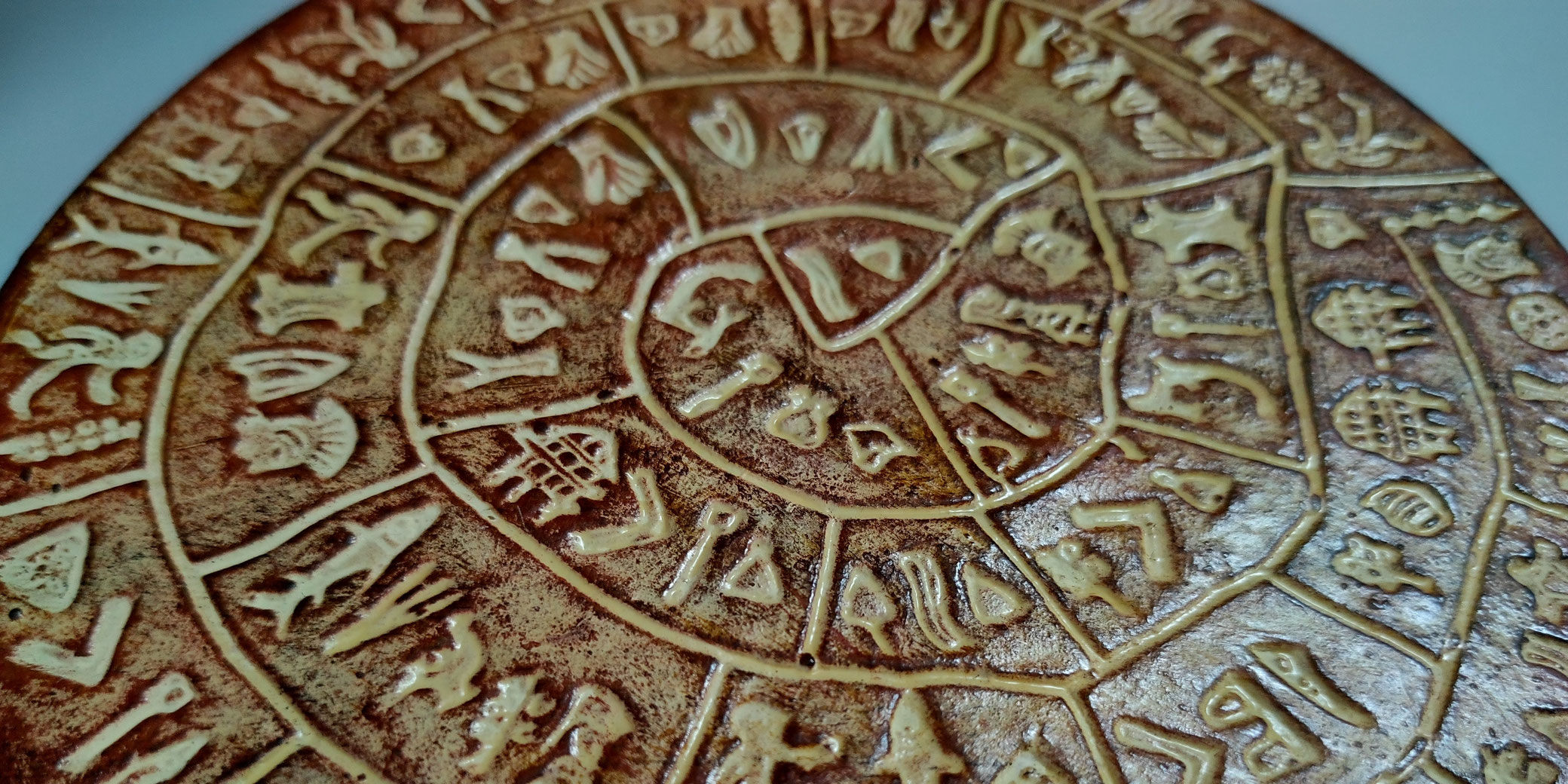
The Phaistos Disc is a remarkably preserved object, a testament to the skilled craftsmanship of the Minoans. It is a circular clay tablet, approximately 15 centimeters (5.9 inches) in diameter and 1.0 to 1.2 centimeters (0.39 to 0.47 inches) thick. Both sides of the disc are covered with a meticulously arranged spiral of stamped hieroglyphic-like symbols, impressed into the wet clay before firing. This stamping technique is itself a significant aspect of the disc’s mystery, as it predates movable-type printing by over 3,000 years, offering a glimpse into sophisticated ancient communication methods.
Each side of the disc features a spiral inscription, beginning at the rim and winding inwards toward the center. Side A contains 31 groups of symbols, while Side B has 30 groups. These groups are separated by vertical lines, suggesting word or phrase divisions. A total of 241 individual signs appear on the disc, comprising 45 distinct symbols. These symbols depict a variety of recognizable objects, including human figures, parts of the body, animals, plants, tools, and abstract designs. Examples include a plumed head, a shield, a fish, a bird, a bee, a lily, a double axe, and a ship. The clarity and consistency of these symbols indicate they were made using a set of pre-carved stamps or seals rather than being individually incised. This raises the intriguing possibility that the Minoans possessed a form of proto-printing technology, allowing for the rapid reproduction of complex texts.
The disc is made of fine, reddish-brown clay, typical of Minoan pottery from the region. Its firing ensured its durability, allowing it to survive millennia relatively intact. The direction of reading—whether inward or outward, and clockwise or counter-clockwise—remains a subject of intense debate among scholars, further complicating decipherment efforts. The fact that no other identical or even similar stamped clay disc has ever been found anywhere in the ancient world only deepens the enigma. While Minoan Crete has yielded thousands of tablets inscribed with Linear A and Linear B scripts, the Phaistos Disc stands alone, an ancient artifact without a direct parallel, making it a truly unique historical mystery.
The Unbreakable Code: Decipherment Attempts and Theories
The allure of the Phaistos Disc lies in its steadfast refusal to be understood. Since its discovery, countless linguists, epigraphers, and amateur code-breakers have attempted to unlock its secrets, each proposing theories ranging from the plausible to the fantastical. The fundamental challenge stems from several critical factors: the brevity of the text, the absence of bilingual inscriptions like the Rosetta Stone, and the unknown language family to which the underlying script might belong.
Many decipherment attempts begin by assuming the language of the disc is an early form of Greek, Luwian (an Anatolian language), or a Semitic language. Other theories suggest it might be Indo-European, or even a non-Indo-European language unique to pre-Greek Crete. Without a definitive linguistic family, assigning phonetic values to the 45 unique symbols becomes an exercise in educated guesswork.
Prominent decipherment efforts include:
- The Prayer/Hymn Theory: One of the most common interpretations suggests the disc contains a religious text, possibly a hymn or a prayer. This theory often relies on identifying repeated sequences of symbols as refrains or liturgical phrases. The late British scholar Peter Kober, for instance, proposed it was a hymn to a Minoan goddess, while American linguist Cyrus H. Gordon suggested a Semitic cult hymn.
- The Legal Document Theory: Some scholars hypothesize the disc is a legal document, a treaty, or an administrative record. This would align with the known use of other Minoan scripts (Linear A and B) for bureaucratic purposes. However, its unique form and stamped nature make this less conventional for administrative records.
- The Calendar Theory: Italian scholar Luigi Rossi proposed that the disc is a calendar, with symbols representing astronomical events or agricultural cycles. This theory gains some traction from the disc’s circular shape and the segmented nature of its inscription.
- The Board Game Theory: A more unconventional idea suggests the disc is a game board, with the symbols representing moves or instructions. While intriguing, this theory lacks direct parallels in Minoan archaeology.
- The Hoax Theory (Disputed): A highly controversial theory, primarily put forth by American archaeologist Jerome Eisenberg in 2008, suggested the disc might be a forgery created by Pernier himself or one of his associates. Eisenberg cited the disc’s unique nature, its “too perfect” appearance, and Pernier’s alleged ambition. However, this theory has been overwhelmingly rejected by the archaeological community, which points to the disc’s secure stratigraphic context, its internal consistency, and the lack of any credible evidence to support a forgery. The clay composition and firing techniques are consistent with Minoan practices, and the discovery alongside a Linear A tablet further strengthens its authenticity.
- Discovery Location and Date: The Phaistos Disc was definitively discovered on July 3, 1908, by Luigi Pernier at the Minoan Palace of Phaistos on Crete, in a secure stratigraphic context (Room XLIV).
- Minoan Context: Its discovery alongside a Linear A tablet (PH 1) and pottery from the Middle Minoan IIB period firmly places it within the Minoan civilization, circa 1850–1600 BCE.
- Physical Characteristics: It is a circular clay disc, approximately 15 cm in diameter, 1.0–1.2 cm thick, made of reddish-brown clay, and fired.
- Unique Stamped Symbols: Both sides are covered with 241 signs, comprising 45 distinct symbols, created by pressing pre-carved stamps into wet clay. This makes it a unique example of early proto-printing.
- Authenticity: Despite occasional claims of forgery (most notably Eisenberg’s, which has been widely discredited), the archaeological community overwhelmingly accepts the disc’s authenticity based on its context, material analysis, and consistency with Minoan craftsmanship. It is housed in the Heraklion Archaeological Museum.
- Language: The underlying language remains unknown. Theories range from Minoan (related to Linear A), Greek, Luwian, Semitic, or an entirely distinct language. No consensus exists.
- Purpose: The function of the disc is highly debated. Was it a prayer, a legal document, a calendar, a game, a ritual object, or something else entirely? Each theory has its proponents but lacks definitive proof.
- Direction of Reading: Scholars disagree on whether the text should be read from the center outward or from the rim inward, and whether it is clockwise or counter-clockwise.
- Meaning of Symbols: While the images are recognizable, their phonetic values or logographic meanings are entirely speculative without a deciphered language.
- Alien Origins: Some popular theories, entirely lacking any archaeological or linguistic support, suggest the disc’s symbols are of extraterrestrial origin or convey messages from advanced alien civilizations. These are imaginative narratives, not based on scientific inquiry.
- Magical Artifacts or Prophecies: Claims that the disc holds magical powers, predicts the future, or describes mythical events like Atlantis are purely speculative and belong to the realm of fantasy rather than ancient history.
- Hidden Messages of Atlantis: The allure of Atlantis often leads to attempts to link any unexplained ancient artifact to Plato’s lost city. There is no historical or archaeological basis to connect the Phaistos Disc to Atlantis.
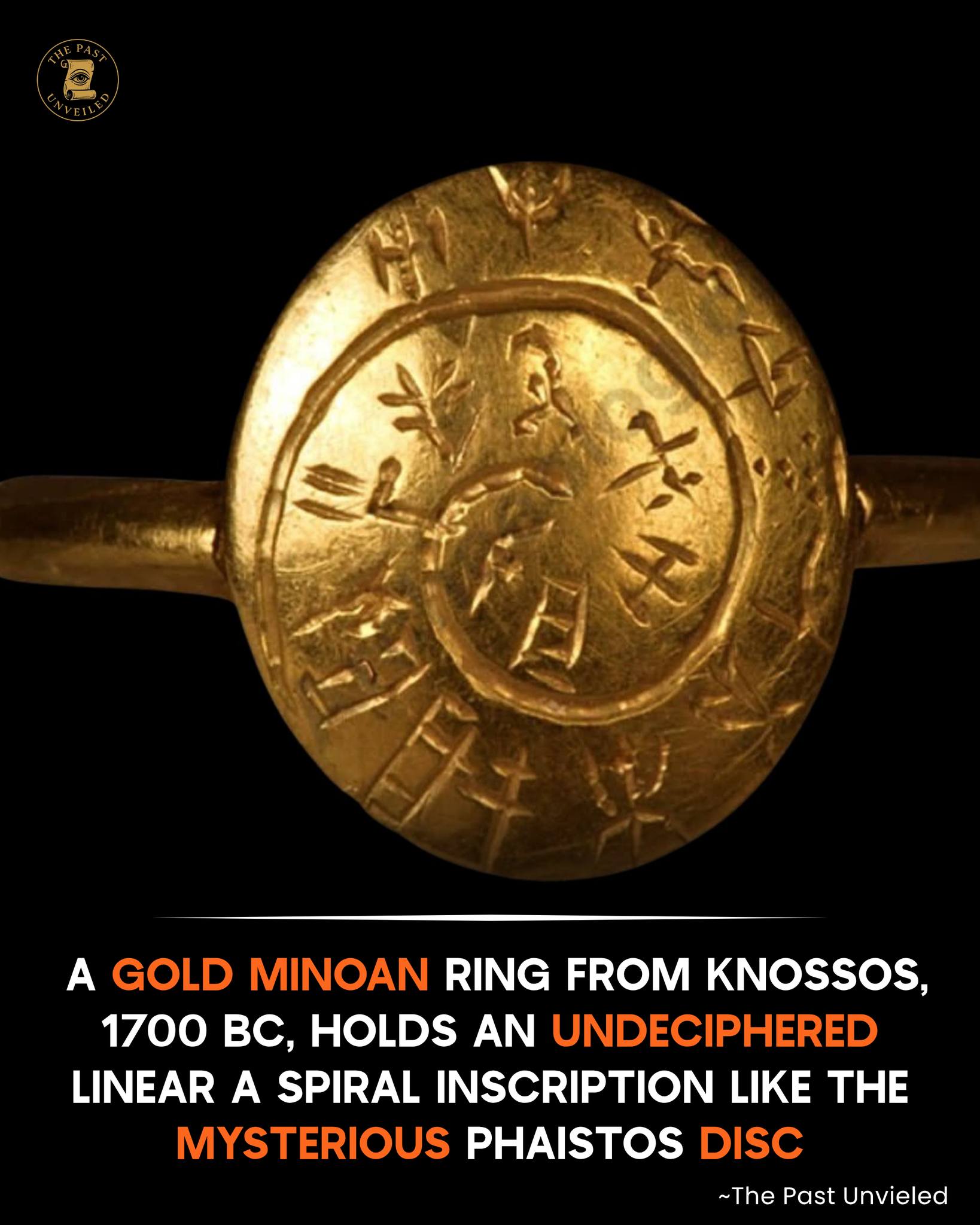
- Cretan Hieroglyphic: An early script, appearing around 2000 BCE, primarily found on seals and clay tablets. It shares some pictorial elements with the Phaistos Disc but is distinct.
- Linear A: Developed around 1800 BCE, this syllabic script is found on numerous clay tablets, seals, and ritual objects across Crete and other Aegean islands. It remains undeciphered, though scholars have identified some phonetic values by comparison with Linear B. Linear A was primarily used for administrative and religious purposes.
- Linear B: This script, derived from Linear A, appeared later, around 1450 BCE, after the Mycenaean Greeks took over Crete. It was famously deciphered by Michael Ventris in 1952, revealing it to be an early form of Greek. Linear B tablets document extensive bureaucratic records.
Despite decades of intense study, no single decipherment theory has gained widespread acceptance among the majority of ancient history and epigraphy experts. The sheer uniqueness of the Phaistos Disc, combined with the limited amount of text, presents an almost insurmountable barrier to conventional decipherment methods, cementing its status as one of the truly profound archaeological mysteries.

Fact vs. Fiction: Separating Archaeology from Speculation
In the realm of ancient mysteries, the line between verifiable fact and imaginative speculation can often blur. For the Phaistos Disc, it is crucial to delineate what archaeology has firmly established from the diverse interpretations and, at times, outright myths that have accumulated around it.
Verified Archaeological and Historical Facts:
Disputed Interpretations and Scholarly Debates:
Internet Mythology and Unsupported Claims:
It is paramount for those fascinated by historical mysteries to rely on documented evidence and rigorous archaeological analysis. While speculation is a natural part of the interpretive process, it must be clearly distinguished from established facts to maintain the integrity of archaeology and forgotten history. The Phaistos Disc remains a mystery precisely because the verifiable facts are insufficient to bridge the gap to a complete understanding—not because of a lack of imaginative theories.

The Broader Context: Minoan Civilization and Its Scripts
To fully appreciate the enigma of the Phaistos Disc, it is essential to understand its place within the broader tapestry of the Minoan civilization. Flourishing on Crete from approximately 2700 to 1450 BCE, the Minoans were a sophisticated Bronze Age culture renowned for their magnificent palatial complexes (like Knossos, Phaistos, and Malia), elaborate frescoes, advanced maritime trade networks, and a unique artistic style. They are often considered Europe’s first advanced civilization.
Minoan society was highly organized, as evidenced by their complex administrative systems that required writing. The Minoans developed at least two other distinct scripts:
The Phaistos Disc stands apart from both Linear A and Cretan Hieroglyphic. While it shares the general period of Linear A’s use, its unique stamped symbols and lack of direct parallels in other Minoan texts make it an outlier. This raises fundamental questions: Was it an experimental script? A one-off creation for a specific, unique purpose? Or does it represent a writing system from a different, perhaps non-Minoan, source that somehow found its way to Phaistos? The very existence of such a distinct script within a civilization already using multiple forms of writing adds another layer to this profound ancient mystery. The disc’s isolation from the main corpus of Minoan inscriptions is a primary reason why its message remains locked.
Why Does the Phaistos Disc Remain a Mystery?
The enduring mystery of the Phaistos Disc is not due to a lack of effort or ingenuity from scholars, but rather a confluence of specific factors that create an almost perfect storm for undecipherability. These challenges highlight the difficulties inherent in deciphering any unknown script, especially one from a forgotten history.