
The Rise and Fall of Rome: A Comprehensive Guide for Students and History Enthusiasts
Introduction
The Roman Empire is one of history’s most influential and enduring civilizations. From its legendary founding in 753 BCE to the fall of the Western Empire in 476 CE, Rome reshaped politics, law, engineering, religion, language, and culture across three continents. For students and history enthusiasts, understanding Rome is essential not only because of its remarkable achievements—roads, aqueducts, the republic, and imperial governance—but also because Rome’s successes and failures offer enduring lessons about power, institutions, and social change. This guide will take you on a structured journey through Rome’s origins, the Republic, the transition to Empire, the high imperial age, crises and transformation, and the eventual decline of the Western Empire. You’ll gain timelines, key figures, primary causes and consequences, and recommended resources for further study. Along the way, you’ll find clear explanations, illustrative examples, and practical study tips that make Roman history accessible and relevant.

Why Study Rome? Relevance for Students and Enthusiasts
– Rome’s influence on modern law: civil law traditions, the concept of citizenship, and legal codes.
- Roman contributions to engineering and urban planning: roads, aqueducts, amphitheaters, and sanitation.
- Political lessons: republic vs. autocracy debates, institutional resilience, and causes of political collapse.
- Cultural heritage: Latin language roots, art, literature, and religion’s transformation into Christianity.
- Early Roman kings and the formation of social and religious institutions.
- Etruscan influence on early Roman culture and technology.
- Republican institutions: Senate, consuls, assemblies, and magistracies.
- Key conflicts: the Struggle of the Orders (patricians vs. plebeians), the Punic Wars (Rome vs. Carthage), and expansion across the Mediterranean.
- Social and economic tensions: land distribution, slavery, and the rise of political populares and optimates.
- Rise of powerful generals: Marius, Sulla, Pompey, and Julius Caesar.
- Caesar’s dictatorship and assassination (44 BCE) and the ensuing civil wars.
- Octavian (Augustus) defeats Antony and Cleopatra and becomes the first emperor in 27 BCE.
- The “Five Good Emperors” (Nerva–Marcus Aurelius) and imperial prosperity.
- Cultural flourishing: Virgil, Horace, Ovid; monumental architecture: the Colosseum, aqueducts, forums.
- The Third-Century Crisis: military anarchy, economic decline, and brief fragmentation.
- The rise of soldier-emperors and the importance of military loyalty.
- Constantine and the Christianization of the Empire; founding of Constantinople (330 CE).
- Decline of the Western Empire: barbarian migrations, internal decay, and the deposition of Romulus Augustulus (476 CE).
- The Eastern Roman/Byzantine continuity until 1453 CE.
- Consuls and magistrates: executive powers with annual offices and collegiality.
- Assemblies: legislative and electoral functions; citizens’ assemblies were foundations of legitimacy.
- Patronage networks and clientela: social mechanisms that structured political life.
- Imperial bureaucracy: prefects, procurators, provincial governors, and imperial household (palace) administration.
- The shift under Diocletian and Constantine to the dominate: open autocracy and increased bureaucratic/military centralization.
- Mechanisms of upward mobility: military service, commerce, and imperial favor.
- Role of women: legal restrictions and social influence via family networks and imperial households.
- Commerce across Mediterranean and overland: grain supply from Egypt, trade with India and China via intermediaries.
- Currency, taxation, and inflation crises in the third century.
- Slavery’s role in labor, domestic life, and the economy; slave revolts (e.g., Spartacus).
- Engineering achievements: aqueducts, sewage systems (Cloaca Maxima), paved roads (viae) enabling rapid movement.
- Public entertainment and social cohesion: gladiatorial games, theater, and public festivals.
- Artistic conventions: realism in portraiture, frescoes and mosaics, sculptural borrowing from Greek models.
- Education: schools for elites, rhetoric training, and the role of Greek tutors.
- Mystery cults and imported religions: Isis, Mithras, and others.
- Christianity’s spread: early persecutions, Constantine’s conversion, and Theodosius’s establishment of Nicene Christianity as state religion.
- Equipment, training, and discipline: the legionary’s kit and tactical flexibility.
- Military roads and fortifications: limes, Hadrian’s Wall, and frontier defense systems.
- Conquests of the Hellenistic East and integration of provinces.
- Defensive wars and pressure from Germanic tribes, Persians, and steppe peoples.
- Economic troubles: taxation burdens, debasement of coinage, and reduced agricultural productivity.
- Military strain: reliance on mercenary forces, decreasing recruitment, and internal power of commanders.
- Demographic and environmental factors: plagues, climatic shifts, and urban decline.
- External pressures: barbarian migrations, Hunnic incursions, and Sassanian threats.
- Institutional inertia and inability to adapt: slow reform, fiscal inflexibility, and weakening civic institutions.
- Long-term consequences: naval development, imperial ambition, and economic integration of the western Mediterranean.
- How Caesar’s concentration of power exposed republican vulnerabilities and enabled imperial transition.
- Diocletian and Constantine’s reforms as recovery mechanisms.
- Inscriptions, legal codes (Twelve Tables, Justinian’s Digest), coins, papyri, and archaeological evidence.
- Reading biases: elite authors, retrospective accounts, and propagandistic elements.
- Examples: Pompeii’s preservation, Roman road networks, and underwater archaeology of shipwrecks.
- The role of “barbarian” peoples: invaders versus foederati (federated allies).
- Economic determinism versus political explanations: interpreting causation in complex systems.
- Use primary sources alongside archaeological reports to balance narrative and material evidence.
- Create maps and spatial visualizations to track expansions, campaigns, and trade routes.
- Compare Roman institutions with modern analogues (law, administration) to deepen understanding.
- Practice essay prompts that require causation analysis, continuity/change arguments, and source evaluation.
- Scholarly overviews: The Cambridge Ancient History series; Walter Goffart’s studies on migration.
- Primary source collections: The Penguin Classics translations of Livy, Tacitus, and Pliny.
- Online resources: The Perseus Digital Library, Internet Ancient History Sourcebook (Fordham), and The British Museum online collections.
- Museums and sites: Capitoline Museums (Rome), British Museum, Pompeii, Herculaneum, and archaeological parks.
- “Roman legal system” → link to site’s article on law and jurisprudence.
- “Ancient engineering achievements” → link to site’s article on aqueducts and roads.
- “Pompeii archaeological discoveries” → link to site’s related excavation or artifact gallery.
- Perseus Digital Library (https://www.perseus.tufts.edu) — primary texts and translations.
- The British Museum (https://www.britishmuseum.org) — collections and research on Roman artifacts.
- The Metropolitan Museum of Art Heilbrunn Timeline (https://www.metmuseum.org) — essays on Roman art and material culture.
- Oxford Classical Dictionary (subscription) for concise, authoritative entries.
- Diagram of Roman political institutions (Image alt: “Chart comparing Roman Republic and Imperial government structures”).
- Photograph of the Colosseum and aqueduct (Image alt: “Colosseum and Roman aqueduct illustrating imperial engineering”).
- Timeline graphic (Image alt: “Timeline of major events from Roman founding to fall of Western Empire”).
- Include author, datePublished, dateModified, headline, description, image, and wordCount properties.
- Add FAQPage schema for the FAQ section to improve chances of featured snippets.
- Suggested Facebook blurb: “From Romulus to Rome’s fall: an in-depth look at politics, society, and culture across a millennium. Read our full guide for timelines, sources, and study tips.”
- Provide Open Graph tags: og:title, og:description, og:image, og:url, og:type=article.
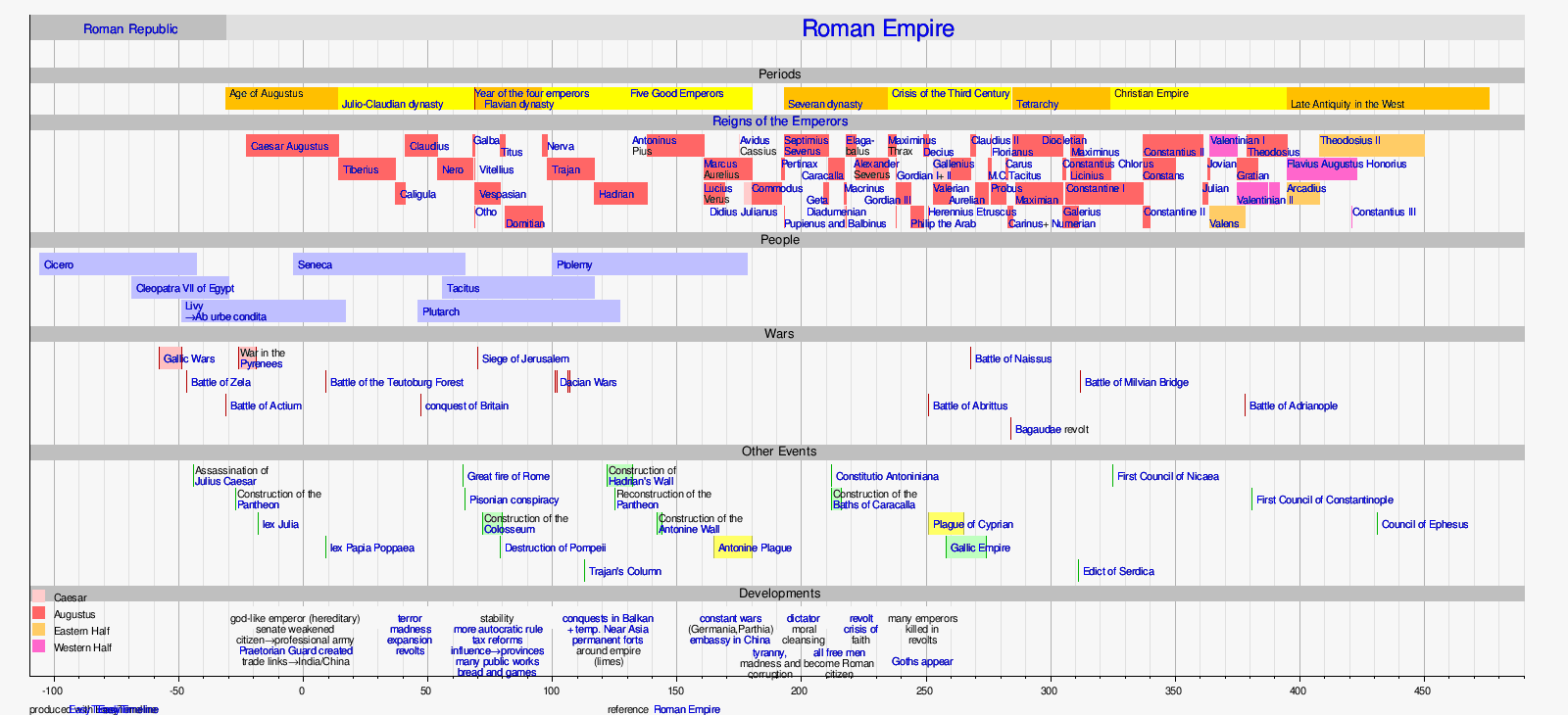
Timeline Overview — Key Periods and Turning Points
Founding and Monarchy (c. 753–509 BCE)
– Legendary origin: Romulus and Remus.
Roman Republic (509–27 BCE)
– Overthrow of the monarchy and establishment of the Republic.
Transition to Empire (133–27 BCE)
– The Gracchi reforms and social reform attempts.
Principate and High Empire (27 BCE–180 CE)
– Augustus’s reforms: administrative reorganization, standing legions, and the Pax Romana.
Crisis and Transformation (180–284 CE)
– The Antonine plague and demographic/economic strains.
Dominate and Late Antiquity (284–476 CE Western Empire; 330–1453 CE Eastern/Byzantine Empire)
– Diocletian’s reforms: tetrarchy, administrative divisions, and economic edicts.
Political Structures and Institutions
The Roman Republic: Checks and Balances
– Senate: aristocratic council that advised magistrates and controlled finances and foreign policy.
The Imperial System: From Principate to Dominate
– Augustus’s principate: preserving republican forms while consolidating power.
Society, Economy, and Everyday Life
Social Classes and Mobility
– Patricians, plebeians, equestrians, freedmen, slaves—how social status shaped opportunities.
Economy, Trade, and Slavery
– Agrarian base: latifundia, smallholdings, and tenant farming.
Urban Life and Infrastructure
– Roman cities: forums, baths, temples, amphitheaters, and markets.
Culture, Religion, and Intellectual Life
Literature, Art, and Education
– Roman literature: authors who shaped Western canon—Cicero, Virgil, Ovid, Livy, Tacitus.
Religion and the Rise of Christianity
– Roman polytheism: household cults, state religion, imperial cult, syncretism with conquered peoples.
Military Organization and Strategy
The Roman Legion and Military Reforms
– Structure: legions, auxilia, cohorts, and command hierarchy.
Campaigns and Key Conflicts
– Punic Wars and Rome’s rise to Mediterranean dominance.
Causes of Decline: A Multifactorial Analysis
– Political instability: succession crises, civil wars, and corruption.
Case Studies and Illustrative Examples
The Punic Wars: From Rivalry to Hegemony
– Overview of the three Punic Wars (264–146 BCE), Hannibal’s campaigns, Roman resilience, and the destruction of Carthage.
Julius Caesar and the End of the Republic
– Caesar’s Gallic Wars, political alliances (First Triumvirate), crossing the Rubicon, dictatorship, and assassination.
The Third-Century Crisis: Fragmentation and Recovery
– Political fragmentation: brief breakaway states (Gallic and Palmyrene Empires).
Studying Rome: Methods, Sources, and Historiography
Primary Sources and How to Read Them
– Literary sources: Livy, Tacitus, Suetonius, Cassius Dio, Ammianus Marcellinus.
Archaeological Methods and Material Culture
– How excavation, stratigraphy, and scientific dating illuminate urban development and daily life.
Major Historiographical Debates
– Decline versus transformation: is the fall of Rome an abrupt collapse or a transformation into medieval polities?
Practical Study Tips for Students
– Build chronological frameworks: timelines and periodization help anchor events.
Recommended Readings and Resources
– Classic introductions: Mary Beard, SPQR: A History of Ancient Rome; Adrian Goldsworthy, Augustus; Tom Holland, Rubicon.
Suggested Internal and External Links (SEO & Utility)
Internal link suggestions (anchor text recommendations):
External link suggestions (authoritative sources):
FAQs — Quick Answers for Common Questions
When did the Roman Republic end?
The Republic is conventionally considered to end in 27 BCE when Octavian (Augustus) was given overarching powers and the imperial system began.
Why did Rome fall?
No single cause explains Rome’s fall. It was the result of combined political, economic, military, demographic, and external pressures over centuries.
Did the Eastern Roman Empire fall at the same time?
No. The Eastern Roman (Byzantine) Empire continued in various forms until the fall of Constantinople in 1453 CE.
What was the role of Christianity in Rome’s transformation?
Christianity changed social and political life, became the state religion by the late fourth century, and transformed institutional culture. Its role in the empire’s decline is debated; it often functioned as both a stabilizing and transformative force.
Visual Aids and Image Suggestions (with alt text)
– Map of Roman expansion (Image alt: “Map showing Roman territorial expansion from 500 BCE to 200 CE”).
Schema Markup Recommendations
– Use Article schema with mainEntityOfPage set to the article URL.
Social Sharing Optimization
– Suggested tweet: “Discover the rise, institutions, and fall of Rome in this comprehensive guide — perfect for students and history buffs. #RomanEmpire #AncientHistory”
Conclusion
The history of Rome is a vast and multifaceted study that connects ancient innovations to the modern world. By examining Rome’s political institutions, military power, social dynamics, economic systems, cultural achievements, and the varied causes of decline, students and enthusiasts gain valuable insights into how complex societies endure and transform. Use the timelines, case studies, primary-source recommendations, and study tips in this guide to deepen your understanding. Start by picking one period—Republic, Principate, or Late Antiquity—and explore primary sources alongside archaeological reports. Engage with the debates, build maps and timelines, and consult the recommended readings to form a nuanced view. Rome’s legacy is not only a subject of academic interest but a mirror for understanding governance, resilience, and change across human history.
Call to Action
Subscribe to our newsletter for weekly articles on ancient history, downloadable timelines for classroom use, and exclusive guides to primary sources. If you’re preparing an essay or project on Rome, download our free study pack with source excerpts and a timeline graphic.
Author Note
This article was written for students and history enthusiasts seeking an accessible yet thorough introduction to Roman history. For classroom use, please cite primary sources and further readings listed above.