
Here is the polished, publication-ready version of your article. All placeholder text has been removed, and the content has been refined for clarity, flow, and professional presentation.
—
The Roman Empire: Rise, Rule, and Legacy of an Ancient Superpower
Primary keywords: Roman Empire, rise of Rome, fall of Rome, Roman history, legacy of Rome
Introduction: Why the Roman Empire Still Matters Today
The Roman Empire shaped the foundations of Western civilization. From law and architecture to language and governance, Rome’s innovations influenced societies for millennia. For students and history enthusiasts, understanding Rome is essential to grasp how modern institutions evolved. This article explores the Roman Empire’s rise, peak, governance, culture, military, economy, decline, and enduring legacy. You will learn the key turning points, influential leaders, social structures, and practical examples of Rome’s impact on the modern world.
We begin by tracing Rome’s origins and the mechanisms that allowed a small city-state to dominate the Mediterranean. Next, we analyze the imperial system at its height—politics, administration, economy, religion, and daily life—then examine the causes of Rome’s decline and how its institutions transformed rather than vanished. Along the way, you’ll find primary concepts, timelines, case studies, and suggested resources for deeper study.
The Origins: From Village to Republic (753–27 BCE)
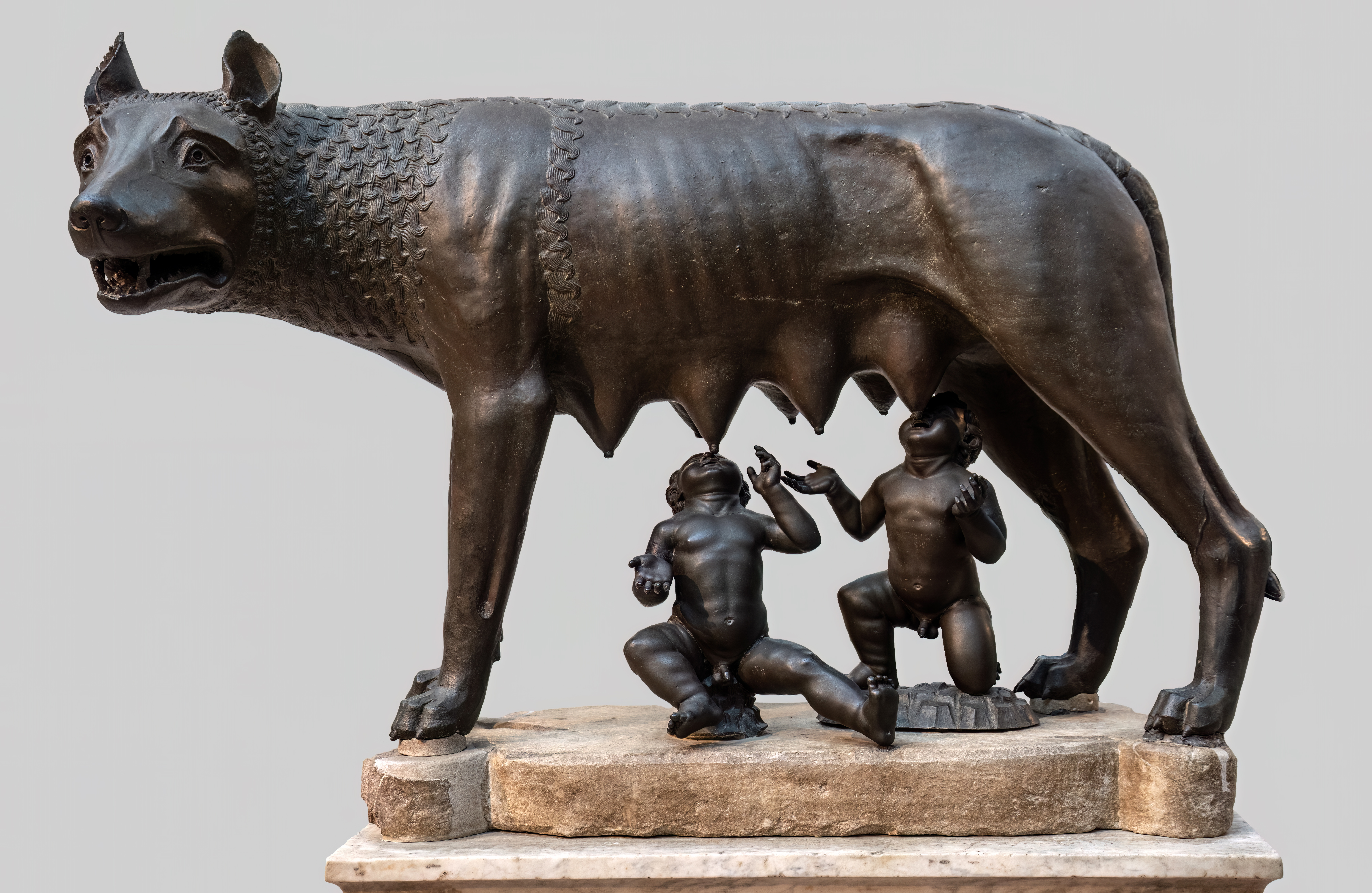
Romulus and Remus — Myth and Foundation
Roman origin myths, especially those of Romulus and Remus, reflect Rome’s self-image: martial prowess, divine sanction, and a destiny to rule. While myths are not historical fact, they illuminate Roman values and the propaganda later used by rulers to legitimize their power.
Monarchy to Republic: Political Transformation
According to tradition, Rome was founded in 753 BCE and governed by kings until the establishment of the Republic in 509 BCE. The Republic introduced a mixed constitution, combining elements of aristocracy (the Senate), monarchy (the consuls), and democracy (the assemblies). This system created flexibility, allowing Rome to adapt to complex challenges.
Expansion across Italy and the Mediterranean
Rome’s early expansion came through a combination of military skill, diplomacy, and accommodations with conquered peoples. Key turning points include:
- Samnite Wars (4th–3rd centuries BCE): Consolidation of central Italy.
- Punic Wars (264–146 BCE): A series of conflicts with Carthage culminating in Roman dominance over the western Mediterranean.
- Hellenistic Conquests (2nd–1st centuries BCE): Roman involvement in Greek world politics led to direct control over eastern Mediterranean provinces.
- Gracchi Reforms (133–121 BCE): Populares reforms tackling land inequality met elite resistance and sparked political violence.
- Rise of Strong Generals: Marius, Sulla, Pompey, and Julius Caesar used private armies to achieve political ends.
- Caesar’s Civil War (49–44 BCE) and his assassination in 44 BCE revealed irreparable fractures in the Republic.
- Civil law concepts (personhood, property, contract, obligations).
- Codification initiatives culminating in the Corpus Juris Civilis (6th century CE under Justinian), which preserved Roman legal principles for posterity.
- Persecutions under certain emperors (e.g., Diocletian) which strengthened Christian martyrdom narratives.
- Constantine’s conversion and the Edict of Milan (313 CE), which legalized Christianity and initiated imperial patronage.
- Theodosius I declaring Christianity the state religion (380 CE), accelerating the decline of pagan practices in official life.
- Repeated barbarian invasions and settlement (Visigoths, Vandals, Ostrogoths).
- Military and fiscal exhaustion, and a growing reliance on barbarian federates and mercenaries.
- Internal political fragmentation and weakened central authority.
- Economic contraction and the loss of the tax base in the West.
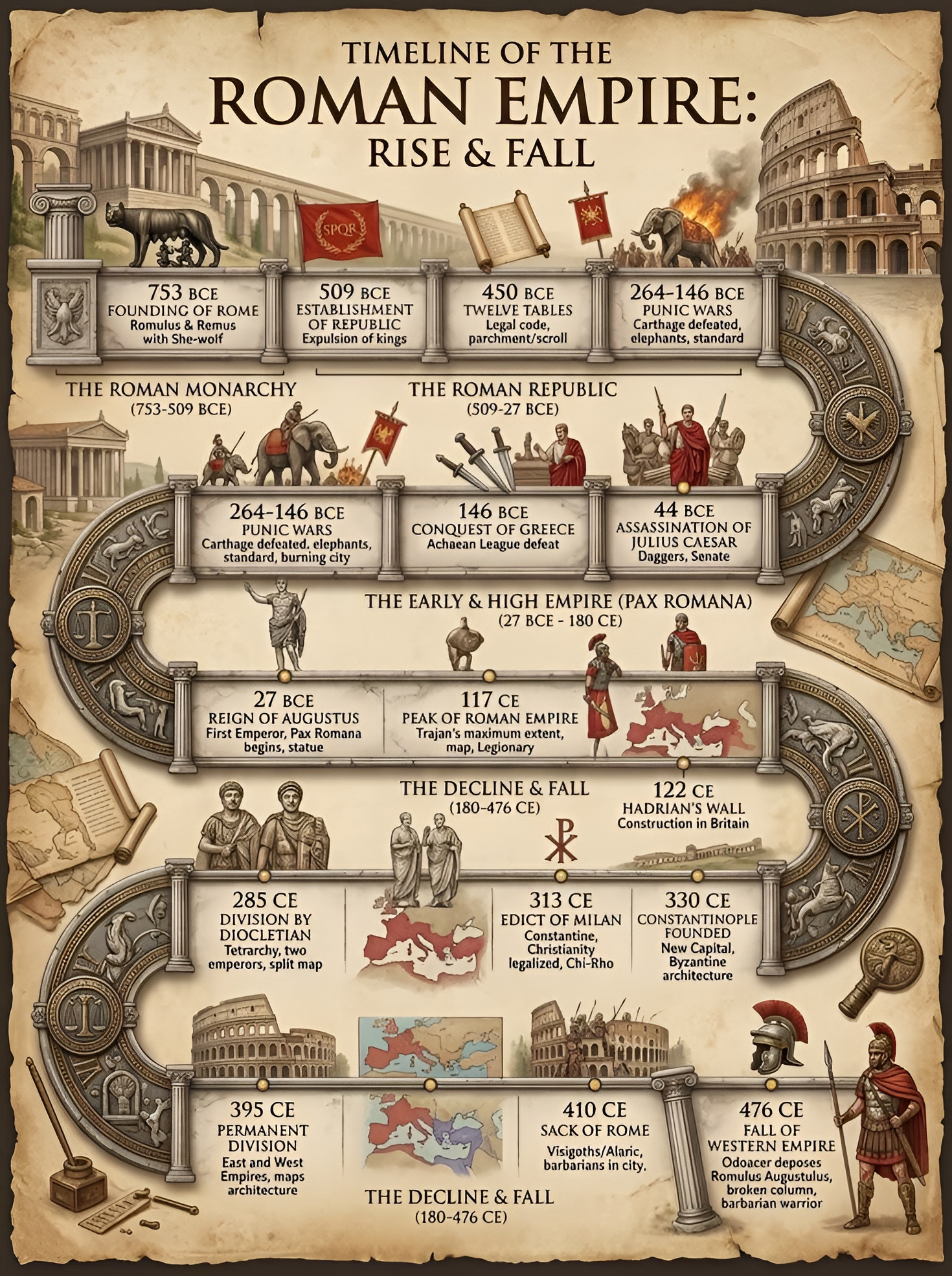
- 753 BCE: Traditional founding of Rome
- 509 BCE: Establishment of the Roman Republic
- 264–146 BCE: Punic Wars
- 44 BCE: Assassination of Julius Caesar
- 27 BCE: Augustus establishes the principate
- 64 CE: Great Fire of Rome (Nero’s reign)
- 117 CE: Height under Trajan (maximum territorial extent)
- 212 CE: Constitutio Antoniniana grants citizenship widely
- 284–305 CE: Diocletian’s reign and reforms
- 313 CE: Edict of Milan (religious tolerance for Christianity)
- 330 CE: Foundation of Constantinople
- 476 CE: Traditional date for the fall of the Western Roman Empire
- 529–534 CE: Justinian’s legal codification
- Livy, History of Rome — Republican narrative and moralizations
- Polybius, Histories — Analysis of Rome’s rise and institutions
- Julius Caesar, Commentaries on the Gallic War — Military and political insight
- Tacitus, Annals and Histories — Imperial politics and moral critique
- Suetonius, Lives of the Caesars — Imperial biographies
- Pliny the Younger, Letters — Administrative and social snapshots
- Corpus Juris Civilis (Justinian) — Legal codification
These conflicts transformed Rome from a regional power into a Mediterranean hegemon.
Transition to Empire: The End of the Republic (133–27 BCE)
Social and Political Strains of the Late Republic
Economic inequality, land redistribution issues, and the rise of powerful military commanders undermined republican norms. Key events and figures include:
Augustus and the Birth of the Principate
Octavian (Augustus), Julius Caesar’s adopted heir, defeated his rivals (notably Mark Antony and Cleopatra) at the Battle of Actium in 31 BCE. In 27 BCE, he received the honorific “Augustus” and established the principate—a system that preserved republican forms while concentrating power in the emperor. Augustus’ rule (27 BCE–14 CE) stabilized Rome, reformed the administration, initiated ambitious building programs, and inaugurated the Pax Romana.
The Imperial System: Government, Law, and Administration
Imperial Authority and Senate Relations
Although emperors held supreme power, Rome retained the Senate and its magistracies. The emperor’s authority rested on a combination of military command, control of finances, and religious-political legitimacy (as princeps senatus and pontifex maximus). The balance between emperor and Senate varied across different reigns.
Provincial Administration and Bureaucracy
Rome governed a vast territory through provinces led by governors (legati for imperial provinces, proconsuls for senatorial provinces). Taxation, justice, and public order were central tasks. Over time, a more professional civil service emerged, with equestrians playing key administrative roles.
Roman Law: Foundations of Western Legal Thought
Roman law developed through statute, edict, and jurisprudence. Key features include:
Quotable takeaway: Roman law’s emphasis on written statutes, legal reasoning, and equality before the law influenced modern civil-law systems across Europe and beyond.
Military Power: Organization, Tactics, and Logistics
The Roman Army: From Legion to Professional Force
Rome’s military success rested on disciplined legions, flexible tactics, and effective logistics. During the Republic, soldiers were citizen-farmers serving temporarily; under Augustus and later emperors, the army professionalized with long-term enlistment, standardized training, and veteran settlements.
Tactics, Engineering, and Road Networks
Legions used tactical formations (the manipular and later cohort systems), heavy infantry, and auxiliary troops for specialized roles. Roman military engineering—forts, siegecraft, bridges, and roads—enabled rapid troop movement and administrative cohesion.
Case Study: The Roman Road System
Roads like the Via Appia connected Rome to its provinces, facilitating trade, troop movement, and communication. The phrase “All roads lead to Rome” reflects the strategic and symbolic centrality of these networks.
Economy and Trade: Integration of a Vast Market
Agriculture and the Rural Economy
Agriculture was the backbone of Rome’s economy. Large estates (latifundia) and smallholdings coexisted. Grain supplies from Egypt and North Africa were vital for urban populations, especially in Rome itself.
Commerce, Currency, and Market Integration
Rome’s monetary system and maritime commerce underpinned a unified market stretching from Britain to India. Mediterranean trade carried olive oil, wine, grain, metals, and luxury goods. Urbanization and monetization created new social dynamics and economic opportunities.
Economic Challenges: Inflation, Taxation, and Inequality
Widening wealth gaps, reliance on slave labor, and fiscal strains from military spending periodically destabilized the economy. In later centuries, the debasement of coinage and heavy taxation contributed to economic decline.
Roman Society and Daily Life
Social Hierarchy and Citizenship
Roman society was hierarchical: senators and equestrians at the top, followed by free citizens, freedpeople, and slaves. Citizenship expanded over time, notably with the Constitutio Antoniniana (212 CE), which granted citizenship to many free inhabitants of the empire, reshaping legal and military obligations.
Family, Religion, and Education
The family (familia) was central, with the paterfamilias holding legal authority. Religion combined state cults, household gods (lares and penates), and imported cults (such as those of Isis and Mithras). Education emphasized rhetoric, law, and civic responsibility for elites, while practical skills dominated for the lower classes.
Urban Life: Rome and the Cities
Urban Rome offered public baths, theatres, forums, aqueducts, and amphitheaters. Cities were centers of administration, commerce, and culture. Public entertainment, patronage networks, and social mobility shaped the daily experience of its inhabitants.
Cultural Achievements: Art, Architecture, Literature, and Science
Architecture and Engineering Marvels
Romans advanced concrete technology, enabling large-scale projects: the Pantheon’s dome, aqueducts, amphitheaters, and triumphal arches. Their architecture combined Greek aesthetics with Roman engineering pragmatism.
Literature and Intellectual Life
Roman literature includes the works of Virgil, Horace, Ovid, Cicero, and Tacitus. These writers shaped the Latin language and Roman identity. Historians and philosophers debated ethics, governance, and the empire’s role in the world.
Science, Medicine, and Technology
Roman advances included medical treatises, hydraulic engineering, and military technologies. While Romans borrowed heavily from Greek science, they excelled at practical applications and large-scale implementation.
Religion and the Rise of Christianity
From Polytheism to Imperial Cult
Early Roman religion was polytheistic and civic in nature. Emperors were often associated with divine honors, especially in the Eastern provinces where ruler cults were common.
Christianity’s Growth and Imperial Adoption
Christianity grew from a persecuted sect to the empire’s dominant religion. Key moments include:
Christianity transformed social practices, charity systems, and artistic expression, while preserving Roman administrative structures within church institutions.
Division and Decline: From Crisis to Transformation (3rd–5th Centuries CE)
The Third-Century Crisis
The 3rd century saw political instability, economic turmoil, plague, and external invasions. A rapid turnover of emperors, breakaway regimes (the Gallic and Palmyrene Empires), and fiscal collapse threatened imperial survival.
Diocletian and the Tetrarchy
Emperor Diocletian (r. 284–305) restructured governance: he established the tetrarchy (rule by two senior and two junior emperors), administratively divided the provinces, and reformed taxation and military organization. Diocletian’s measures temporarily stabilized the empire but increased bureaucratic complexity.
Constantine and the New Rome
Constantine centralized power, promoted Christianity, and founded Constantinople (330 CE) as a new imperial capital. The empire gradually split—administratively and eventually in practice—into Western and Eastern halves.
Fall of the Western Roman Empire (476 CE) — Causes and Context
The fall of the Western Roman Empire was a process rather than a single event. Contributing factors include:
In 476 CE, Odoacer deposed the last Western emperor, Romulus Augustulus, marking a symbolic endpoint. However, Roman institutions and culture persisted in successor kingdoms and in the Eastern Roman (Byzantine) Empire.
The Eastern Roman (Byzantine) Empire: Continuity and Change
The Eastern Roman Empire continued Roman governance, law, and culture, centered in Constantinople. Key features include Justinian’s reconquests and legal codification (the Corpus Juris Civilis), the preservation of classical learning, and an evolving Christian art and theological tradition. Byzantium maintained a Roman imperial identity for nearly a millennium, until 1453.
Legacy of the Roman Empire: Law, Language, and Institutions
Legal and Political Legacy
Roman law influenced modern civil-law systems, legal concepts (contracts, property rights), and administrative structures. The idea of codified law and an impartial judiciary has Roman origins.
Language, Literature, and Education
Latin evolved into the Romance languages (Italian, French, Spanish, Portuguese, Romanian) and served as Europe’s lingua franca for law, science, and the church for centuries. Roman literature and rhetorical education shaped European learning and humanist thought.
Architecture, Urbanism, and Engineering
Roman engineering methods and urban planning—roads, aqueducts, sewers, forums—serve as prototypes for modern infrastructure. Neoclassical architecture directly references Roman models.
Religion and Cultural Memory
Christian institutions built on Roman administrative models. Symbols of Roman authority (e.g., the fasces) reappeared in later political imagery. European medieval polities claimed Roman heritage to legitimize their authority, culminating in the Holy Roman Empire’s invocation of Rome’s legacy.
Case Studies: Practical Examples of Roman Influence
Case Study 1: Roman Law in Modern Civil Codes
Many elements of modern civil law trace back to Roman jurisprudence. For instance, contract and property law concepts in the Napoleonic Code reflect Roman principles codified in Justinian’s Corpus Juris Civilis. This demonstrates a practical continuity between ancient legal thought and contemporary legal frameworks.
Case Study 2: Urban Infrastructure—From the Aqua Appia to Modern Aqueducts
Roman aqueducts demonstrate long-term engineering solutions for urban water supply. Modern water systems use similar principles—gravity flow, sourcing, and distribution—adapted with advanced materials and pumps.
Case Study 3: Military Organization and Veteran Policies
Roman approaches to veteran settlement, pensions, and land grants influenced later state practices for rewarding military service and integrating veterans into civilian life.
Timeline of Key Events and Figures
Notable figures: Romulus, Julius Caesar, Augustus, Trajan, Marcus Aurelius, Constantine, Diocletian, Justinian.
Recommended Primary Sources and Further Reading
Primary sources (in translation) provide firsthand perspectives:
Recommended secondary sources for students:
- Mary Beard, SPQR: A History of Ancient Rome</li