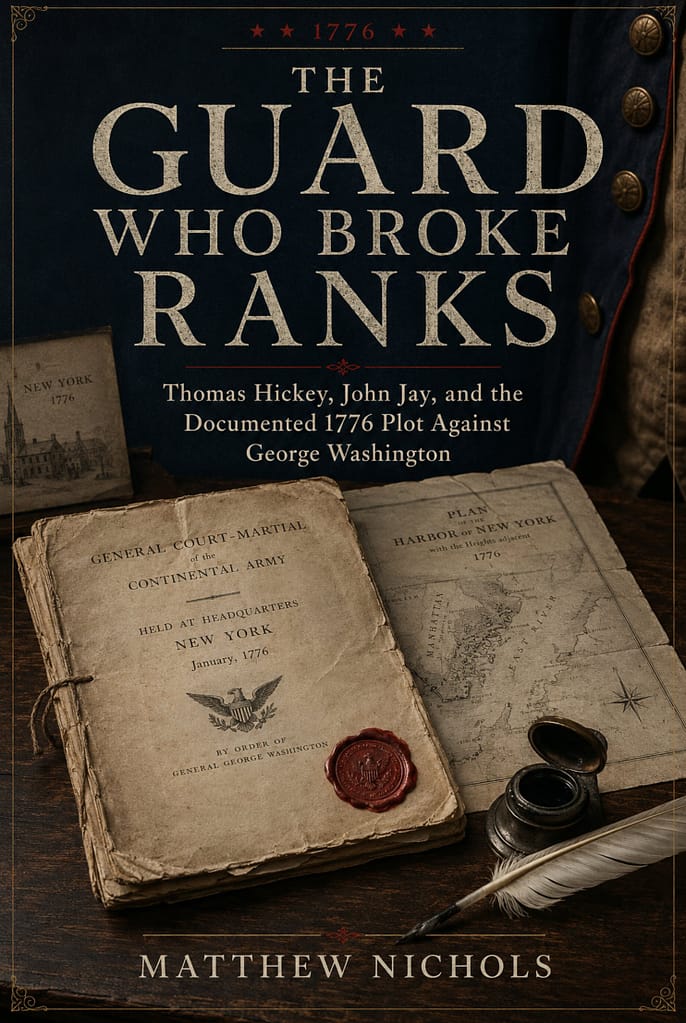
Did a member of George Washington’s own guard join a Loyalist conspiracy in 1776? Discover the documented investigation that led to arrests, accusations of treason, and one of the most debated security threats of the American Revolution.
Days before the Declaration of Independence, the American Revolution faced a threat from within.
In June 1776, New York City stood on the edge of invasion. British warships waited offshore. Loyalist sympathizers moved through the streets. George Washington struggled to hold together an inexperienced army while preparing for what could become the decisive campaign of the war.
Then authorities uncovered something alarming.
A soldier from Washington’s own guard, Thomas Hickey, was arrested. What began as an investigation into counterfeit money quickly expanded into accusations of treason, secret Loyalist recruitment, and a suspected network reaching from ordinary soldiers to powerful political figures. New York Mayor David Mathews was implicated. Royal Governor William Tryon was named. John Jay helped oversee the inquiry. Washington himself reported the discovery of a dangerous plot to Congress.
But what was actually proven?
Was there truly a conspiracy aimed at Washington? How much of the story rests on documented evidence, and how much was added by later generations eager to create a patriotic legend?
Drawing on military records, committee reports, court-martial proceedings, congressional correspondence, and surviving contemporary accounts, Matthew Nichols follows the evidence through one of the most controversial security investigations of the American Revolution.
This is not a tale of mythic heroes and villains.
It is the story of a fragile rebellion struggling to survive, a city divided by loyalty and fear, and a file that still refuses to close cleanly nearly 250 years later.
Perfect for readers of Revolutionary War history, espionage, hidden history, political intrigue, and investigative nonfiction, The Guard Who Broke Ranks separates documented fact from centuries of retelling to reveal the real story behind the most famous alleged plot against George Washington.

Author’s Note
The story of Thomas Hickey and the alleged 1776 plot against George Washington occupies an unusual place in American history. It is a story that sits at the intersection of documented fact, wartime investigation, political suspicion, military discipline, and later patriotic memory.
Certain parts of the record are clear. Thomas Hickey was a member of Washington’s Commander-in-Chief’s Guard. He was arrested, tried by court-martial, convicted, and executed in June 1776. George Washington reported the discovery of a dangerous plot to the Continental Congress. John Jay and New York authorities participated in a wider investigation that reached prominent Loyalist figures, including Mayor David Mathews and Governor William Tryon.
Other parts of the story are far less certain.
Over the generations, the Hickey affair accumulated additional details, dramatic retellings, and patriotic legends. Some accounts transformed the case into a fully documented assassination conspiracy. Others added colorful stories that cannot be firmly traced to contemporary evidence. Like many events from the Revolutionary era, the line between history and memory became increasingly difficult to see.
This book was written with a simple goal: to follow the evidence as far as it will go and no farther.
Throughout these pages, I have attempted to distinguish between what can be supported by surviving records and what remains uncertain, disputed, or speculative. Primary documents, military orders, court proceedings, correspondence, committee records, and reputable scholarship form the foundation of the narrative. Where the evidence is incomplete, I have tried to say so openly rather than fill the gaps with assumption.
History is often strongest when it resists the temptation to become legend.
The American Revolution was not experienced by the people living through it as a finished national myth. It was uncertain, dangerous, and deeply human. Men and women made decisions with incomplete information. Authorities investigated threats they did not fully understand. Rumors circulated alongside facts. Loyalty and betrayal were not always easy to distinguish.
The Hickey affair reveals that reality in unusually sharp detail.
My hope is that this book helps readers see the Revolution not as a collection of settled stories, but as a living historical record still capable of surprising us. The documents do not always provide comfortable answers. They do, however, offer something more valuable: a chance to encounter the past as it was, rather than as later generations wished it to be.
Matthew Nichols
The Real Story Behind the Thomas Hickey Plot
Few events from the American Revolution have generated more debate than the alleged 1776 plot against George Washington. For nearly two and a half centuries, historians, writers, and patriotic storytellers have repeated versions of the story, often presenting it as a fully documented assassination conspiracy aimed at eliminating Washington before the United States even declared independence.
The reality is both more complicated and more revealing.
In June 1776, New York City stood at the center of the Revolutionary War. British forces were preparing to return in strength, Loyalist sentiment remained strong throughout the city, and Washington’s Continental Army was attempting to defend one of the most strategically important locations in North America. Military defeat was a real possibility. Political loyalties were divided. Revolutionary authority remained fragile.
It was in this atmosphere that Thomas Hickey, a member of Washington’s Commander-in-Chief’s Guard, entered the historical record.
Hickey was not an ordinary soldier. He served in a unit specifically selected to protect Washington, his headquarters, military correspondence, official papers, and army funds. When Hickey was arrested and later tried by court-martial, the case immediately attracted attention because it appeared to place questions of loyalty and treason inside the very organization responsible for protecting the commander-in-chief.
The surviving records confirm that Hickey was convicted and executed in June 1776. They also confirm that revolutionary authorities investigated a wider network involving Loyalist sympathizers and individuals connected to British interests in New York. Washington himself informed Congress that a dangerous plot had been uncovered, while prominent figures including John Jay participated in the broader inquiry.
Yet many of the most famous elements of the story remain subjects of historical debate.
Was there truly a documented plan to assassinate George Washington? Were members of Washington’s guard actively working for the British? How extensive was the alleged Loyalist network operating in New York? To what extent have later generations expanded the story beyond what the surviving evidence can support?
These questions remain important because they reveal how revolutions actually function. The American Revolution was not only fought on battlefields. It was also fought through intelligence gathering, political loyalty, military discipline, financial stability, and the constant fear that internal betrayal might prove more dangerous than enemy armies.
The Thomas Hickey affair offers a rare glimpse into that hidden side of the Revolution.
Rather than focusing only on famous battles and celebrated leaders, this investigation examines the wartime machinery operating behind the scenes. It explores the role of revolutionary committees, the influence of Loyalist networks, the position of royal officials such as Governor William Tryon, the involvement of New York Mayor David Mathews, and the efforts of Patriot authorities to identify threats before British forces arrived.
At its heart, this is a story about evidence.
Many Revolutionary War legends have grown larger with time. Stories are retold, details are added, and historical uncertainty is often replaced by confidence that the original participants never possessed. The challenge for modern historians is separating what can be documented from what was added later through tradition, memory, and patriotic storytelling.
Using military records, congressional correspondence, court-martial proceedings, committee reports, and contemporary sources, The Guard Who Broke Ranks follows the documentary trail wherever it leads. Some popular claims are strengthened by the surviving evidence. Others become less certain when examined closely.
The result is a portrait of Revolutionary New York that feels less like a myth and more like a city under pressure. British warships waited offshore. Loyalists and Patriots watched one another with suspicion. Washington struggled to prepare an army for invasion. Revolutionary leaders investigated rumors, examined witnesses, and searched for signs of disloyalty within their own ranks.
Understanding the Thomas Hickey case means understanding the fragile reality of 1776 itself.
For readers interested in George Washington, the American Revolution, Revolutionary War espionage, Loyalist history, John Jay, military intelligence, hidden American history, and the documented evidence behind famous historical controversies, this book offers a carefully researched examination of one of the most fascinating and debated episodes of the nation’s founding.