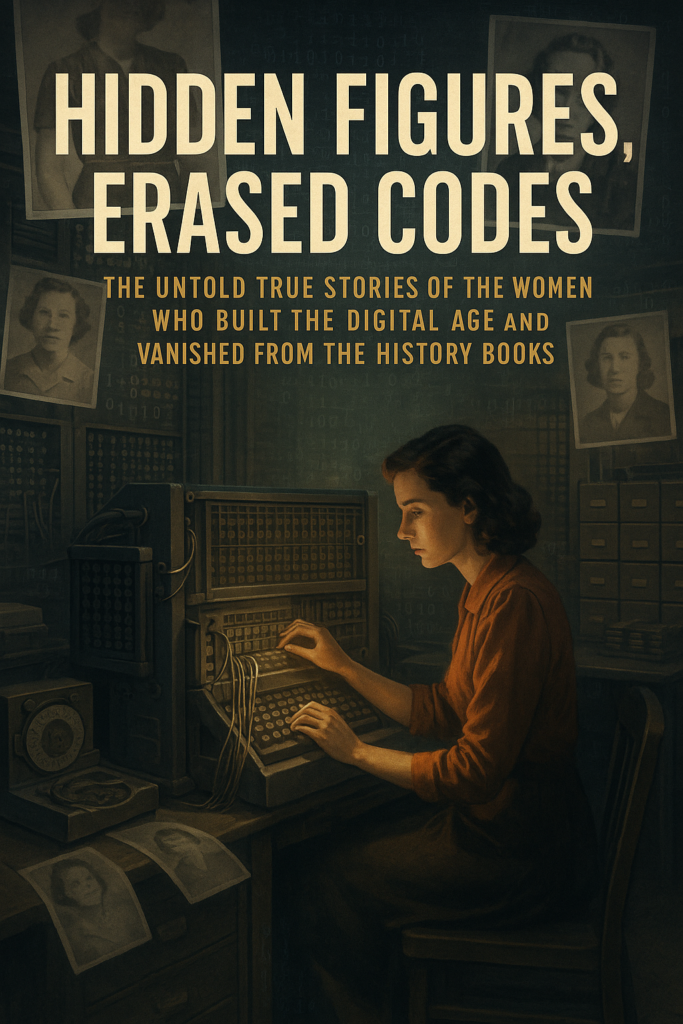
HIDDEN FIGURES, ERASED CODES
They built the digital age.
Then their names disappeared.
This book documents how women built the foundations of computing, cryptography, and software—and how institutions rewrote the record once the machines took over.
Overview
Hidden Figures, Erased Codes uncovers the real women whose intelligence, precision, and brilliance shaped the early digital world — and the political, cultural, and bureaucratic forces that erased them from the record.
Long before computers became machines, “computers” were women — calculating missile arcs in wartime bunkers, translating abstract mathematics into the first machine languages, wiring early circuits, programming mainframes the size of rooms, and cracking enemy ciphers behind locked government doors. Their fingerprints are on the technologies that reshaped civilization… yet their names barely survived a footnote.
This book restores their stories — the women photographed beside early machines but mislabeled as clerks, the coders whose signatures vanished from the final printouts, the cryptanalysts whose intelligence shortened wars but whose identities remained classified for decades.
Get 3 cases, These are real the book goes deeper
Why This Story Matters
When history erases its builders, it distorts the truth about how innovation really happens.
These women didn’t “assist” the digital revolution — they built it. They laid foundations that modern computing, cryptography, aerospace, and artificial intelligence still rest on.
By bringing their stories back into the light, this book doesn’t just correct the record — it reveals how gender, hierarchy, secrecy culture, and political pressure shaped the digital age long before Silicon Valley existed.
Understanding who was forgotten is the first step in understanding the world we inherited.
Who This Book Is For
Readers who will connect with this book include:
✅ fans of hidden history and overlooked intelligence work
✅ readers who loved Hidden Figures, Code Girls, or The Woman Who Smashed Codes
✅ people fascinated by the origins of computing, cryptography, and digital technology
✅ those who enjoy narrative nonfiction with real archival depth
✅ students, educators, and researchers seeking accurate historical accounts
✅ readers who sense there’s more to the story than the official narrative
If you want the truth behind the early digital era — the real names, real files, and real work — this is the book.
What This Book Reveals
Behind the creation of the digital age lies a hidden workforce of women whose contributions were systematically overshadowed or erased. Through archival research, declassified documents, oral histories, and surviving field notes, this investigation uncovers:
- the wartime “computers” who computed ballistic tables by hand before the first ENIAC switch was ever flipped
- the cipher-breaking specialists whose intelligence operations shifted battles but never earned public recognition
- the early programmers whose work launched satellites, missiles, and the space race — while men took the credit on camera
- the bureaucratic and political systems that actively buried women’s names out of sight
- the forgotten labs, basements, and office annexes where the digital revolution quietly began
- These aren’t symbolic stories — they are historically verified accounts of the people who literally wrote the world into a new era.
Frequently Asked Questions
Are these stories actually true?
Yes. Every chapter is grounded in documented history — military records, lab memos, declassified intelligence files, programmer logs, and early computing archives. Where there is uncertainty or debate, I flag it clearly instead of pretending it’s settled fact.
Does this book focus only on women in the United States?
No. While many key stories take place inside American programs, the book also follows work done in the U.K. and parts of Europe wherever the paper trail is strongest. The goal is to show how women across multiple countries helped build the digital age.
Do I need a background in math or coding to understand it?
You don’t need a technical background. This is narrative nonfiction first. When I explain ciphers, code, or early computers, I do it in plain language so you can follow the stakes and impact without getting lost in jargon or formulas.
How is this different from other books about women in computing?
If you’ve read books like Hidden Figures, Code Girls, or The Woman Who Smashed Codes, you’ll recognize the territory—but this book digs into a wider range of projects, lesser-known programs, and women whose stories barely survived as a line in an internal memo or a mislabeled photograph.
Why were these women erased from the history books?
A mix of classification, wartime secrecy, institutional sexism, and credit structures that favored supervisors and public-facing figures. Their work was often filed under “clerical,” “support,” or “team effort,” even when they were designing methods, writing code, or solving problems no one else could.
Is this more biography or more big-picture history?
It’s both. Each chapter follows specific women and teams in detail, but always anchors their lives in the larger story of computing, cryptography, the Cold War, and the rise of digital technology. You see the personal struggle and the global consequences together.
Who is this book a good fit for?
This book is for readers who love surprising nonfiction, hidden history, and true stories that feel stranger than fiction. It’s a match for anyone curious about the real origins of the digital age, especially readers who suspect the official story left a few names out.